
Commercial Roof Coatings, Waterproofing and Protection Systems in Bolton
Forti Nova supplies commercial roof coatings, liquid waterproofing, metal roof refurbishment, below-ground waterproofing and industrial flooring across Bolton and the wider borough — including Horwich, Farnworth, Westhoughton and Kearsley.
Commercial Roof Coatings and Waterproofing in Bolton
Bolton is Greater Manchester's northernmost major borough — positioned on the western foot of the Pennines, with an industrial building stock shaped by the town's cotton-spinning and engineering history. Former mill buildings repurposed as warehousing and commercial units, manufacturing premises on established industrial estates, retail parks, schools and a significant healthcare estate create varied refurbishment demand across the borough.
The town's industrial areas — Horwich, Lostock, Farnworth and Westhoughton — concentrate profiled metal roofing on steel portal frame construction. These buildings accumulate lap failures, cut edge corrosion and gutter blockages through years of deferred maintenance. Bolton's older mill building stock presents a different challenge: complex, multi-layer concrete or steel decks where substrate investigation is needed before specification. Each building type requires its own assessment — no single system or programme approach is universally applicable.
Forti Nova supplies Liquid Rubber and Prokol systems across Bolton and the wider North Greater Manchester area from our Blackburn headquarters. Technical assessment, product specification, substrate compatibility guidance and approved-applicator coordination are available for Bolton and surrounding areas.
Who This Information Is For
- Building owners and asset managers
- Facilities managers
- Roofing contractors
- Main contractors
- Education estates teams
- Local authority property teams
- Housing associations
- Industrial and logistics operators
- Architects and surveyors
Commercial Roofing Problems Across Bolton
Bolton's building stock — former mills, active industrial units, education and commercial — creates specific failure patterns. Correct diagnosis before specification is essential to avoid repeated remedial expenditure.
Metal Roof Lap Failure and Cut Edge Corrosion
Likely cause: Profiled metal roofing on Bolton's industrial and logistics buildings fails most commonly at sheet laps. Thermal movement progressively opens lap sealants. Rainwater retained between overlapping sheets corrodes the exposed steel at cut edges. Bolton's elevated position at the Pennine fringe means lap zones remain wet for extended periods during autumn and winter.
What to inspect: Inspect all lap positions — not just above reported internal leaks. Probe the lap gap. Assess fixing condition. Determine whether corrosion is surface-only or has caused section loss at sheet edges or fixing zones.
Remediation routes: Lap sealant reinstatement, cut edge treatment, metal primer and elastomeric overcoat as part of a full metal roof refurbishment. Discrete lap treatment where general roof condition is sound.
Coating not appropriate when: perforation or significant section loss has occurred at sheet laps or fixings — those areas require sheet replacement before coating.
Metal Roof Coatings for Bolton BuildingsMill Building Concrete Deck — Multi-Layer History
Likely cause: Bolton's former mill buildings often have concrete roof decks with multiple decades of repair history — original asphalt or felt waterproofing overlaid with bitumen repairs, coating applications and temporary patches. The build-up sequence is often unknown, moisture is frequently trapped between layers, and adhesion between layers is uncertain.
What to inspect: Core sampling at representative points to establish the actual build-up sequence. Adhesion testing at each interface. Electrical capacitance moisture survey to map wet areas within the build-up.
Remediation routes: Where build-up is sound and dry: cold-applied liquid rubber overlay. Where localised moisture is found: selective strip-out of wet zones before overlay. Where the build-up is complex, wet or of unknown composition: full strip-out to a confirmed substrate before specification.
Coating not appropriate when: structural damage to the concrete deck from long-term water ingress — structural assessment is required before waterproofing specification.
Commercial Roof CoatingsFlat Roof Moisture and Felt Blistering
Likely cause: Bolton's education buildings, retail parks and commercial flat roofs have built-up felt systems that accumulate moisture through membrane failure, blocked drainage and condensation within the build-up. Bolton's consistent annual rainfall means flat roofs that are marginally draining in an average year fail consistently in above-average rainfall years.
What to inspect: Electrical capacitance moisture survey before any overlay specification. Drainage outlet and falls assessment. Core sampling to confirm moisture distribution and insulation condition.
Remediation routes: Dry, sound felt: cold-applied liquid rubber overlay. Localised wet areas: selective strip-out before overlay. Widespread saturation: full strip-out required.
Coating not appropriate when: moisture testing confirms saturation across the majority of the felt build-up — overlay will produce blistering of the new membrane.
Why Trapped Moisture Destroys OverlaysGutter Joint Failure and Outlet Blockage
Likely cause: Commercial gutters on Bolton's industrial buildings fail at joints and outlet connections. Bolton's Pennine fringe rainfall — consistently above 900mm annually — means gutter performance is critical. Any drainage deficiency is tested repeatedly. Blocked outlets in high-rainfall conditions cause rapid damage to roof edges and internal structures.
What to inspect: Clear gutters before inspection. Map all joint failure locations, confirm falls direction, assess outlet condition and capacity relative to the draining roof area.
Remediation routes: Seamless liquid rubber gutter lining — forms a monolithic membrane over the existing substrate eliminating all joints. Outlet enlargement or addition where capacity is insufficient.
Coating not appropriate when: gutter structure has corroded through or is physically failing — lining does not restore structural integrity.
Commercial Gutter Refurbishment in BoltonSystems Available for Bolton Projects
All systems are subject to project assessment and substrate suitability review.

HBS200 — Single-Component Liquid Rubber
Full Spec →Technology: Single-component moisture-curing liquid rubber. Cold-applied.
Application: Hand application by brush or roller. Two coats with reinforcement fabric at details and junctions.
Substrates: Concrete, existing roofing felt (subject to moisture testing), metal (primed), asphalt, GRP, bitumen.
Cure: Moisture-curing — cure rate varies with humidity and temperature.
UV: UV-stable formulation.
Elongation: High elongation — accommodates substrate movement and crack bridging.
Warranty: Manufacturer warranty available subject to approved-applicator installation and complete specified build-up.
Equipment: Standard application equipment.
Applications: Flat roof waterproofing on Bolton's education, commercial and public-sector buildings. Gutter and valley gutter lining across Bolton's industrial and commercial estate. Penetration and upstand detailing.
SprayGrade — High-Output Spray Waterproofing
Full Spec →Technology: Spray-applied liquid rubber. Cold-applied via specialist spray equipment.
Application: Spray application using dedicated cold-spray equipment. Approved operatives only.
Substrates: Concrete, metal (primed), existing felt (subject to moisture testing), asphalt, bitumen.
Cure: Similar cure profile to HBS200.
UV: UV-stable.
Elongation: High elongation — consistent with cold-applied liquid rubber technology.
Warranty: Manufacturer warranty subject to approved equipment and operatives.
Equipment: Specialist cold-spray equipment required. Contractor must hold current approval.
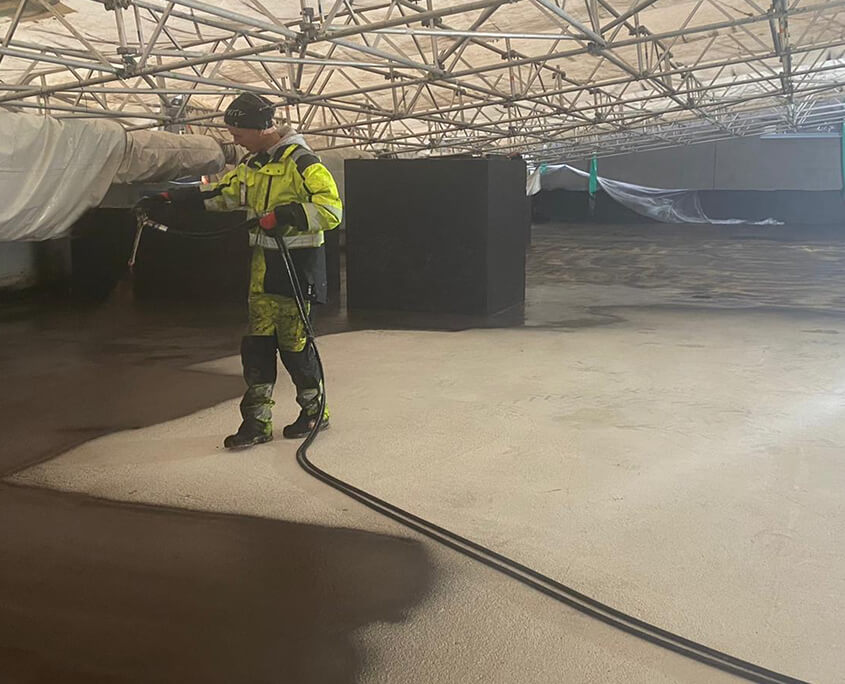
Applications: Large commercial and industrial roof waterproofing — Bolton's mill buildings, Horwich and Farnworth industrial estates. 600m²+ per day. Primary system for Bolton's larger industrial roofs within operational programme constraints.
Primary system for Bolton's larger industrial and former mill roof areas where hand application cannot achieve the required coverage within the available programme window.
BelowGrade — Below-Ground Waterproofing
Full Spec →Technology: Cold-applied liquid rubber formulated for below-ground and negative-side waterproofing.
Application: Brush or roller application. Multiple coats. Reinforcement at construction joints and details.
Substrates: Concrete, masonry, blockwork. Surface must be clean, sound and free of contamination.
Cure: Moisture-curing — cure time varies with ambient conditions.
UV: Not exposed in below-ground applications.
Elongation: Accommodates minor substrate movement and crack bridging.
Warranty: Manufacturer warranty subject to approved installation.
Equipment: Standard application equipment.
Applications: Below-ground waterproofing for Bolton's older commercial buildings, former mill basements and any commercial development requiring basement or foundation waterproofing.

Rocathaan TopSpray35 — Aliphatic Protective Topcoat
Full Spec →Technology: Two-component aliphatic polyurethane protective topcoat. UV stable. RAL colours. Cold-applied.
Application: Spray application. Approved operatives required.
Substrates: Steel and aluminium profiled sheet. Sound existing coatings where adhesion confirmed. Primer and preparation requirements must be confirmed separately for the relevant substrate and complete system specification.
Cure: Return to service typically within 24 hours in standard conditions.
UV: UV-stable — colour and gloss maintained under prolonged exposure.
Elongation: Confirm from current manufacturer PDS for the specific project and substrate.
Warranty: System warranty up to 35 years subject to approved application, full build-up and inspection.
Equipment: Spray application equipment. Approved operatives required.
Applications: Profiled metal roof sheets on Bolton's industrial estate and logistics buildings. Cladding refurbishment. System warranty up to 35 years subject to full specification compliance including approved applicator and inspection.
A protective topcoat system may be relevant for suitably prepared metal roofing or cladding. Compatibility with the existing finish and the required preparation and primer must be confirmed for the project.
MonoSeal — Waterproof Protective Coating
Full Spec →Technology: Waterproof protective coating. Cold-applied.
Application: Brush, roller or spray application.
Substrates: Concrete, masonry, existing coatings (subject to adhesion testing), metal. Primer and preparation requirements must be confirmed separately for the relevant substrate and complete system specification.
Cure: Consult technical data sheet for project-specific information.
UV: Good UV stability.
Elongation: Moderate elongation — appropriate for stable substrates with limited movement.
Warranty: Manufacturer warranty available subject to specification compliance.
Equipment: Standard application equipment.
Applications: Roofs, walls and horizontal surfaces on Bolton commercial buildings where a coating-grade system is appropriate. Primer and preparation requirements must be confirmed separately for the relevant substrate and complete system specification.
ProFix — Emergency Localised Repair
Full Spec →Technology: MS hybrid emergency waterproof repair compound for localised wet-surface and difficult-detail urgent repairs.
Application: Brush, roller or trowel application.
Substrates: Concrete, masonry, metal, existing coatings — for emergency localised use only.
Cure: Confirm open time and recoat interval with product data sheet before application.
UV: Not a surface coat — UV performance not applicable.
Elongation: Emergency repair compound — not applicable.
Warranty: Emergency localised repair use only. Not a complete system or primer.
Equipment: Standard application equipment.
Applications: Substrate preparation preceding MonoSeal and Rocathaan TopSpray35 applications on Bolton projects.
Industrial Flooring — ProFast Flooring
ProFast Flooring is an autocatalytic polyurea floor coating suitable for Bolton warehouses, production areas, loading bays and walkways. Up to three times the wear resistance of conventional epoxy or polyurethane. Aliphatic, colour-fast and UV stable. Available in RAL colours with anti-slip configurations. Walkable from approximately 45–60 minutes where approved system conditions are achieved. Concrete substrate mechanical preparation — shot blasting or diamond grinding — is required before application.
Industrial Protective CoatingsFireGuard Pro 200 — Reaction-to-Fire Classified Surface Coating
FireGuard Pro 200 is a high-solid 2K coating based on polyurea combinations. The current PDS cites reaction-to-fire class A2-s1,d0 to EN 13501-1:2007+A1:2009 under Classification Report 18831B (Warringtonfire). It is a surface classification coating for interior walls, ceilings, stairwells and escape routes — applied within the tested and classified field of application. It is not an intumescent coating and does not provide structural fire resistance. For Bolton commercial and public-sector projects with fire-performance requirements, submit full project details including substrate type and fire strategy for system confirmation.
Commercial Buildings and Sectors Across Bolton
Industrial and Logistics — Horwich, Farnworth, Westhoughton
Steel portal frame buildings with profiled metal roofing across Bolton's industrial parks. Lap failure, cut edge corrosion and gutter overflow are the primary refurbishment drivers. The M61 corridor logistics buildings add large-format warehouse roofing requirements.
Systems: SprayGrade for large roof areas; Rocathaan TopSpray35 for metal roof protection; HBS200 for gutters.
Sector information →Former Mill Buildings
Repurposed cotton-spinning mills across Bolton town and the surrounding townships — now warehousing, storage or commercial use. Large concrete or steel roof decks with complex repair histories require substrate investigation before specification.
Systems: SprayGrade or HBS200 following substrate investigation — system confirmed after moisture testing and core sampling.
Sector information →Education — Schools and Colleges
Bolton's school and further education estate has significant flat-roof areas with built-up felt systems, often with restricted summer-holiday access windows. Metal-clad sports halls and single-storey flat-roof classroom extensions are typical refurbishment subjects.
Systems: HBS200 and SprayGrade during school holiday access windows.
Sector information →Healthcare — Royal Bolton and GP Premises
Royal Bolton Hospital and the wider healthcare estate operates continuously. Occupied-building programme management is required. GP premises and community health buildings across the borough add smaller-scale flat-roof refurbishment demand.
Systems: HBS200 for occupied healthcare buildings with restricted access and programme management.
Sector information →Retail and Commercial Parks
Bolton's out-of-town retail parks — including Middlebrook Retail Park at Horwich — have flat-roof commercial buildings with complex drainage arrangements and trading-continuity constraints on access windows.
Systems: Commercial roof coatings, gutter refurbishment, rooflight junction detailing.
Sector information →Local Authority and Housing Associations
Bolton Metropolitan Borough Council and housing associations across the borough manage significant flat-roof residential and commercial portfolios. Framework procurement routes are standard.
Systems: Flat roof waterproofing, gutter refurbishment, below-ground waterproofing.
Sector information →Bolton Coverage Area
Commercial roof coatings, waterproofing and protection systems are available across Bolton and the surrounding Greater Manchester North area. Technical support, product supply and approved-applicator coordination are managed from Forti Nova's Blackburn headquarters. There is no Bolton office.
Commercial Roof Coatings Bolton — FAQs
All answers permanently visible. No accordions or collapsed content.
1. What commercial roof coating systems are available in Bolton?
The Liquid Rubber range — HBS200, SprayGrade and BelowGrade — covers cold-applied and spray-applied waterproofing for commercial roofs, gutters and below-ground structures across Bolton and the wider borough. The Prokol range — MonoSeal, Rocathaan TopSpray35 and ProFix — covers aliphatic protective topcoat and surface preparation. ProFast Flooring is the autocatalytic polyurea floor coating for Bolton warehouses and production facilities. System selection depends on substrate type, existing condition, moisture content and programme constraints. Every project requires substrate assessment before specification.
2. What building types drive refurbishment demand in Bolton?
Bolton's refurbishment demand is shaped by its textile and engineering heritage. Former mill buildings — repurposed as warehousing, storage or light commercial use — often have large concrete or steel roof decks with complex repair histories. Manufacturing and logistics units across Horwich, Farnworth, Kearsley and Westhoughton have profiled metal roofing with common lap failure, corrosion and gutter overflow issues. Bolton's public-sector estate — schools, healthcare, council buildings — adds flat-roof refurbishment demand managed around occupational constraints.
3. Can manufacturing operations continue during roof refurbishment in Bolton?
Yes, in most cases. SprayGrade achieves 600m² or more per day — allowing significant roof areas to be treated within the programme windows available on occupied industrial buildings. Phased programmes treating one bay or section while operations continue in adjacent areas are standard practice. Out-of-hours working is an option for operations with strict daytime production requirements. The programme must be designed for the specific building's operational pattern — noise, vibration, access and overhead safety considerations all need to be established before work commences.
4. What is the most common roofing failure on Bolton industrial buildings?
On Bolton's profiled metal industrial buildings — particularly on Horwich, Lostock and Farnworth industrial parks — the most common failures are lap sealant breakdown combined with cut edge corrosion at sheet overlaps, and gutter joint failures at eaves and valley positions. Bolton sits at the foot of the Pennines where westerly weather systems deposit consistent rainfall — any drainage deficiency is tested repeatedly. On Bolton's older commercial and public-sector flat roofs, felt blistering and moisture accumulation within the build-up are the most frequent failure mechanisms.
5. How does Bolton's location affect coating programme planning?
Bolton sits on the western fringe of the Pennines at the northern edge of Greater Manchester — subject to consistent westerly rainfall from the Irish Sea and some Pennine uplift that increases precipitation above the Manchester conurbation average. Annual rainfall commonly exceeds 900mm. Outdoor coating programmes must incorporate weather window planning — no application during rainfall, and substrate moisture confirmation before each day's work. Bolton's elevation also creates more frost days than central Manchester, making autumn and winter programme starts riskier. Planning for weather delays of 15–25% of programme duration is standard for Bolton outdoor coating work.
6. Are flat roof overlay systems valid for Bolton commercial buildings?
Yes — where the existing substrate is structurally sound, free of trapped moisture and drainage is adequate. Many of Bolton's commercial and public-sector flat roofs are valid overlay candidates. The key constraint is moisture within the existing felt or asphalt build-up. Bolton's consistent rainfall means flat roofs on commercial, education and industrial buildings regularly accumulate trapped moisture — electrical capacitance moisture testing before overlay specification is mandatory on any Bolton flat roof. Where moisture is found, extent mapping determines whether selective strip-out or full replacement is required.
7. Can below-ground waterproofing be applied to Bolton commercial buildings?
Yes. BelowGrade liquid rubber is available for below-ground and negative-side waterproofing applications. Bolton's older commercial stock — including former mill buildings with basement areas — and any commercial or residential development requiring basement waterproofing can be served. Construction joints, tie holes and pipe entries are primary ingress points in below-ground structures and require specific detailing before general membrane application. Where exterior access to the structure is available before backfill, positive-face application is preferred.
8. Can commercial gutters on Bolton buildings be relined?
Yes. Liquid rubber gutter lining is a consistent application across Bolton's commercial and industrial buildings. Box gutters, valley gutters, eaves gutters and parapet gutters in steel, aluminium, concrete, asphalt and asbestos cement can all be relined — subject to structural assessment of the gutter itself. The seamless liquid rubber membrane eliminates all gutter joints, covers lap failures and provides a continuous waterproof surface. Reinforcement at outlets and end laps is standard. Outlet capacity must be confirmed adequate before lining — lining does not increase drainage capacity.
9. What industrial flooring systems are available for Bolton warehouses?
ProFast Flooring is an autocatalytic polyurea floor coating for Bolton warehouses, production areas, loading bays and walkways. Up to three times the wear resistance of conventional epoxy or polyurethane. Aliphatic, colour-fast and UV stable. Available in RAL colours with anti-slip configurations. Walkable from approximately 45–60 minutes where approved system conditions are achieved. Concrete substrate preparation — shot blasting or diamond grinding — is required before application.
10. What is the difference between HBS200 and SprayGrade for Bolton projects?
Both are single-component liquid rubber systems with the same chemistry — the difference is application method and output. HBS200 is hand-applied by brush or roller — appropriate for complex roof profiles, occupied-building access, gutter relining, and manageable roof areas. SprayGrade uses specialist cold-spray equipment and achieves 600m² or more per day — the practical system for Bolton's larger industrial and former mill buildings where hand application cannot cover the required area within the available programme window. SprayGrade requires approved spray equipment and trained operatives.
11. How are Bolton school and education projects managed?
Bolton's schools and further education buildings are programme-constrained to holiday access windows — summer holidays for the largest programme periods, half-term breaks for smaller interventions. SprayGrade's high output allows significant flat roof areas to be treated within summer holiday windows. Programme planning must be confirmed in advance — summer applicator scheduling cannot always be arranged at short notice. Individual building access constraints — occupied holiday club provision, summer examination rooms, caretaker access requirements — must be confirmed with the school estates team before scheduling.
12. What fire protection coatings are available in Bolton?
Forti Nova supplies FireGuard Pro 200 — a 2K polyurea fire-rated protective coating achieving fire class A2-s1,d0 (EN 13501-1), independently tested by Warrington Fire. It is a surface fire-rating system for interior walls, ceilings, stairwells and escape routes — not a structural intumescent system and not a roof waterproofing product. For Bolton commercial, industrial and public-sector buildings with fire-protection requirements, submit full project details including substrate type, construction type and fire strategy for system confirmation.
13. What sectors does Forti Nova serve in Bolton?
Industrial and warehousing (Horwich, Farnworth, Lostock industrial estates); logistics and distribution (M61 corridor, Westhoughton logistics parks); education (Bolton's school and college estate); healthcare (Royal Bolton Hospital estate and GP premises); retail parks (Bolton town centre and out-of-town commercial parks); local authority (Bolton Metropolitan Borough Council commercial and housing portfolio); housing associations managing flat-roof residential blocks across the borough; and facilities management companies managing Bolton's commercial estate.
14. Is asbestos roof encapsulation available in Bolton?
Where asbestos cement roof sheets are in sound structural condition and the management survey confirms encapsulation is the appropriate control measure, specialist encapsulation by a licensed contractor can extend useful life. This is a licensed activity requiring a management survey by a qualified asbestos surveyor, a licensed contractor and HSE compliance. Asbestos cement sheets are present on a proportion of Bolton's older industrial and commercial buildings. Encapsulation does not restore structural integrity to degraded sheets, does not make sheets safe for foot traffic, and does not remove the asbestos hazard.
15. What areas around Bolton does Forti Nova cover?
Coverage extends across the full Bolton borough and surrounding areas — Horwich, Farnworth, Kearsley, Westhoughton, Radcliffe, Bury, Ramsbottom, Heywood, Leigh and the wider North Greater Manchester area. Bolton sits within easy reach of both the Lancashire coverage area to the north (Blackburn, Chorley) and the Manchester conurbation to the south.
16. How does prior repair history affect Bolton industrial buildings?
Bolton's former mill buildings and older industrial premises frequently have complex and unrecorded roof repair histories — original felt or asphalt waterproofing repaired multiple times with varied and sometimes incompatible materials. Before any specification is issued for a building with a complex repair history, substrate investigation — core sampling, moisture testing, adhesion testing, material identification — is required to establish what is actually present. Specification issued without substrate investigation on a Bolton former mill building risks incompatible system selection or inadequate preparation scope.
17. What preparation is required before coating a Bolton metal industrial roof?
Metal roof preparation before any coating application requires: mechanical cleaning of the full roof surface — pressure washing and wire brushing or abrasive cleaning at corroded areas; cut edge treatment at all sheet laps — sealant applied to close the gap and prevent water retention in the overlap zone; corrosion treatment at any areas of active rusting; primer application appropriate to the substrate and system; and specific detailing at ridges, eaves, gutters, penetrations and any equipment bases. Skipping any of these steps — particularly cut edge treatment and primer — is the most common cause of premature failure on Bolton industrial metal roof refurbishment projects.
18. Are roof coating warranties available for Bolton projects?
Manufacturer warranties are available for most systems on Bolton commercial buildings, subject to conditions including: installation by an approved and trained applicator; substrate preparation to the specified method and extent; primer application where required; application within specified temperature and humidity limits; achievement of minimum dry film thickness across the full area; completion of specified build-up including reinforcement; and final inspection on behalf of the manufacturer. Inadequate surface preparation is the most common warranty rejection cause on Bolton commercial roof projects.
19. Can car park decks be waterproofed in Bolton?
Yes. Traffic-bearing waterproofing for Bolton car park decks requires a system rated for vehicular loading. Systems without a traffic rating — HBS200, SprayGrade — are not appropriate for vehicle-trafficked surfaces. Rocathaan HotSpray polyurea is the traffic-rated system for car park decks, ramps and access roads. Correct system selection for car park deck waterproofing requires confirmation of the traffic loading, deck structure type, drainage arrangement and programme requirements before specification.
20. How is the correct system selected for a Bolton commercial building?
System selection for a Bolton building follows a structured assessment:
- Identify the substrate: Metal, concrete, felt, asphalt, asbestos cement, existing liquid membrane?
- Assess condition: Moisture testing, adhesion testing, core sampling on flat roofs.
- Define performance requirement: Waterproof? UV-stable protection? Traffic-rated? Anti-slip flooring? Fire-rated?
- Consider programme: Occupied industrial? School holiday windows? Bolton weather window planning?
- Confirm warranty: Approved applicator required? What inspection?
Submit project details — building type, substrate, area, problem description and programme — for confirmation of applicable systems.
System Selector ToolBolton Project Assessment
Submit project details — building type, substrate, approximate area and programme — and we confirm the applicable systems for your Bolton project.