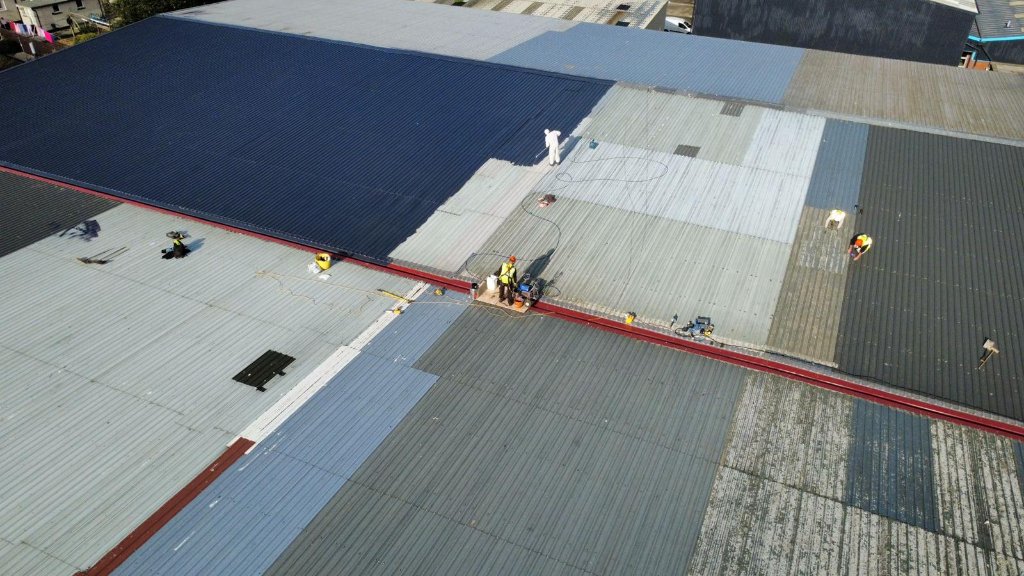
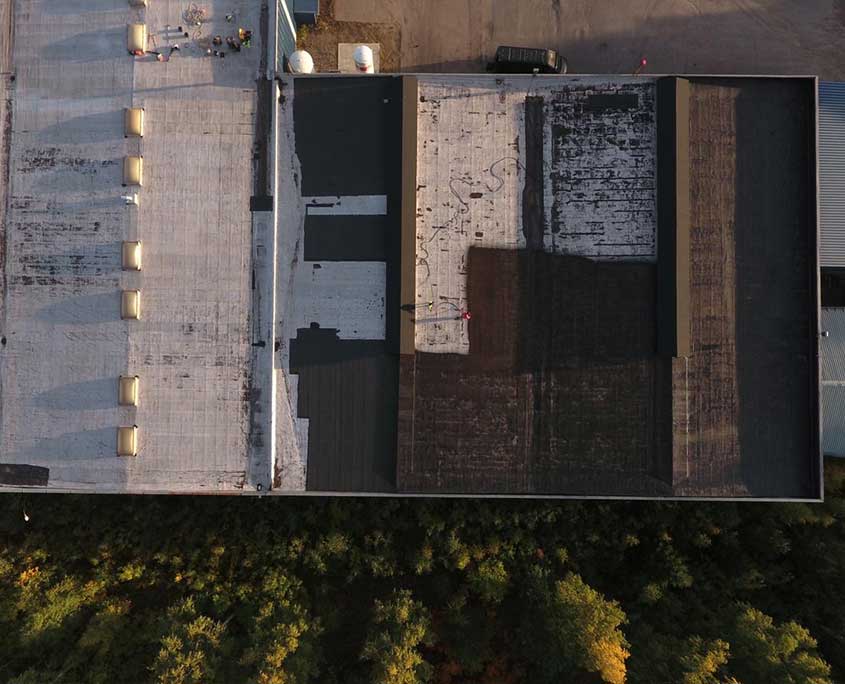
A metal roof coating is a spray-applied or roller-applied liquid system that creates a continuous protective or waterproofing layer over the surface of an existing metal roof — without requiring strip-out of the existing sheeting. Coating is appropriate where the metal roof is structurally sound, sheets are not perforated, fixing lines are functional (though possibly surface-corroded), falls are adequate and the primary issue is UV degradation, failing lap sealants, surface corrosion, or declining weatherproofing performance. It is not appropriate where sheets are perforated, structural integrity is compromised, insulation is saturated or the fixing system has failed — those conditions require repair or replacement.
Spray-applied protective coating and waterproofing systems may be applied to profiled corrugated steel, box profile (trapezoidal) steel, standing seam steel, aluminium profiled roofing, galvanised and pre-painted steel, plastisol-coated sheets and composite panel outer skins — subject to substrate condition, preparation and adhesion confirmation. Each substrate type has specific preparation requirements, primer specifications and compatibility checks. Universal adhesion cannot be assumed — adhesion testing and test areas are standard practice before committing to a full programme, particularly on plastisol, polyester-coated, previously painted or contaminated substrates.
Rocathaan TopSpray35 is a two-component aliphatic, UV-stable spray-applied protective coating — its primary function is UV-stable long-cycle surface protection. No elongation figure is published in the available TopSpray35 TDS. SprayGrade is a two-component cold-spray water-based liquid rubber waterproofing membrane — approximately 850% elongation, approximately 2.7 kg/m² at a nominal 2 mm membrane — its primary function is creating a seamless, fully-bonded waterproof barrier. On metal roofs with surface degradation and UV embrittlement but no active waterproofing requirement, TopSpray35 may be the appropriate system subject to assessment. On metal roofs where a waterproofing membrane is technically required, SprayGrade may be considered — any build-up combining the two products must be confirmed against the approved manufacturer specification for intercoat compatibility, primer, sequencing and warranty eligibility. They are not interchangeable — they serve different functions.
Metal roofs are exposed to direct UV radiation year-round. Aromatic coatings — including standard mastics and some proprietary products — yellow, darken and lose gloss under sustained UV exposure. As the coating surface degrades under UV, surface cracking initiates and moisture ingress begins. Aliphatic coatings — including TopSpray35 — use a different chemistry that resists UV-induced colour change and surface degradation. On a metal roof expected to have a 25-year coating service life, aliphatic UV stability is a specification requirement, not a preference.
Yes, subject to the extent and type of corrosion. Surface and moderate corrosion — rust bloom, degraded galvanising, paint adhesion failure — is addressed through mechanical preparation: wire brushing, grinding, or blast preparation depending on severity, followed by appropriate corrosion treatment and primer. Advancing corrosion at fixing lines must be treated to the correct standard — cleaning alone is insufficient. Through-corrosion — where the base metal has perforated — requires patch repair or sheet replacement before any coating. Applying an elastomeric coating over perforated metal creates a superficially sound appearance while the metal beneath continues to corrode. The extent of perforation and structural corrosion must be mapped at survey before specification.
Preparation requirements depend on the substrate type, existing coating condition and the system to be applied. Typically: mechanical cleaning to remove loose material, contaminated coatings, failed sealants and organic growth; wire brushing or mechanical grinding of corroded positions; corrosion treatment at all fixing lines and lap positions where active corrosion is identified; removal of failed or silicone-based lap sealants — silicone contamination prevents adhesion of most coating systems and must be physically removed; degreasing where contamination is present; primer application where required by the manufacturer for the specific substrate and build-up; and test area adhesion confirmation on previously treated or coated surfaces. Preparation is the largest single contributor to programme duration and the primary determinant of coating service life.
Primer requirements depend on the substrate type, its condition and the approved system build-up. For TopSpray35 applied to bare prepared steel, galvanised steel, aluminium or previously painted surfaces, primer type and coverage rate must be confirmed against the manufacturer's current specification for the specific substrate and condition. Applying TopSpray35 without primer where primer is specified by the manufacturer is a preparation failure that will affect adhesion and invalidate warranty eligibility. Primer selection is substrate-specific — not a generic step that applies equally to all metal roofing conditions.
Metal roof sheets expand and contract with temperature changes. In the UK, this thermal cycling produces movement at fixing positions, lap joints and ridge lines through every annual cycle. Rigid coatings — including most factory-applied paint systems after 15–20 years — cannot accommodate this movement and crack at these positions. Coatings used on metal roofing must be capable of accommodating this substrate movement; rigid or brittle systems crack at fixing lines and laps within a small number of thermal cycles. The movement characteristics of the specific substrate and the suitability of any proposed coating for that substrate must be confirmed at specification stage. This is why applying a standard masonry paint or rigid coating to a profiled metal roof consistently produces cracking at fixing lines and laps.
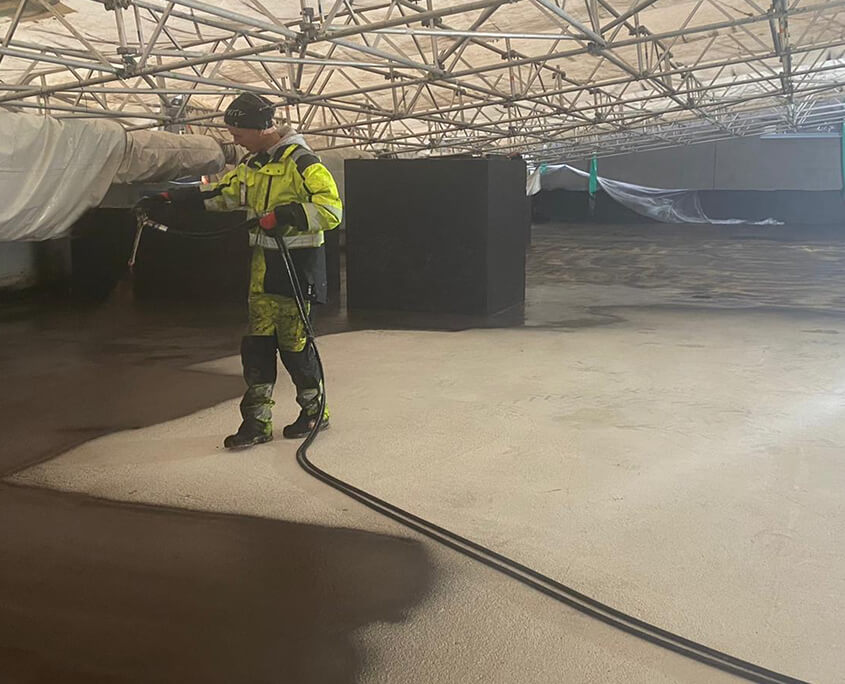
TopSpray35 and SprayGrade are cold-applied systems requiring no hot works and producing no open flame. They are suitable for application to occupied commercial and industrial buildings with appropriate operational planning — zone management, HVAC air-intake protection during spray, overspray controls and daily programme communication with the building operator. Standard safe-working-at-height procedures and access management apply. Internal operations can continue during application on a defined external zone. The absence of hot works is a significant operational advantage on occupied buildings where hot-work permit restrictions apply.
Neither TopSpray35 nor SprayGrade should be applied below 5°C ambient or surface temperature, in wet conditions, onto a damp or frosted surface, or in high wind that causes spray drift. Metal roofs cool faster than masonry or concrete substrates — surface temperature can drop below ambient after rainfall or overnight even on mild days. A surface temperature check before application commences is standard practice, particularly in spring and autumn. Dew point checks are required — application must not proceed when surface temperature is within 3°C of the dew point.
Any warranty position is project-specific and depends on the substrate, preparation, complete system build-up, application records and manufacturer acceptance. Where multiple components are used within a single project build-up, the warranty conditions for the complete build-up must be confirmed by the manufacturer as part of a single approved specification — not assumed from individual product positions. All warranties require application by trained approved applicators, preparation to specification, achievement of specified film thickness and documented compliance. Warranty is not automatic — it is confirmed by the manufacturer following verification that all conditions have been met.
Composite panels — steel-faced insulated panels with a polyurethane or mineral wool core — can be coated where the outer steel skin is sound, falls are adequate and the insulated core is not moisture-saturated. Moisture saturation of the core significantly reduces thermal performance and, in steel-faced composites, accelerates internal face corrosion that is invisible from the outside. Where composite panels are suspected of retaining moisture — evidenced by condensation, internal staining or visible core damage at joints — a moisture investigation should be carried out before any coating specification. Coating a composite panel with a saturated core does not resolve the moisture issue.
Silicone contamination is one of the most common causes of adhesion failure on metal roof coating projects. Silicone prevents bonding of most coating systems — including elastomeric and liquid rubber membranes — and cannot be overcoated. Silicone-contaminated areas must be identified and physically removed before coating. Even trace silicone transfer from previous sealant applications — at fixing positions, lap edges and ridge caps — can cause spot delamination in a new coating. Identification of existing sealant types at survey is a standard step before specification.
Yes. A coated metal roof should be inspected annually and after significant storm or wind events. Inspection should confirm: no mechanical damage at fixing positions, ridge lines or lap edges; no blistering or delamination at detail positions; gutters and outlets are clear and unblocked; and no organic growth — moss or algae — is colonising the coating surface. Minor damage can be repaired locally using compatible coating material without full re-application. Gutters and outlets must be cleaned to prevent standing water from backing up against the coated roof surface. These maintenance requirements are typically a condition of the warranty.
Asbestos cement profiled roofing requires specific management before any coating work can proceed. Asbestos cement sheets are fragile — working on them without appropriate controls is a duty holder and contractor obligation. Suitable asbestos information must be in place; where it is not, an appropriate survey or assessment by a competent person must be carried out before work proceeds. The type of survey or assessment required depends on the proposed scope of work. Work on asbestos cement must follow the applicable asbestos-management and work-control requirements — the specific controls depend on the nature and extent of the work. Encapsulation does not remove the duty to manage asbestos. Coating of asbestos cement roofing is only appropriate where the sheets are assessed as suitable and the proposed system is confirmed suitable for the sheet condition. Asbestos cement roofing is addressed as a distinct application on this site — see Asbestos Roof Encapsulation. Metal roof coating guidance on this page does not apply to asbestos cement roof sheets without the above preconditions being confirmed.
Re-roofing is more appropriate than coating where: sheets are perforated through advancing corrosion across a significant proportion of the roof; the structural purlin or fixing system is so degraded that sheets cannot be confirmed secure under load; composite panels have extensively saturated insulation that cannot be remediated; the existing roof profile or insulation specification is being upgraded as part of the project; or where the total extent of defects across the roof is such that coating would be applied over a predominantly compromised substrate. These are not always binary decisions — partial re-sheeting of the most-defective sections combined with coating of the remaining sound sections is often the most economical outcome. Survey determines which areas are candidates for each approach.
A useful assessment enquiry should include: the metal roof profile type and approximate area; the age of the roof and the original coating or galvanising specification where known; any known leaks — position, frequency and suspected cause; fixing-line and lap joint condition from any previous inspection; access arrangements and whether the building is occupied during works; any previous coatings, treatments or patch repairs applied; whether gutters and outlets are included in the programme scope; and photographs of the roof surface, fixing lines, lap positions, ridge caps and any known defect areas. This enables a preliminary assessment of the likely programme scope and system selection. Submit project details via the enquiry form.
Cut edge corrosion occurs at the sheared edges of profiled metal roof sheets — at eaves, ridges, hips, verges and cut lines around rooflights and penetrations. When sheets are cut to length or angle during installation, the factory-applied protective coating is absent at the cut edge, exposing the bare galvanising and base metal directly to moisture. Over time the cut edge corrodes, often advancing beneath the factory coating adjacent to the cut. Treatment requires mechanical cleaning of the affected edge to sound metal, application of a compatible corrosion-inhibiting primer, and sealing of the cut edge with a compatible coating material — carried out as part of or before the main roof coating programme. Cut edge corrosion treatment is a standard preparatory stage on profiled metal roof programmes, not an optional extra.
Yes, subject to the condition of the existing factory coating and an adhesion assessment. Plastisol (PVC organosol) and polyester factory coatings are the most common factory-applied finishes on steel profiled roofing. Where these are in sound condition — well-bonded, no extensive blistering or delamination — they can provide a substrate for an overcoat. Where they are chalking, blistering, delaminating or heavily contaminated, the unsound material must be removed or treated before any coating proceeds. Adhesion testing on the existing factory coat is standard practice before committing to a programme on these substrates. The primer type and preparation regime required for adhesion to plastisol and polyester coatings must be confirmed against the manufacturer's specification for the specific coating product — universal compatibility cannot be assumed.
No. A spray-applied coating conforms to the existing roof surface — it does not alter falls or drainage gradients. Flat sections, valleys or low-slope areas where water ponds after rainfall will continue to pond after coating. Persistent ponding water accelerates coating degradation regardless of system quality. Where fall correction is required — through sheet re-profiling, drainage channel insertion or outlet lowering — it should be addressed before or alongside the coating specification. Coating over a metal roof without fall correction is not an appropriate use of a warranted waterproofing or protective system.
Yes — and coordinating both within the same access and preparation mobilisation is typically the most efficient approach. Metal-roofed industrial and commercial buildings almost always incorporate metal box gutters, valley gutters or eaves channels. Coating the roof while leaving the gutters unaddressed — or vice versa — produces a programme gap at the roof-to-gutter junction, which is typically the highest-risk transition point. The junction between the roof coating system and the gutter lining must be specified as a continuous, compatible detail — confirmed against both system specifications. Both programmes benefit from the same access mobilisation and preparation sequence. See Commercial Gutter Refurbishment for the gutter-specific system guidance.
Where fire performance is a specification requirement — for example, buildings subject to insurance requirements or planning conditions — the manufacturer's fire-performance data for the specific system, build-up and application conditions must be confirmed before specification.