A commercial roof coating is a liquid-applied waterproofing or protective system applied directly to an existing commercial roof substrate — metal, felt, concrete, asphalt or an existing membrane — to restore waterproofing performance, provide UV protection or extend service life. Applied cold or by specialist spray equipment, the coating cures to form a seamless, fully-bonded membrane with no joints or laps. Unlike traditional built-up roofing, there are no joints at which failure initiates. Coating systems are not universally appropriate — suitability depends on substrate condition, structural integrity, moisture content, drainage and detailing scope.
In many cases, yes — but suitability must be confirmed by assessment, not assumed. Where the existing structure is sound, the substrate is dry and stable, drainage is adequate and the existing material is compatible with the proposed coating, a liquid coating overlay can eliminate the source of water ingress without strip-out. Where leaks originate from trapped moisture within a saturated build-up, from structural deflection or from failed drainage, coating over the symptom without addressing the cause will produce a repeat failure. The assessment — not the budget — determines which route is correct.
Commercial roof coating systems are used on profiled metal (corrugated, box profile, standing seam), concrete flat decks, asphalt, modified bitumen felt, existing liquid membranes, asbestos cement (subject to condition and licensing requirements) and most sound existing coated substrates. Each substrate type requires different preparation, primer and system selection. Metal roofing requires elastomeric systems to accommodate thermal movement. Flat concrete and felt roofs require moisture assessment before overlay. Asbestos cement requires a licensed survey and specific management plan before any coating work proceeds.
HBS200 and SprayGrade can both be applied over sound felt without strip-out, subject to substrate assessment. The critical check is moisture content. Felt that has become saturated — particularly where the insulation beneath has absorbed water over time — will cause blistering and delamination of the new membrane through vapour pressure. Core sampling at representative locations and electronic moisture testing are standard before overlay specification. Where insulation has become wet through long-term leakage, condensation or prior waterproofing failure, the moisture source must be identified and eliminated, the wet insulation must be dried or replaced, and substrate moisture must be confirmed within the manufacturer's specification limits before any overlay proceeds. Felt that is delaminated, loose or structurally failed must be repaired before any overlay.
Yes, subject to the degree of corrosion. Surface and moderate corrosion is addressed through preparation — mechanical cleaning to bare metal, corrosion treatment, primer confirmed from the manufacturer's specification for the specific substrate and build-up, then coating. Rocathaan TopSpray35 is the principal Prokol system for metal roof refurbishment. SprayGrade cold-spray liquid rubber is also used where full waterproof membrane formation is the primary requirement. Through-corrosion, hole formation or structural section loss at sheets or fixings requires repair or sheet replacement before coating. Coating cannot restore structural integrity.
Cut edge corrosion is the oxidation that occurs at the cut edges of profiled steel roofing sheets — where the protective factory coating does not extend to the cut edge, leaving bare steel exposed. It presents as a rust-brown staining running from sheet edges, laps and eaves. Untreated, it progresses inward along the sheet. Treatment involves mechanical cleaning to remove loose rust and corrosion products, application of a rust-inhibiting primer to the treated edge, and coating with an elastomeric system that spans the prepared edge and accommodates thermal movement. Cut edge treatment is a preparation stage, not a standalone product application.
Yes. HBS200 single-component liquid rubber is the standard system for commercial gutter lining — applied by brush, roller or trowel to create a seamless cold-applied membrane over the existing substrate. Suitable for steel box gutters, parapet gutters, valley gutters and internal drainage channels. The seamless nature of the cured membrane eliminates all joint positions — which is where virtually every gutter failure originates. Substrate preparation including mechanical cleaning, corrosion treatment and priming is required before lining. Structural integrity of the gutter must be confirmed — lining cannot restore a gutter that has corroded through.
Subject to a current management survey by a licensed asbestos surveyor confirming that the sheets are in suitable condition for encapsulation, elastomeric coating systems can be applied over asbestos cement profiled roofing. Encapsulation is only appropriate where the ACM is sound, the sheets have structural integrity and the management plan permits surface coating rather than removal. All work must comply with the Control of Asbestos Regulations 2012 and be carried out by contractors with appropriate licensing and risk assessment. No coating specification on asbestos cement can proceed without a current licensed surveyor assessment.
Adhesion testing establishes whether a proposed coating system will bond adequately to the existing substrate — particularly where a previous coating, sealant or treatment has been applied. On commercial buildings with a history of patch repairs, previous proprietary coatings or silicone sealants, the compatibility between the existing surface and the proposed system is not always predictable from visual inspection. A pull-off adhesion test or test area confirms actual bond strength before the full specification is committed. Silicone contamination in particular is a significant incompatibility risk — silicone prevents bonding of most coating systems and must be physically removed before coating.
Not universally — but primer is required in most commercial roofing applications and is a warranty condition for many systems. Primer requirements for TopSpray35 and MonoSeal on metal and previously coated substrates must be confirmed from the manufacturer's current specification for the specific substrate and build-up. HBS200 and SprayGrade may require primer depending on substrate type, porosity and condition. Omitting primer where it is specified by the manufacturer typically voids the system warranty and reduces bond strength. Primer selection is substrate-specific — the correct primer for concrete differs from the correct primer for steel or an existing coating.
Reinforcement — typically a geotextile fleece or glass fibre scrim bedded into the wet coating — is standard practice at all critical detail positions: penetrations, upstands, outlets, abutments, movement joints and laps. It also bridges minor substrate cracks and movement. On aged felt or concrete substrates with surface cracking, reinforcement extends across the affected area. Omitting reinforcement at details is a common cause of early failure at penetrations and upstands — which is where most commercial roof failures originate. Reinforcement requirements are specified per substrate and detail type; the field area and the detail areas have different requirements.
Hand-applied systems (HBS200, MonoSeal) are applied by brush, roller or trowel without specialist equipment. They are practical for smaller roofs, gutters, complex details, penetrations and maintenance applications. Spray-applied systems use specialist equipment to achieve substantially higher output on large open areas — application output depends on the system, equipment, access, detailing, substrate condition, preparation, weather and project controls. TopSpray35 is a two-component protective topcoat applied by airless spray — not a hot-spray system. On large commercial and industrial roofs, spray application is the economically viable approach. The two approaches are typically combined within the same programme: spray for the field membrane, hand application for all detail work.
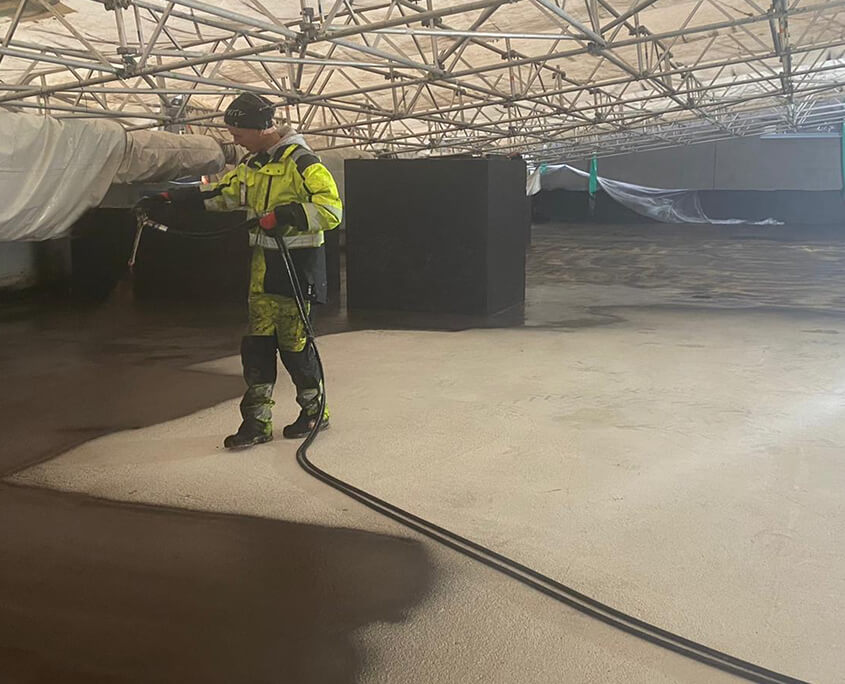
Cold-spray liquid rubber (SprayGrade) is a two-component water-based system applied at ambient temperature using specialist cold-spray equipment. It cures by moisture uptake — touch-dry approximately 1 minute at 20°C, full adhesion approximately 48 hours subject to conditions. TopSpray35 is a two-component aliphatic protective topcoat applied by airless spray — it is not a hot-spray system. Rocathaan HotSpray PA 260-FR is the hot-applied polyurea membrane, applied at elevated temperature using heated plural-component equipment, suited to traffic-bearing decks where rapid return to service is critical. Both cold-spray and hot-spray waterproofing systems require specialist equipment and trained applicators. Cold-spray is the standard approach for general commercial flat roof waterproofing; hot-spray polyurea is specified where traffic-bearing or high-performance requirements apply.
Cure times vary significantly by system and conditions. SprayGrade cold-spray liquid rubber is touch-dry approximately 1 minute at 20°C; full adhesion approximately 48 hours subject to temperature, humidity and conditions — cure time is not the same as full service readiness. HBS200 cures by moisture uptake — cure rate varies with ambient humidity and temperature, particularly in cold or dry conditions. TopSpray35 reference cure stages at 20°C: recoat approximately 12–24 hours; mechanical resistance after approximately three days; chemical resistance after approximately seven days — these are application-sequencing references, not building-handover times. None of these figures are absolute — weather, substrate temperature and application thickness all affect actual cure performance. The manufacturer's technical data sheet for the specific system and the prevailing site conditions governs the applicable cure schedule.
Cold-applied liquid rubber systems (HBS200, SprayGrade) do not require hot works, generate no open flame and contain no solvents — making them suitable for application to occupied commercial buildings subject to safe working zone management, access control and consideration of HVAC air intakes for spray application. Schools, hospitals, offices and retail buildings regularly receive liquid rubber roof coatings during occupation. Spray-applied systems require a controlled working zone around the application area. Hot-spray systems require specialist risk assessment for occupied buildings. Our technical team can advise on access and method statement requirements for occupied commercial buildings.
Service life and warranty term are two different things. Warranty position and service-life expectations for any system are project-specific and depend on the substrate, preparation, complete system build-up, application records and manufacturer acceptance. A warranty is a conditional commitment by the manufacturer, subject to compliance at every stage. Actual service life on any individual commercial roof depends on the quality of the original substrate, preparation, detailing and ongoing maintenance — not solely on the product specification.
Any warranty position is project-specific and depends on the substrate, preparation, complete system build-up, application records and manufacturer acceptance. Warranty eligibility requires: substrate assessment confirming suitability; full preparation to the manufacturer's specification; primer application where required; application by a trained and approved applicator; achievement of specified minimum dry film thickness; completion of reinforcement at all detail positions; and final inspection on behalf of the manufacturer where required. Warranty is not automatic — it is confirmed by the manufacturer following verification that all conditions have been met. A warranty is not a service-life guarantee.
Commercial roof coating cost depends heavily on factors beyond the roof area: substrate condition and preparation requirement; extent of detail work at penetrations, upstands and outlets; whether moisture investigation or test areas are needed; access method (scaffold, MEWP, rope access); project programme constraints; distance and logistics; and whether existing defects require repair before coating. A roof that requires extensive preparation, moisture investigation, repair work and complex detailing will cost significantly more per m² than a clean, accessible roof with a straightforward substrate. Headline m² rates without a site assessment are not meaningful for commercial roof coatings — they should be treated with caution.
Commercial roof coatings are not appropriate where: the roof deck or structure is failing due to structural movement or deterioration — coating cannot restore structural integrity; the insulation is saturated and cannot be adequately dried; the existing waterproofing build-up is extensively delaminated, failed or incompatible with the proposed coating; drainage problems cannot be resolved as part of the programme; metal sheets have through-corrosion or significant section loss; or asbestos cement sheets are in a condition that requires removal rather than encapsulation. In these conditions, repair or replacement of the affected area is required before any coating specification can proceed.
System selection for any commercial roof coating follows a structured assessment: (1) identify the substrate — metal, felt, concrete, asphalt, existing membrane, ACM; (2) assess structural condition — no deflection, cracking or movement beyond coating system capacity; (3) investigate moisture — core sampling, moisture meter survey; (4) assess drainage — falls, outlet condition, standing water risk; (5) test adhesion — particularly on previously coated substrates or where incompatible treatments may have been applied; (6) define performance requirement — waterproofing, elastomeric protection, UV stability, traffic rating; (7) identify access and programme constraints; (8) confirm warranty route. No two commercial roofs are identical — system selection is project-specific. Submit project details for technical confirmation of applicable systems.