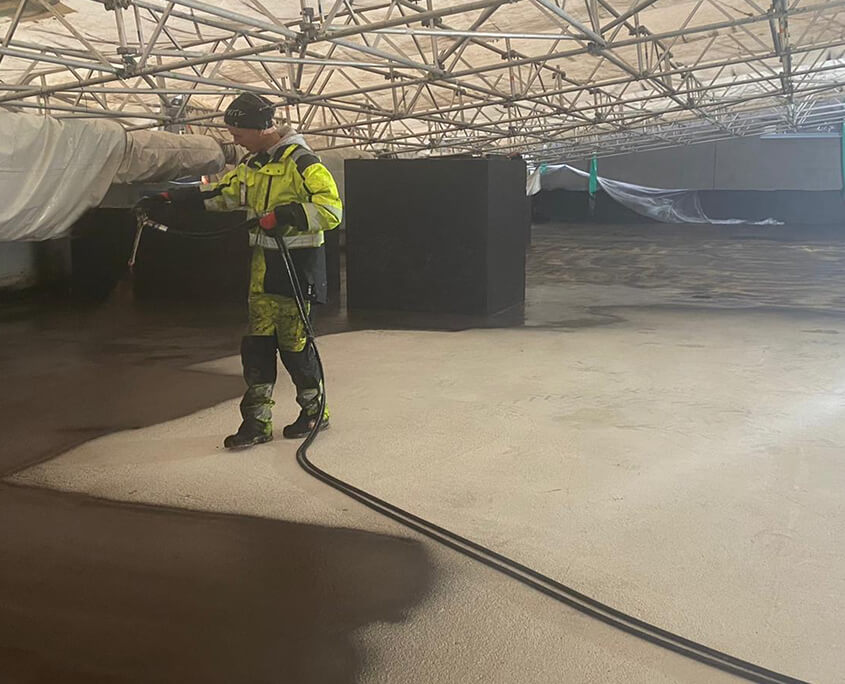
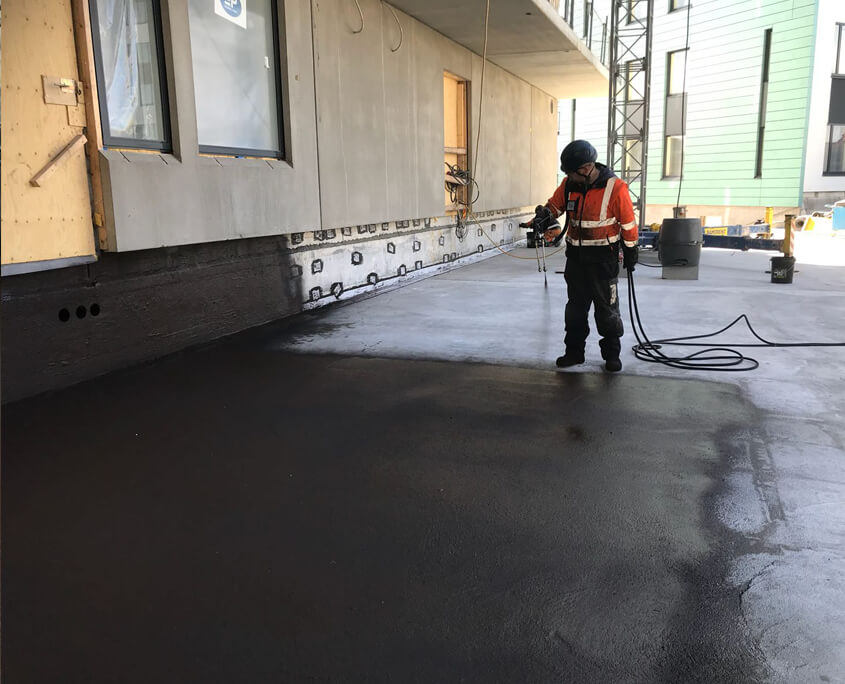
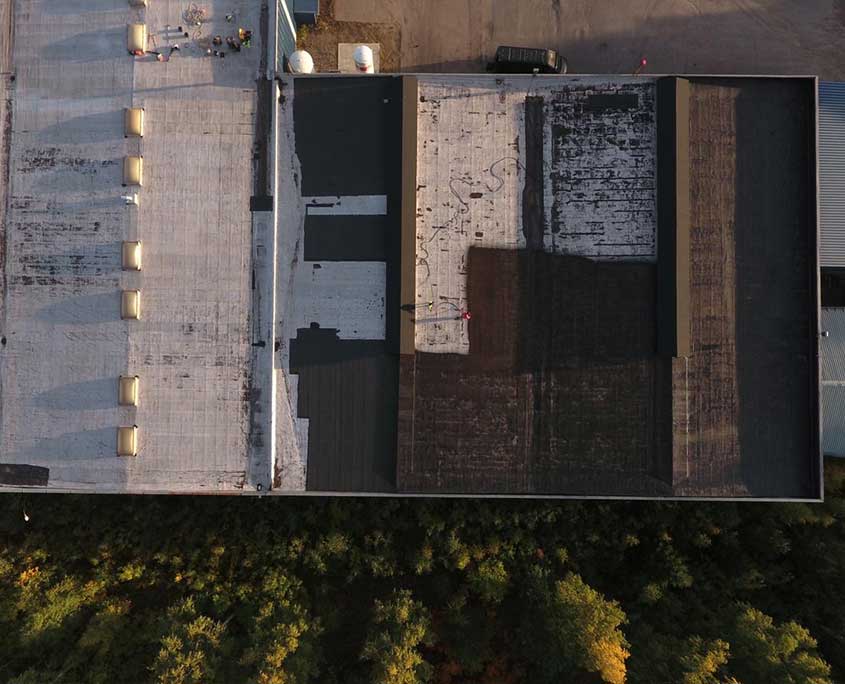
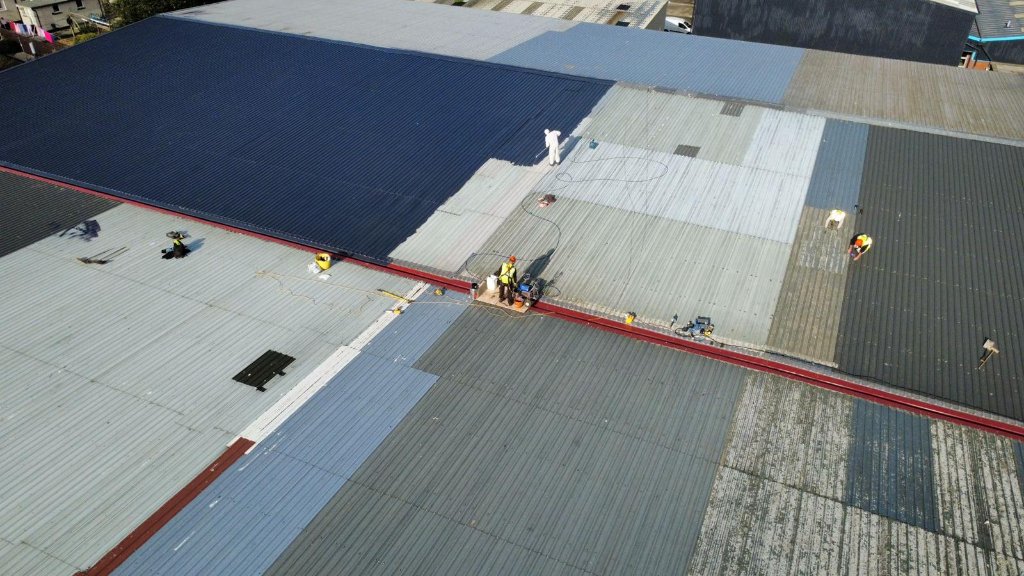
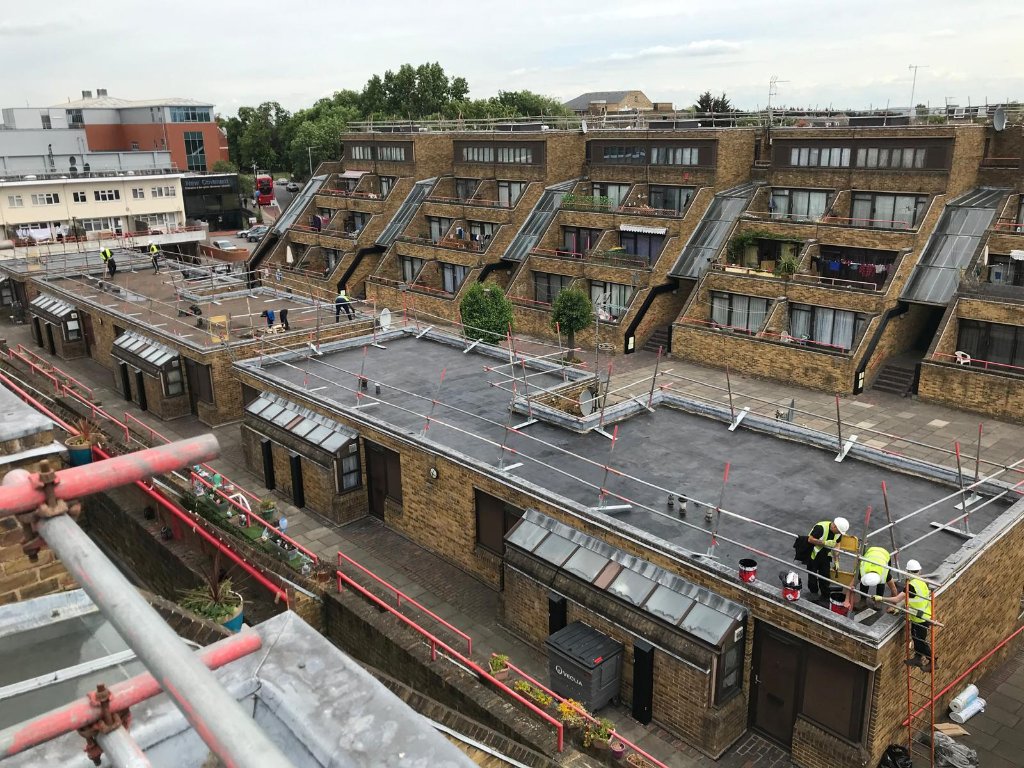
Cold-spray liquid rubber (SprayGrade) is a two-component water-based system applied at ambient temperature. It cures by moisture uptake — touch-dry approximately 1 minute at 20°C, but this is not full adhesion; full adhesion takes approximately 48 hours subject to temperature, humidity and conditions. Hot-spray polyurea (Rocathaan HotSpray PA 260-FR) is applied using heated specialist equipment at 85°C and 180–200 bar pressure. It reacts in approximately 12–15 seconds, with tack-free time approximately 30–120 seconds — rapid return to service is a primary characteristic. Cold-spray is the standard approach for large-format commercial and industrial roof waterproofing. Hot-spray is specified for traffic-bearing decks and high-performance requirements. They require different equipment, different operative competencies and cannot be substituted for each other.
Application output for SprayGrade cold-spray liquid rubber depends on the system, equipment, access, detailing, substrate condition, preparation, weather and project controls. Output should not be presented as a fixed daily figure. Preparation, detailing, repairs and inspection are separate stages that must not be compressed in order to extend the spray stage — compressed preparation is the most common source of warranty rejection on large-format projects.
SprayGrade can be applied to profiled metal roofing, concrete decks, existing felt and bituminous membranes, asphalt, modified bitumen and most existing liquid membranes — subject to substrate assessment, preparation and moisture testing. Each substrate type may require specific preparation, primer and coverage rate. Metal substrates require corrosion treatment before spray. Felt and concrete substrates require moisture investigation, including core sampling at representative locations. Adhesion testing on previously coated substrates confirms compatibility. No substrate should be assumed suitable without assessment.
Rocathaan HotSpray PA 260-FR is specified where rapid reaction, high elongation and a seamless fully-bonded polyurea membrane are required — including car park decks, podium decks, plant room roofs and high-performance waterproofing applications. Where a traffic-deck application is proposed, PA 260-FR may form part of a project-specific deck waterproofing build-up where the complete system, substrate preparation, primer, reinforcement, protection and wearing-surface requirements have been confirmed. It must not be treated as a default traffic-bearing wearing surface without that confirmation. Cold-spray liquid rubber is not rated for vehicular traffic and should not be specified where HotSpray PA 260-FR is the appropriate system.
No. Reaction time for Rocathaan HotSpray PA 260-FR is approximately 12–15 seconds — this is the time from application to initial film formation, with tack-free time at approximately 30–120 seconds. Rapid reaction enables swift return to service compared with cold-spray systems. However, full chemical cure and the development of maximum mechanical properties develops over a longer period subject to film thickness, substrate temperature and conditions. Return to service timing must be confirmed from the manufacturer's application data for the specific project conditions — not assumed from the reaction time figure alone.
Rocathaan HotSpray PA 260-FR requires specialist heated plural-component hotspray equipment operating at 180–200 bar, with component temperatures at 85°C and hose temperatures at 78–82°C. The base component requires thorough mixing before heating — minimum 20 minutes, or 45 minutes for a first-use 200-litre drum. Beyond the equipment, installation requires: competent operatives trained in the specific application method; product-specific handling controls; appropriate respiratory and skin protection; applicable chemical-safety training including diisocyanate awareness; and controlled mixing, temperature and pressure throughout. This is not a product that can be applied by general contractors with standard spray equipment.
Yes. Rocathaan HotSpray PA 260-FR uses aromatic polyurea chemistry — UV yellowing, darkening in colour and loss of gloss over time are characteristics of aromatic polyurea, not product defects. Waterproofing and mechanical performance are unaffected. Where colour retention or appearance matters — exposed car park decks, architectural applications — a suitable UV-stable topcoat should be applied over the membrane after cure. Confirm topcoat compatibility and elasticity match with the manufacturer before specifying.
Rocathaan TopSpray35 is a spray-applied aliphatic aliphatic protective topcoat — not a waterproofing membrane system. It is relevant to metal roof and industrial roof refurbishment where the primary requirement is UV-stable, long-cycle surface protection, colour restoration and thermal movement accommodation. It is applied by airless spray using standard (not heated) spray equipment. It is not positioned on this page as an equivalent waterproofing membrane method because it does not fulfil the waterproofing membrane role. Where waterproofing is required on a substrate for which TopSpray35 provides protection, a waterproof membrane must be confirmed beneath it as a separate stage. TopSpray35 is entirely distinct from Rocathaan HotSpray PA 260-FR — different chemistry, different equipment, different function and different application context. See Metal Roof Coatings for the primary TopSpray35 application context.
Preparation and primer requirements depend on the substrate, system and intended build-up. For cold-spray liquid rubber (SprayGrade), primer requirements vary by substrate — concrete, metal, felt and previously coated surfaces each have different requirements, confirmed by the manufacturer. For Rocathaan HotSpray PA 260-FR, substrate preparation is substrate-specific: metal requires blasting to a defined anchor profile; concrete requires confirmed compressive and bond strength, moisture below 4%, and all friable material removed; foam substrates require a closed, dry, grease-free surface. For Rocathaan TopSpray35, primer and preparation requirements — including whether ProFix or another primer is appropriate — must be confirmed for the specific substrate, existing coating and approved system build-up. Primer choice depends on substrate type, existing coating, surface condition, contamination level and intended build-up, confirmed against the manufacturer's specification.
Cold-spray liquid rubber (SprayGrade) contains no solvents, requires no hot works and generates no open flame — making it suitable for occupied commercial and industrial buildings with appropriate zone management. Internal operations can continue while application proceeds on a defined external zone. Key considerations: HVAC air-intake protection during spray; overspray management near open areas; daily programme communication with the building operator. Hot-spray polyurea systems require a more detailed risk assessment for occupied buildings due to the specialist equipment, operating temperatures and isocyanate content.
SprayGrade cold-spray must not be applied below 5°C ambient or surface temperature, in wet conditions, onto a damp or frosted surface, or in high wind that causes spray drift. Rocathaan HotSpray PA 260-FR additionally requires relative humidity below 85% and surface temperature at least 3°C above dew point. Both systems require the substrate to be dry and within specified temperature limits. For large-format projects, weather window assessment must be carried out at programme planning stage, not managed reactively on site.
SprayGrade cold-spray liquid rubber achieves approximately 850% elongation — sufficient to accommodate substrate movement, crack bridging and thermal expansion on commercial and industrial roofs. Rocathaan HotSpray PA 260-FR achieves approximately 1900% elongation (DIN 53504) — reflecting the polyurea chemistry and making it appropriate for traffic-bearing applications where impact loading, vehicle deflection and structural movement create higher deformation demands. Elongation should not be used to compare systems directly for general roofing — the correct system is determined by the performance requirement, not elongation as an isolated figure.
Any warranty position for spray-applied waterproofing is project-specific and depends on the substrate, preparation, complete system build-up, application records and manufacturer acceptance. Warranty eligibility requires full preparation to specification, primer where required by the manufacturer, application by trained approved applicators, achievement of specified film thickness, completion of reinforcement at all details, and final inspection where required. Warranty is not automatic — it is confirmed by the manufacturer following verification that all conditions have been met.
Subject to adhesion testing and compatibility assessment, cold-spray liquid rubber can be applied over sound existing coatings. The critical checks are: adhesion — pull-off testing confirms bond strength; compatibility — some existing coatings and sealants are chemically incompatible; and silicone contamination — silicone prevents bonding of most coating systems and must be physically removed. On roofs with a history of patch repairs or previous proprietary coatings, compatibility cannot be assumed from visual inspection. A test area should confirm performance before full application.
Preparation requirements vary by substrate and system but typically include: mechanical cleaning to remove loose material, contamination and degraded coatings; corrosion treatment on metal substrates; moisture testing and confirmation below threshold; adhesion testing on previously coated surfaces; removal of silicone contamination at sealant positions; primer application where required by the manufacturer; and reinforcement at all detail positions before the field membrane stage. Preparation is the largest single contributor to programme duration on large-format spray projects — the spray membrane application stage is comparatively fast.
Reinforcement — typically geotextile fleece or glass fibre scrim bedded into the wet coating — is applied at all critical detail positions: penetrations, upstands, outlets, abutments, movement joints and laps. It bridges substrate cracks, accommodates minor movement at junctions, and ensures membrane continuity at positions more demanding than the open field area. Omitting reinforcement at details is one of the most common causes of early failure at penetrations and upstands on spray projects.
Yes — phased spray programmes are standard practice on large industrial and commercial roofs. The roof is divided into zones by structural bay, drainage zone or material type. Only one zone is under active treatment at a time; other zones remain intact and watertight. Each phase requires its own preparation, priming and application sequence. Phase boundaries must be designed at ridge lines, movement joints or structural breaks. Cure intervals between phases must be observed. Phased programmes are the standard approach on occupied buildings where operational continuity is a constraint.
A complete quality-control record should include: pre-application substrate moisture readings at documented locations; ambient and surface temperature readings on each application day; primer application records with batch numbers and measured coverage rate; wet-film thickness checks or consumption records during application; photographic records of detail treatment at all penetrations, upstands, gutters, outlets and abutments; inspection hold-point records; records of any defect or repair; weather records for each spray day; and a final inspection record confirming completion of all details to specification. These records are the basis for warranty application and provide the building owner with documentary assurance.
Both deliver seamless, fully-bonded liquid rubber membranes — the difference is method, output and equipment requirement. Hand-applied HBS200 is applied by brush, roller or trowel without specialist equipment — practical for smaller roofs, gutters, penetrations, complex geometries and maintenance. Spray-applied SprayGrade uses dedicated cold-spray equipment to achieve far higher output on large open areas. On large commercial and industrial roof projects the two are typically combined: spray for the field membrane, hand application for all detail work. The systems are compatible within the same programme.
Spray application is not appropriate where: substrate moisture content is above the specified threshold; the roof has structural failure, widespread sheet perforation or saturated insulation requiring prior remediation; roof geometry is too complex or the spray area too small to justify specialist equipment mobilisation; wind conditions make overspray control impractical; application is on asbestos cement roofing without a current licensed survey and management plan; or where penetration and detail density is so high that hand application dominates the programme and spray offers no practical advantage. In these cases, HBS200 hand-applied liquid rubber is the appropriate system.