
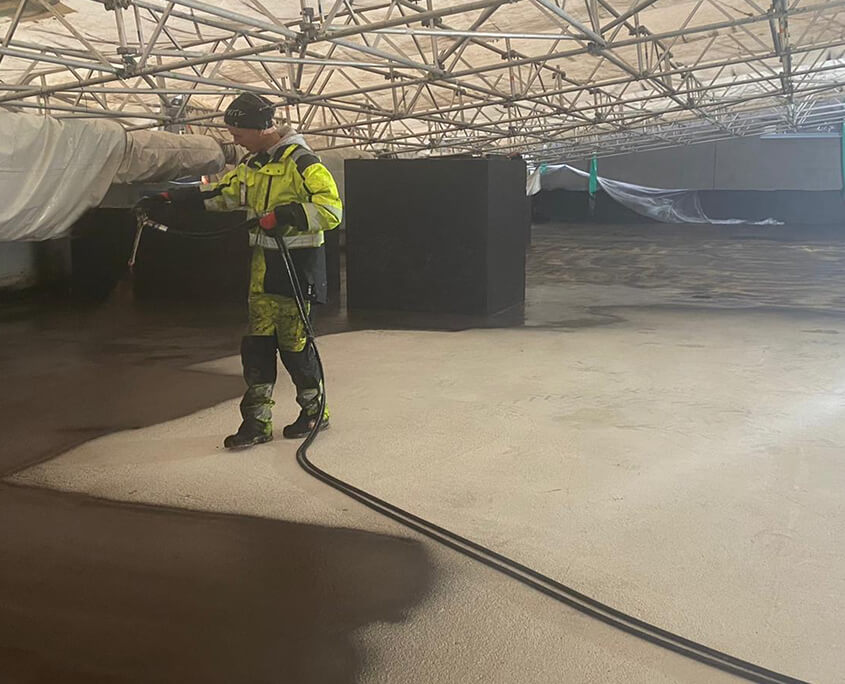
Commercial Roof Coatings, Waterproofing and Protection Systems in Manchester
Forti Nova supplies commercial roof coatings, liquid waterproofing, metal roof refurbishment, below-ground waterproofing and industrial flooring systems for commercial and industrial buildings across Manchester and Greater Manchester. Projects range from single-building roof surveys to large-area spray waterproofing programmes on Manchester's warehouse and logistics estate.
Commercial Roof Coatings and Roof Refurbishment in Manchester
Manchester and Greater Manchester concentrate a significant proportion of northern England's commercial and industrial roofing stock. Trafford Park — one of the largest industrial estates in Europe — together with major warehouse and logistics parks on the M60 and M62 corridors, holds extensive areas of older profiled-metal roofing requiring coating, refurbishment and overlay programmes. Across Salford, Stockport, Tameside, Oldham and Rochdale, converted mill buildings and light-industrial premises add a different refurbishment profile. Manchester city centre, Salford Quays and the wider commercial areas contribute flat-roof offices, retail parks, apartment buildings and multi-storey car parks.
Commercial roof waterproofing in Manchester demands different approaches depending on the building type and substrate. Metal roofs require elastomeric systems that accommodate thermal movement. Flat concrete or felt roofs require cold-applied liquid membranes. Below-ground structures — basements, foundations, retaining walls — require hydrostatic-pressure-resistant membranes. Industrial concrete floors require durable polyurea or protective coating systems. Asbestos cement roofs — still present on Manchester's older industrial stock — require licensed encapsulation rather than standard coating. No single system covers every scenario: correct specification begins with substrate assessment.
Forti Nova supplies Liquid Rubber and Prokol systems for Manchester projects. Technical assessment, product specification, substrate compatibility guidance and approved-applicator coordination are available for projects across the full Greater Manchester area, including Bolton, Bury, Wigan, Rochdale, Oldham, Tameside, Stockport, Salford and Trafford.
Who This Information Is For
- Building owners
- Facilities managers
- Roofing contractors
- Main contractors
- Architects
- Surveyors and specifiers
- Local authorities
- Industrial operators
- Property and asset managers
- Housing associations
Commercial Roofing Problems Across Manchester
Manchester's high rainfall, westerly exposure and large commercial building stock create consistent and repeating failure patterns. Identifying the correct root cause before specifying any system is essential — coating over an incorrectly diagnosed failure creates a second failure inside the first.
Recurring Water Ingress
Likely cause: Recurring leaks on Manchester commercial roofs are typically caused by failed details — upstand junctions, penetration flashings, parapet cappings and drainage outlets — rather than general membrane failure. Multiple failed spot repairs are a reliable indicator of systemic membrane failure rather than isolated defect.
What to inspect: Locate the precise ingress point before specifying any work. Thermal imaging or flood testing can assist where the ingress point is not visually apparent. Check all details around penetrations, upstands and drainage outlets, not just the area directly above the internal leak.
Remediation routes: Localised repair using compatible liquid membrane at discrete failure points. Full refurbishment using spray or cold-applied liquid membrane if the existing membrane has generalised deterioration. Overlay is only valid if the existing substrate is sound, dry and provides adequate adhesion.
Coating not appropriate when: the deck or existing membrane is saturated — liquid waterproofing applied over saturated substrates will blister and delaminate.
Commercial Roof Coatings in ManchesterFailed Temporary Patch Repairs
Likely cause: Temporary patches — bitumen felt, mastic, self-adhesive tape — applied over an active failure do not address the underlying cause. They typically disbond at the edges within one to two wet seasons, allowing water to track underneath and extend the affected area.
What to inspect: Map all previous repair attempts and assess their current adhesion. Document the extent of areas that have been patched multiple times — this pattern indicates a systemic rather than isolated failure.
Remediation routes: Remove failed patch material and treat the original substrate. If the area of repeated repair is large, a full condition survey to establish whether overlay or strip-out is required.
Coating not appropriate when: patches have been applied repeatedly over saturated or structurally compromised substrate — the substrate beneath must be investigated before any new membrane system is applied.
Why Roof Overlays FailOpen Sheet Laps and Failed Sealants
Likely cause: Profiled metal roof sheet laps open through thermal movement, fixing corrosion and the progressive loss of original lap sealant. Open laps allow wind-driven rain to penetrate and water to be retained between sheets, accelerating corrosion and ingress. On Manchester's metal-roofed warehouse stock, this is one of the most common single failure types.
What to inspect: Inspect all lap positions visually and by probing with a flexible blade. Check the condition of any existing lap sealant or foam infill. Assess fixing condition at laps — corroded or missing fixings indicate that the lap geometry has changed.
Remediation routes: Lap sealant reinstatement and overcoating as part of a full metal roof refurbishment programme. Localised repair of discrete open laps where general roof condition is sound.
Coating not appropriate when: the lap zone shows advanced corrosion with section loss or perforation at the sheet edge — these areas require sheet replacement before coating.
Metal Roof CoatingsLoose or Defective Fixings and Penetration Details
Likely cause: Mechanical fixings through the roof membrane, HVAC penetrations, pipe services and cable entries are primary ingress points. Original seals around fixings and penetrations degrade through UV exposure and thermal movement. Loose fixings on metal roofing can lift sheet edges and compromise lap integrity.
What to inspect: Identify all penetrations and assess the condition of sealing details. Check for secondary flashings and collar seals. On metal roofing, check fixings for corrosion, missing sealing washers and evidence of pull-through.
Remediation routes: Liquid membrane detailing around all penetrations as part of any refurbishment — penetrations cannot be treated as separate from the general membrane work. Fixing replacement where corrosion is significant.
Coating not appropriate when: penetrations have caused structural damage to the deck beneath — structural attention is required before membrane work proceeds.
Why Detailing Determines Roof LifespanCut Edge Corrosion
Likely cause: Cut edge corrosion on profiled metal sheets begins at exposed lap edges where the protective coating is absent. Rainwater retained between overlapping sheets creates a sustained corrosion environment. Corrosion progresses inward from the cut edge and, if untreated, eventually perforates the sheet. Prevalent on north-facing roof slopes across Manchester's industrial buildings where drying time between rain events is limited.
What to inspect: Inspect all lap positions across the full roof area — not just the areas above reported internal leaks. Assess depth and extent of corrosion at each lap. Determine whether corrosion is limited to surface degradation or has caused section loss.
Remediation routes: Mechanical cleaning to remove corrosion products, metal treatment, specific sealant application to close the lap gap, primer and elastomeric overcoat. Cut edges must be specifically addressed — not simply overcoated.
Coating not appropriate when: section loss at the sheet edge or fixing zone is structurally significant — these sheets must be replaced before a coating programme commences.
Metal Roof CoatingsSurface Corrosion and Perforated Roof Sheets
Likely cause: General surface corrosion on metal roof sheets results from the progressive breakdown of the factory-applied protective coating, accelerated by UV exposure, acid rainfall and mechanical damage. Once the protective layer is gone, corrosion of the steel substrate proceeds continuously. Perforation occurs at the thinnest points — typically the corrugation troughs and lap edges.
What to inspect: Distinguish between surface corrosion (treatable) and perforation or significant section loss (requiring replacement). Walk the roof where safe to do so — or use aerial or drone survey — to map the distribution and severity of corrosion across the full area.
Remediation routes: Surface corrosion — mechanical cleaning, treatment and overcoating with elastomeric system. Perforation — sheet replacement in affected areas, then overcoating of remaining sound area.
Coating not appropriate when: perforation is present — coating over perforated sheets will not produce a watertight or warranted result. Perforated areas must be replaced.
Industrial Roof RefurbishmentWet Insulation and Trapped Moisture
Likely cause: Moisture trapped within a flat roof build-up — insulation layer, felt layers or screed — accumulates through membrane failure, inadequate drainage or condensation. Once insulation is wet, it retains moisture for extended periods even when the membrane above appears intact. Manchester's sustained rainfall means that wet insulation is a very common finding on flat-roof commercial buildings across the city.
What to inspect: Electrical capacitance moisture testing or infrared thermography to map wet areas within the build-up. Core sampling at representative wet and dry points to confirm moisture distribution and assess insulation condition.
Remediation routes: Where wet areas are localised, strip and replace those zones while overlay proceeds on confirmed-dry areas. Where saturation is extensive, full strip-out is required before any new membrane system.
Coating not appropriate when: moisture saturation is extensive — overlay will trap the moisture and cause blistering and delamination of the new membrane within 12–24 months.
Why Trapped Moisture Destroys OverlaysFelt Blistering and Felt Splitting
Likely cause: Built-up felt roofing blisters when moisture trapped within or beneath the felt layers turns to vapour under solar heat, pushing the upper layers away from the deck. Splitting occurs through UV degradation, thermal cycling and the progressive loss of the bitumen binder. Both are common on Manchester's older flat-roof commercial and educational buildings.
What to inspect: Assess blister size, distribution and integrity. Blisters that have not opened can sometimes be incorporated into an overlay where substrate condition is otherwise sound. Split felt must be mapped — splits that expose the deck indicate advanced membrane failure.
Remediation routes: Small, intact blisters on otherwise sound felt may be compatible with cold-applied overlay if moisture testing confirms the felt is dry. Open blisters and split felt require selective removal and reinstatement before overlay or full strip-out.
Coating not appropriate when: blistering is widespread and associated with moisture within the felt build-up — overlay over wet felt will not deliver a lasting result.
Flat Roof WaterproofingCoating Delamination and Poor Historic Preparation
Likely cause: Previous coating applications that delaminate typically fail because of inadequate surface preparation — contaminated substrate, insufficient mechanical key, omitted primer, or application over a wet or incompatible surface. Poor historic preparation is common on Manchester buildings where multiple coating attempts have been made over decades.
What to inspect: Identify the original system and assess adhesion at representative points across the roof. Adhesion testing (pull-off dolly test) confirms whether the existing coating can act as a substrate. Delaminated coating must be fully mapped before specification.
Remediation routes: Remove delaminated coating to expose sound substrate. Apply compatible liquid membrane to the exposed substrate. Where some areas are well-adhered, selective removal and overlay may be viable — confirmed by adhesion testing.
Coating not appropriate when: adhesion testing shows failure across the coating-to-substrate interface — the existing layer cannot act as a substrate and must be fully removed.
Why Liquid Coatings DelaminateContaminated Substrates
Likely cause: Contamination from industrial processes, oil, silicone sealants, cleaning chemicals or biological growth can render a substrate incompatible with liquid waterproofing systems. Silicone contamination is particularly problematic — liquid membranes cannot bond to silicone-treated surfaces. Common on Manchester's factory and logistics buildings where roof surfaces have been accessed for plant maintenance.
What to inspect: Identify the nature of contamination. Test a small area with the proposed primer — if the primer beads or does not wet-out the surface, contamination is preventing adhesion. Map the extent of contaminated areas.
Remediation routes: Mechanical cleaning and degreasing. Abrasive blasting or grinding in severe cases. Where silicone contamination is identified, the affected area must be abraded to remove contamination before primer application.
Coating not appropriate when: contamination cannot be fully removed and covers a significant proportion of the roof area — specification must be reviewed against the achievable substrate condition.
Preparation Sequencing GuideDefective Gutters and Valley Gutter Failure
Likely cause: Box gutters and valley gutters on Manchester commercial buildings fail at joints, end laps and outlet connections. Blocked drainage creates ponding within the gutter, driving water under the roof edge. Historic bitumen or mastic patching degrades and cracks. Gutter overflow is a common cause of water ingress into commercial buildings across Stockport, Tameside and the M60 industrial corridors.
What to inspect: Clear and clean gutters before assessment. Identify joint failure locations, check falls, assess outlet condition. Assess existing gutter material — steel, aluminium, concrete, asbestos cement or asphalt. Establish whether capacity is adequate for the roof drainage load.
Remediation routes: Seamless liquid rubber lining over existing gutter substrate — forms a monolithic waterproof membrane eliminating all joints. Reinforced detailing at outlets and end laps. Outlet replacement or enlargement where capacity is inadequate.
Coating not appropriate when: the gutter structure itself is failing, corroded through, or outlet capacity is fundamentally inadequate — lining will not resolve structural defects or insufficient capacity.
Gutter and Valley Gutter Lining in ManchesterBlocked Drainage and Standing Water
Likely cause: Inadequate drainage design, blocked outlets, deflection of the roof structure or outlets positioned at high points rather than low points. Standing water accelerates UV degradation of membranes, increases biological growth, and creates freeze-thaw damage at pool edges. Persistent ponding on flat Manchester commercial roofs is a significant contributor to premature membrane failure.
What to inspect: Identify pool locations and sizes after rainfall. Assess whether drainage can be improved by clearing or enlarging outlets. If pooling is caused by structural deflection, assess whether a tapered insulation system can improve falls.
Remediation routes: Drainage improvement where feasible. Tapered insulation to improve falls. Selection of a waterproofing system rated for ponding water where drainage cannot be fully resolved.
Coating not appropriate when: ponding is caused by significant structural deflection — coating alone cannot resolve the underlying structural issue. Structural assessment is required first.
Why Standing Water MattersRooflight Degradation
Likely cause: GRP and polycarbonate rooflights degrade through UV exposure — yellowing, embrittlement and crazing reduces light transmission and structural integrity. The junction between rooflight kerb and the roof membrane is a primary ingress point on most Manchester commercial flat roofs.
What to inspect: Assess rooflight structural condition. Determine whether the rooflight unit has structural integrity remaining. Check the membrane-to-kerb junction detail and the condition of any sealing compounds around the kerb perimeter.
Remediation routes: Liquid membrane refurbishment to kerb junctions as part of any roof membrane programme. Rooflight unit replacement where structurally degraded. Replacement rooflights can be installed with correctly formed liquid membrane kerb details as part of the refurbishment.
Coating not appropriate when: rooflights are embrittled to the point of structural failure — they must be replaced before any membrane work proceeds around them.
Why Detailing Determines Roof LifespanMovement Cracking
Likely cause: Concrete or screed roof decks, parapets and upstands develop movement cracks through thermal cycling, structural loading, carbonation or drying shrinkage. Cracks allow water ingress and, in below-ground structures, can allow hydrostatic pressure to drive water through. Live cracks — actively moving — are a more complex specification challenge than dormant cracks.
What to inspect: Map crack locations, widths and activity. Dormant cracks are fixed in width; live cracks show evidence of movement through the accumulation of debris or discolouration differential. Structural cracks require a structural engineer before any coating specification.
Remediation routes: Dormant cracks — fill before membrane application. Live cracks — detail with reinforcement fabric and sufficient liquid membrane to bridge movement. Structural cracking requires structural engineer input before any membrane specification.
Coating not appropriate when: cracking indicates fundamental structural failure — consult a structural engineer. A membrane system cannot compensate for structural movement beyond its elongation limits.
Why Overlay Cannot Fix Structural FailureDeteriorated Asbestos Cement and Failed Material Interfaces
Likely cause: Asbestos cement roof sheets deteriorate through weathering, impact and biological growth. At interfaces between different materials — asbestos cement to metal, felt to metal, concrete to metal — movement differentials and incompatible thermal expansion rates cause sealing failures. These interfaces are the most common single point of failure on Manchester's older mixed-construction industrial roofs.
What to inspect: Asbestos cement: condition survey by a qualified asbestos surveyor before any specification. Material interfaces: inspect the full perimeter of every material change across the roof, not just the primary leak area.
Remediation routes: Asbestos cement: encapsulation by licensed contractor where removal is not the required management route. Interfaces: liquid membrane detailing bridging the junction, with reinforcement to accommodate differential movement.
Coating not appropriate when: asbestos cement sheets are structurally failing, broken, or where a management survey confirms removal is the appropriate control — encapsulation is not a substitute for removal where HSE guidance requires it.
Asbestos Roof EncapsulationIndustrial Roof Waterproofing Systems in Manchester
The appropriate refurbishment route depends on the substrate, existing condition, moisture content, drainage arrangement, structural integrity and programme constraints. None of the following is universally applicable — every Manchester project requires a condition survey before specification.
Commercial Roof Condition Assessment
A condition survey is the prerequisite for any refurbishment specification on a Manchester commercial building. This involves visual inspection, moisture testing (electrical capacitance or infrared thermography), adhesion testing of existing coatings, core sampling of flat roof build-ups, and drainage assessment. Without a condition survey, system selection is guesswork. The survey output defines preparation scope, identifies areas where overlay is valid, identifies areas where strip-out is required, and identifies any structural or drainage issues that must be resolved before membrane application.
Inspection ChecklistMetal Roof Coatings and Cut Edge Corrosion Treatment in Manchester
Profiled metal roofing — dominant across Manchester's logistics estates at Trafford Park, Wigan, Bolton and the M60 corridor industrial parks — requires elastomeric coatings that accommodate thermal movement. Cut edge corrosion treatment at sheet laps is mandatory before overcoating. A metal roof coating programme on a Manchester warehouse without adequate cut edge treatment will fail at those points regardless of the quality of coating applied to the general roof area. See: metal roof coatings and industrial roof refurbishment.
Flat Roof and Felt Roof Waterproofing in Manchester
Cold-applied liquid waterproofing systems form a continuous membrane around complex details — parapets, upstands, outlets, penetrations and rooflights — without joints or seams. On Manchester's flat-roof offices, retail units, schools and healthcare buildings, this flexibility is the primary advantage over sheet-applied systems. Built-up felt roofing that is structurally sound and free of trapped moisture can be overlaid — avoiding strip-out cost. Manchester's climate means moisture testing is mandatory before overlay specification on any felt roof.
Flat Roof WaterproofingSpray-Applied Waterproofing for Manchester Warehouses
Where roof areas are large — Manchester warehouses, distribution centres and manufacturing facilities routinely exceed 5,000m² — spray application dramatically increases output compared to hand-application. SprayGrade achieves 600m² or more per day on large commercial roof areas, making it the only practical approach within the programme windows available on continuously occupied industrial buildings across Trafford Park, Salford and the M60 corridor. Spray application requires approved equipment and trained operatives.
Spray-Applied WaterproofingAsbestos Roof Encapsulation in Manchester
Asbestos cement roof sheets are still present on a proportion of Manchester's older industrial buildings — particularly in Oldham, Rochdale and Tameside where factory buildings from the mid-20th century remain in use. Where sheets are in sound structural condition and the management survey does not recommend removal, specialist encapsulation by a licensed contractor can extend useful life. This requires prior survey, licensed contractor and HSE compliance. Encapsulation does not make sheets safe for foot traffic.
Asbestos Roof EncapsulationGutter and Valley Gutter Lining in Manchester
Commercial box gutters and valley gutters across Manchester's industrial and commercial buildings can be relined with seamless liquid rubber — creating a monolithic membrane that eliminates joints and covers all lap failures. Applicable to steel, aluminium, concrete, asbestos cement and asphalt gutters, subject to structural assessment. Reinforced detailing at outlets and end laps is standard. Return-to-service is typically within 24 hours. Outlet capacity must be confirmed adequate before lining work commences.
Commercial Gutter RefurbishmentRoof Overlay vs Strip-Out Assessment
Not every Manchester commercial roof can or should be refurbished with liquid waterproofing overlay. Where the deck is structurally compromised, where moisture saturation is extensive, where drainage cannot be adequately resolved, or where the existing build-up is too heavily loaded with previous repair layers, replacement may be the appropriate course. A thorough condition survey allows an informed decision — and avoids the cost of a liquid membrane system that will underperform on a substrate it cannot bond to.
Overlay Suitability ScoringConcrete and Below-Ground Waterproofing in Manchester
Below-ground and structural waterproofing differs fundamentally from exposed roof waterproofing. The membrane must resist hydrostatic pressure rather than purely weathering. Manchester's city-centre regeneration projects, basement car parks under commercial developments in Salford and Spinningfields, and older commercial buildings with failing basement structures all require below-ground waterproofing systems.
Basement and Foundation Waterproofing
Liquid rubber systems for basement walls and floors provide a continuous seamless membrane resisting lateral and upward hydrostatic pressure. BelowGrade is specifically formulated for below-ground applications including negative-side waterproofing.
Basement and Foundation WaterproofingRetaining Wall Waterproofing
External application to retaining walls before backfill, or internal application after construction. External application is more effective — the membrane is on the water-pressure side of the structure.
Concrete Waterproofing
Concrete structures — walls, floors, soffits — can be waterproofed using liquid-applied membranes. Substrate preparation must remove laitance and contamination. Cracks assessed for activity before specification.
Concrete WaterproofingPodium Deck Waterproofing
Podium decks carrying paving, planting or car parking over occupied space below require a waterproofing membrane protected from traffic loading. Detail at edges, drainage channels and service penetrations is critical.
Balconies and Terraces
Concrete balconies and terraces across Manchester's apartment and mixed-use developments require waterproofing membranes that accommodate thermal movement and correctly detail at thresholds, drainage outlets and upstand perimeters.
Car Park Deck Waterproofing
Traffic-bearing waterproofing for Manchester car park decks requires a system rated for vehicular loading. Systems without traffic rating are not appropriate for vehicle-trafficked decks, ramps or access roads.
Car Park Deck WaterproofingIndustrial Flooring Systems for Manchester Buildings
Manchester's warehouse, distribution and manufacturing estate — concentrated across Trafford Park, Salford, Wigan and the M60/M62 corridor industrial parks — requires flooring systems that withstand continuous mechanical wear, forklift traffic and rapid return-to-service. ProFast Flooring is the Prokol autocatalytic polyurea floor coating system for these environments.
ProFast Flooring — Autocatalytic Polyurea
Note: walkable does not mean fully mechanically or chemically service-ready. Full cure progression continues after initial walkability. Do not specify chemical-resistance, exact thickness or warranty figures without consulting the current technical data sheet.
Application environments in Manchester
- Warehouses and distribution centres (Trafford Park, Wigan, Salford)
- Factories and production areas
- Walkways and mezzanine floors
- Loading bays and dock areas
- Balconies and external terraces on commercial and residential developments
- Stairwells in commercial and industrial buildings
Substrate preparation requirements
Substrate preparation for industrial flooring is as critical as for liquid roofing. Concrete floors must be mechanically prepared — typically by shot blasting or diamond grinding — to remove laitance, contamination and weak surface layers. Surface defects and cracks must be repaired before the coating system is applied. Primers are required on most systems. Where moisture vapour transmission from the concrete is a risk, an appropriate moisture management approach must be incorporated into the specification.
Systems Available for Manchester Projects
All systems are subject to project assessment and substrate suitability review. The information below reflects publicly available technical data — project-specific performance figures are confirmed during technical assessment for each Manchester project.

HBS200 — Single-Component Liquid Rubber
Full Spec →Technology: Single-component moisture-curing liquid rubber. Cold-applied.
Application method: Hand application by brush or roller. Typically applied in two coats with reinforcement fabric at details and junctions.
Suitable substrates: Concrete, existing roofing felt (subject to moisture testing), metal (primed), asphalt, GRP, bitumen. Primer required on most substrates.
Cure / return to service: Moisture-curing — cure rate depends on relative humidity and temperature. Allow 24 hours between coats in standard conditions.
UV characteristics: UV-stable formulation. Does not require a separate UV protection layer in most standard applications.
Movement / elongation: High elongation — accommodates crack movement and substrate thermal cycling.
Warranty position: Manufacturer warranty available subject to approved-applicator installation and completion of the specified build-up.
Equipment / contractor: Standard application equipment. Approved applicator required for warranty purposes.
Applications: Flat roof waterproofing across Manchester commercial buildings, gutter and valley gutter lining, detail waterproofing around penetrations and upstands, below-ground waterproofing in combination with appropriate primers.
Key performance: Flexible, seamless, fully bonded membrane. Resistant to standing water. Accommodates substrate movement.
SprayGrade — High-Output Spray Waterproofing
Full Spec →Technology: Spray-applied liquid rubber. Cold-applied via specialist spray equipment.
Application method: Spray application using dedicated cold-spray equipment. Approved operatives only.
Suitable substrates: Concrete, metal (primed), existing felt (subject to moisture testing), asphalt, bitumen. Full substrate preparation required.
Cure / return to service: Similar cure profile to HBS200. Spray achieves more uniform film thickness on large areas.
UV characteristics: UV-stable.
Movement / elongation: High elongation — consistent with cold-applied liquid rubber technology.
Warranty position: Manufacturer warranty subject to approved equipment and operatives.
Equipment / contractor: Specialist cold-spray equipment required. Contractor must hold current approval.
Applications: Large commercial and industrial roof waterproofing — Manchester warehouses, factories and distribution centres. Achieves 600m²+ per day. Primary choice for Trafford Park, M60 corridor and Wigan logistics buildings where large roof areas and occupied-building constraints require high output.
Key performance: Seamless, fully bonded membrane across large areas. Same chemistry as HBS200.
SprayGrade is the primary system for Manchester's large warehouse and logistics roof areas where programme time is constrained by operational requirements.
BelowGrade — Below-Ground Waterproofing
Full Spec →Technology: Cold-applied liquid rubber formulated for below-ground and negative-side waterproofing applications.
Application method: Brush or roller application. Multiple coats. Reinforcement at construction joints and details.
Suitable substrates: Concrete, masonry, blockwork. Surface must be clean, sound and free of contamination.
Cure / return to service: Moisture-curing — cure time varies with ambient conditions.
UV characteristics: Not exposed in below-ground applications.
Movement / elongation: Accommodates minor substrate movement and crack bridging.
Warranty position: Manufacturer warranty subject to approved installation.
Equipment / contractor: Standard application equipment.
Applications: Basement walls and floors, foundation waterproofing, retaining walls, below-ground structures on Manchester commercial and residential developments. Positive and negative face application.
Key performance: Hydrostatic pressure resistance. Seamless and fully bonded. Accommodates minor substrate movement.

MonoSeal — Waterproof Protective Coating
Full Spec →Technology: Waterproof protective coating. Cold-applied.
Application method: Brush, roller or spray application.
Suitable substrates: Concrete, masonry, existing coatings (subject to adhesion testing), metal. Primer and preparation requirements must be confirmed separately for the relevant substrate and complete system specification.
Cure / return to service: Standard cure — consult technical data sheet for project-specific information.
UV characteristics: Good UV stability.
Movement / elongation: Moderate elongation — appropriate for stable substrates with limited movement.
Warranty position: Manufacturer warranty available subject to specification compliance.
Equipment / contractor: Standard application equipment.
Applications: Roofs, walls, horizontal surfaces and facades on Manchester commercial buildings where a coating-grade waterproof system is appropriate. Used where the substrate is stable and movement is limited.
Key performance: Waterproof, weatherproof protective coating. Accommodates minor movement.
Rocathaan TopSpray35 — Aliphatic Protective Topcoat
Full Spec →Technology: Two-component aliphatic polyurethane protective topcoat for metal roofing and cladding. UV stable. Available in RAL colours. High elongation to accommodate thermal movement.
Application method: Spray application. Matched to the output requirement of Manchester's large logistics and industrial roofing.
Suitable substrates: Steel and aluminium profiled sheet. Existing sound coatings where adhesion is confirmed by testing. Metal must be clean, dry and free of loose corrosion. Primer and preparation requirements must be confirmed separately for the relevant substrate and complete system specification.
Cure / return to service: Confirm with technical data sheet — return-to-service typically within 24 hours in standard conditions.
UV characteristics: UV-stable — essential for large unshielded metal roofs across Manchester's industrial estates.
Movement / elongation: High elongation — essential for metal roofing where thermal movement is significant.
Warranty position: System warranty up to 35 years subject to approved application, full build-up completion and inspection.
Equipment / contractor: Spray application equipment. Approved operatives required.
Applications: Profiled metal roof sheets — corrugated steel, trapezoidal steel — on Manchester's industrial and logistics buildings. Cut edge corrosion treatment as part of a full system. Cladding refurbishment. Long-life lifecycle extension for metal roofing across Greater Manchester.
Key performance: Elastomeric — high elongation to accommodate thermal movement of metal sheets. UV-stable. System warranty claimed at up to 35 years subject to full specification compliance.
Rocathaan TopSpray35 is the primary aliphatic protective topcoat for Manchester's profiled metal warehouse and logistics roofs. It is a protective topcoat — not a standalone waterproofing membrane. Where waterproofing is also required, SprayGrade liquid rubber membrane is specified beneath it.
ProFix — Primer and Surface Preparation System
Full Spec →Technology: Commercial primer and surface preparation system for Prokol waterproofing and coating applications.
Application method: Brush, roller or spray application.
Suitable substrates: Concrete, masonry, metal, existing coatings. Specific primer grade selected based on substrate type and system.
Cure / return to service: Confirm open time and recoat interval with product data sheet before application.
UV characteristics: Not a surface coat — UV performance not applicable.
Movement / elongation: Primer — not applicable.
Warranty position: Part of warranted system build-up. Omitting ProFix typically voids system warranty.
Equipment / contractor: Standard application equipment.
Applications: Substrate preparation preceding MonoSeal and Rocathaan TopSpray35 applications across Manchester commercial projects. Adhesion promotion and substrate consolidation.
Key performance: Adhesion promotion. Substrate consolidation. Moisture barrier in some grades.
Fire Protection Systems
Forti Nova also supplies FireGuard Pro 200 — a 2K polyurea fire-rated protective coating achieving fire class A2-s1,d0 (EN 13501-1), independently tested by Warrington Fire. It is a surface fire-rating system for interior walls, ceilings, stairwells, escape routes and facades — not a structural intumescent system and not a roof waterproofing product. Where fire-protection requirements form part of a Manchester project specification, submit the full project details — substrate type, construction type and fire strategy requirements — for system confirmation.
Substrate-Led System Selection for Manchester Buildings
System selection begins with substrate identification. The same performance requirement — watertight Manchester commercial roof — may require different products, primers and build-up depending on what the system is applied over.
Profiled Metal Sheets
Require mechanical cleaning, corrosion treatment and appropriate metal primer. Thermal movement is high on Manchester's large-span uninsulated roofs — high-elongation elastomeric systems are required. Cut edges must be specifically addressed.
Profiled Metal SheetsAsbestos Cement Sheets
Require specialist pre-survey, licensed contractor and encapsulation-grade products. Sheet structural condition must be confirmed. System must be applied without foot traffic on sheets.
Asbestos Cement SheetsExisting Roofing Felt
Moisture testing is mandatory. Sound, dry felt can act as substrate for cold-applied liquid overlay. Wet or delaminated felt must be removed before membrane application.
Existing Roofing FeltConcrete
Laitance must be removed by mechanical preparation. Cracks assessed for activity. Primer applied before liquid membrane. For below-ground applications, construction joints and water bars must be detailed.
ConcreteMasonry and Brickwork
Pointing integrity must be assessed and reinstated where defective. Surface must be consolidated and primed. Liquid coatings can provide weatherproof finish to masonry facades across Manchester's older commercial buildings.
Existing Liquid Membranes
Adhesion testing at representative points before overcoating. If the existing membrane is delaminated or shows adhesive failure, removal is required before new membrane application.
Existing Liquid MembranesIndustrial Concrete Floors
Shot blasting or diamond grinding required. Primers required. Surface defects and cracks repaired before coating. Moisture vapour management may be required on some Manchester warehouse floor slabs.
Industrial Concrete FloorsBelow-Ground Structures
Substrate must be structurally sound — waterproofing cannot compensate for structural defects. Construction joints, pockets and tie holes require specific detailing. Common on Manchester city-centre basement and car park projects.
Below-Ground StructuresGRP and Rooflight Kerbs
Liquid rubber applied to the kerb junction and surrounding membrane — not to the rooflight unit itself unless the system is specifically compatible. Adhesion testing required on GRP substrates.
Commercial Buildings and Sectors Across Manchester
Greater Manchester's property base spans Victorian industrial stock, 20th-century commercial development, modern logistics parks and mixed-use urban regeneration. The appropriate system depends on building type, occupancy and the specific defects present.
Warehouses, Distribution Centres and Logistics Parks
Trafford Park, the Wigan logistics corridor and Salford's commercial estates contain extensive areas of older profiled metal roofing with cut edge corrosion, lap failures and gutter defects. Large roof areas — often exceeding 5,000m² — require spray application and tight programme management around operational requirements.
Systems: SprayGrade or Rocathaan TopSpray35 for large roof areas; HBS200 for gutter lining and penetration detailing.
Sector information →Factories and Manufacturing Plants
Oldham, Rochdale, Tameside and Stockport retain significant manufacturing premises with older roof profiles including asbestos cement, profiled metal and flat concrete. Industrial process environments create condensation, chemical exposure and complex penetrations.
Systems: Metal roof coatings, asbestos encapsulation, industrial protective floor coatings for production areas.
Sector information →Retail Parks and Shopping Centres
Manchester and the wider conurbation has significant retail park stock with complex drainage arrangements, multiple rooflight penetrations, occupied refurbishment and trading-hours constraints that limit access windows.
Systems: Commercial roof coatings, gutter refurbishment, rooflight junction detailing.
Sector information →Commercial Offices — Manchester City Centre and Salford
Manchester city centre, Spinningfields and Salford Quays have modern and older commercial office buildings with flat roof waterproofing requirements, parapet drainage, occupied building access constraints and basement car parks.
Systems: Cold-applied liquid waterproofing, below-ground waterproofing for basement car parks.
Sector information →Schools, Colleges and Universities
Greater Manchester's extensive education estate — from primary schools in Bury and Wigan to the University of Manchester and Manchester Metropolitan University — has large flat roof areas, often with asbestos cement elements, term-time access restrictions and limited capital budgets.
Systems: Roof overlay, asbestos encapsulation, gutter refurbishment during school holiday windows.
Sector information →Healthcare Buildings
Manchester University NHS Foundation Trust and other Greater Manchester healthcare facilities operate 24/7 with infection control requirements, restricted access and critical service continuity. Complex drainage from plant-heavy roofs and basement plant rooms are common.
Systems: Liquid roof waterproofing, gutter refurbishment, below-ground waterproofing for plant rooms.
Sector information →Council and Local Authority Property
Manchester, Salford, Stockport and the ten Greater Manchester metropolitan boroughs have significant mixed asset portfolios — offices, depots, community centres, housing — with procurement framework requirements and limited maintenance budgets.
Systems: Commercial roof coatings, asbestos encapsulation, below-ground waterproofing across mixed municipal estate.
Sector information →Car Parks and Concrete Structures
Multi-storey car parks in Manchester city centre, Salford and the wider conurbation require traffic-rated waterproofing for decks, ramps and access roads. Failed deck waterproofing on concrete car parks leads to reinforcement corrosion and structural deterioration.
Systems: Traffic-rated waterproofing for decks and ramps, below-ground waterproofing for underground structures.
Sector information →Housing Associations and Residential Blocks
Greater Manchester has a large housing association sector managing flat-roof residential blocks, balconies and terraces across the conurbation — particularly in Salford, Oldham, Rochdale and Bury.
Systems: Flat roof waterproofing, balcony waterproofing, gutter refurbishment.
Sector information →Mixed-Use and Apartment Developments
Manchester and Salford's urban regeneration has produced significant mixed-use apartment and commercial developments with podium decks, below-ground car parks, balconies and flat roofs that require specialist waterproofing system coordination.
Systems: Below-ground waterproofing, podium deck waterproofing, balcony liquid membranes.
Sector information →Manchester and Greater Manchester Coverage
Commercial roof coatings, waterproofing and protection systems are available across Manchester city centre and all ten Greater Manchester metropolitan boroughs. Forti Nova's technical support, product supply and approved-applicator coordination cover the full region. There is no Manchester office — product supply, technical support and project discussions are coordinated through Forti Nova's Blackburn headquarters.
Technical Support for Manchester Roofing and Waterproofing Projects
The following technical support is available for Manchester and Greater Manchester projects. None of the below involves commercial pressure to commit to a specification before you have the information you need.
Initial Project Review
Submit project details — building type, substrate, problem description, approximate area — and receive confirmation of applicable systems and any fundamental constraints for the Manchester project.
System Selection Guidance
Technical discussion to determine the appropriate system for the substrate, application type and programme. Includes substrate compatibility review and identification of conditions that prevent system use.
Moisture Assessment Guidance
Guidance on appropriate moisture testing methods for the substrate and application type. Moisture assessment requirements for Manchester commercial roofs are defined before system selection.
Read morePreparation Requirements
Specification of the preparation sequence required — mechanical preparation, cleaning, priming and repair of defects — for the identified substrate and system.
Read moreTechnical Data
Full technical data sheets, method statements and safety data sheets available for all systems. Coverage calculations and consumption estimates provided as part of project review.
Contractor Approval and Training
Identification of approved applicators for the specified system. Warranty requirements for approved-applicator installation confirmed at the point of specification.
Read moreSubstrate Compatibility
Assessment of whether the proposed system is compatible with the identified substrate — including conditions such as moisture content, pH, surface profile and temperature that affect performance.
Warranty Requirements
Confirmation of the conditions under which manufacturer warranty is available — substrate preparation, primer specification, film thickness, approved applicator, final inspection.
Manufacturer Technical Involvement
Manufacturer technical representatives can be involved in project assessment and specification for complex or high-value Manchester projects.
Commercial Roof Coatings Manchester — FAQs
All answers permanently visible. No accordions or collapsed content.
1. What commercial roof coating systems are available in Manchester?
The Liquid Rubber range — HBS200, SprayGrade and BelowGrade — covers cold-applied and spray-applied waterproofing for commercial roofs, gutters and below-ground structures across Greater Manchester. The Prokol range — MonoSeal, Rocathaan TopSpray35 and ProFix — covers aliphatic protective topcoat, waterproof protective coatings and industrial flooring. ProFast Flooring is the autocatalytic polyurea floor coating system for warehouses, production facilities, walkways and external terraces. System selection for any Manchester building depends on the substrate type, existing condition, moisture content, performance requirement and programme. There is no single system appropriate for all Manchester commercial roofing scenarios — every project requires substrate assessment before specification.
2. Can a leaking warehouse roof in Manchester be coated instead of replaced?
Only after a thorough substrate investigation. Many Manchester warehouse and logistics buildings on the Trafford Park and M60 corridor estates have large-span profiled metal roofs with multiple repair cycles — and some are suitable candidates for liquid coating overlay. But a membrane applied over a failing substrate will not deliver a lasting result. The existing deck must have structural integrity, the substrate must be dry, adhesion must be confirmed by testing, drainage must be adequate, and all details — penetrations, upstands, gutters — must be included in the scope. If the insulation is saturated, if the deck is weakened by long-term water ingress, or if the existing membrane is delaminated across the area, strip-out or replacement is the correct route rather than overlay.
3. Why do commercial roof repairs on Manchester buildings repeatedly fail?
Repeated failure of roof repairs across Manchester's commercial estate — particularly on older industrial buildings in Tameside, Rochdale and Oldham — is almost always caused by one of three things: treating the symptom rather than the cause; using incompatible repair materials that do not bond to the existing substrate; or applying repair materials over a contaminated or wet surface. Manchester's high rainfall frequency means every roof defect is tested frequently — poorly executed repairs typically fail within one or two wet seasons. A proper condition survey before any repair or refurbishment work identifies the actual failure mechanism, defines the correct preparation scope, and prevents repeated expenditure on repairs that cannot hold.
4. Can felt roofs on Manchester commercial buildings be overlaid with liquid waterproofing?
Yes — if the felt is structurally sound and free of trapped moisture. Built-up felt roofing in sound condition provides a suitable substrate for cold-applied liquid rubber overlay, avoiding the cost and disruption of strip-out. The critical constraint is moisture. Manchester's climate — high annual rainfall, frequent westerly weather — means that flat felt roofs on commercial and public-sector buildings regularly accumulate trapped moisture, particularly where waterproofing has failed or drainage has been inadequate. Electrical capacitance moisture testing or core sampling is required before overlay is specified. Areas with moisture saturation above the system threshold must be stripped before any overlay proceeds. Felt that is delaminating, blistering or splitting through the full build-up must also be removed.
5. When does wet insulation prevent overlay on a Manchester commercial roof?
Wet or saturated insulation within a flat roof build-up is one of the most reliable reasons overlay cannot proceed. Where the insulation layer has absorbed moisture — through a failed membrane, inadequate drainage or prolonged localised ponding — applying a new membrane over the top traps that moisture. As the roof heats during warmer periods, the trapped moisture creates vapour pressure that blisters and delaminate the new membrane, typically within 12–24 months. Moisture testing must therefore identify not just surface moisture but moisture within the insulation layer. Where wet areas are localised, those zones can be stripped and replaced while sound areas proceed to overlay. Where saturation is extensive, full strip-out is the only reliable approach.
6. How are metal roofs refurbished on Manchester industrial buildings?
Manchester's logistics and manufacturing buildings — particularly on Trafford Park, the Wigan and Bolton industrial estates, and across the Tameside and Stockport commercial corridors — have significant concentrations of older profiled metal roofing. Refurbishment with elastomeric liquid coating typically follows this sequence:
- Mechanical cleaning — pressure washing and, where corroded, wire brushing or abrasive cleaning
- Cut edge treatment at sheet laps — sealant applied to close the gap and prevent water retention in the overlap
- Metal primer applied to the full surface and any areas of bare or treated metal
- Aliphatic protective topcoat (Rocathaan TopSpray35) applied by spray in the specified number of coats
- Detail treatment at ridge, eaves, gutters, penetrations and any roof-mounted equipment bases
The coating must be elastomeric — able to accommodate the thermal movement inherent in uninsulated metal roofing — to avoid cracking and delamination at sheet movement joints. Metal Roof Coatings
7. What is cut edge corrosion and why does it matter on Manchester roofs?
Cut edge corrosion occurs at the exposed edges of profiled metal roof sheets — the edges where the steel has been cut during manufacture or installation and where the protective coating is absent. Rainwater running off the roof surface is retained in the gap between overlapping sheets at laps, creating a sustained wet environment that corrodes the exposed steel. Left untreated, cut edge corrosion progressively destroys the metal at sheet laps, eventually causing perforation. On Manchester's logistics buildings — where large metal roofs on Trafford Park and similar estates are rarely inspected — cut edge corrosion is a very common cause of roof failures that appear to be general membrane failures but originate at specific lap locations. Correct treatment requires physical cleaning of the corrosion, application of metal treatment products and sealing of the lap edge — not simply applying a coating over corroded material.
8. When must corroded metal roof sheets be replaced rather than coated?
Surface corrosion — corrosion that has degraded the protective surface coating but not perforated the sheet or caused significant section loss — can generally be treated and overcoated as part of a refurbishment programme. Sheet replacement is required where: perforation has occurred at any point on the sheet; section loss at fixings or sheet edges is structurally significant; fixings are corroded through and cannot provide adequate holding; or the sheet profile has deformed through corrosion loss. A condition inspection by a roofing professional confirms which areas can be treated and which must be replaced before a coating programme commences. Attempting to coat over perforated sheets or sheets with structural section loss will not produce a warranted or durable result.
9. Is asbestos roof encapsulation available across Greater Manchester?
Where asbestos cement roof sheets are in sound structural condition and the management survey does not recommend removal as the appropriate control measure, specialist encapsulation can extend the useful life of the sheets. Encapsulation-grade coatings are applied to the surface, sealing asbestos fibres and reducing further fibre release. This is a licensed activity requiring a management survey confirming sheets are appropriate for encapsulation, a licensed contractor, and compliance with current HSE Control of Asbestos Regulations. Encapsulation does not make asbestos cement sheets safe for foot traffic, does not restore structural integrity to sheets that have degraded, and does not remove the asbestos. It is one management option — not a permanent solution. <InternalLink to='/applications/asbestos-roof-encapsulation'>Asbestos Roof Encapsulation</InternalLink> covers the full scope and limitations.
10. Can commercial gutters and valley gutters be relined across Manchester?
Yes. Liquid rubber gutter lining is one of the most established applications of cold-applied waterproofing on Manchester commercial buildings. Box gutters, valley gutters, parapet gutters and eaves gutters in steel, aluminium, concrete, asbestos cement and asphalt can all be relined — subject to structural assessment of the gutter itself. The liquid rubber is applied over the existing gutter surface after cleaning and preparation, forming a seamless monolithic membrane that eliminates joints, covers lap failures, and provides a waterproof surface to the full gutter profile. Reinforcement fabric is used at outlets, end laps and corners. The system does not increase gutter capacity — if the gutter is undersized for the roof drainage load, relining will not resolve overflow. Outlet condition and capacity must be assessed before lining commences.
11. What below-ground waterproofing systems are available in Manchester?
BelowGrade liquid rubber is formulated for below-ground and negative-side waterproofing applications — basements, foundations, retaining walls and below-ground structures. The system can be applied to the positive face (exterior of the structure before backfill) or the negative face (interior after construction). Positive-face application is generally more effective — the membrane is on the water-pressure side of the structure. Negative-face application is used where access to the exterior is not possible. Manchester's city-centre regeneration projects, basement car parks, and older commercial buildings with failing basement walls represent the primary demand for below-ground waterproofing systems. Construction joints, tie holes and form-tie pockets are the primary ingress points in below-ground structures and must be specifically detailed before general membrane application.
12. What protection is required over below-ground waterproofing membranes?
Below-ground waterproofing membranes applied to the positive (exterior) face require protection from backfill damage during the construction process. Protection boards — typically foam or fibre-based sheet materials — are applied over the membrane before backfilling to prevent physical damage from sharp stones and compaction equipment. Without protection boards, backfill compaction can perforate the membrane at any point across the treated area. On negative-face applications the membrane is protected by the substrate itself — but must have sufficient hydrostatic resistance for the pressure head present. A structural engineer should confirm the waterproofing design for below-ground structures carrying significant hydrostatic load, particularly in Manchester's city-centre redevelopment and basement-level commercial projects.
13. What industrial flooring systems are suitable for Manchester warehouses?
ProFast Flooring is an autocatalytic polyurea floor coating suitable for Manchester warehouses, distribution centres, production facilities, walkways, balconies, terraces and stairwells — internal and external. It is aliphatic, colour-fast and UV stable, making it appropriate for external applications as well as internal production areas. ProFast is available in RAL colours with anti-slip configurations. It is up to three times more wear and scratch resistant than conventional epoxy or polyurethane coatings, making it suitable for the heavy forklift and pallet-traffic environments common on Manchester's Trafford Park, Wigan and Salford logistics estates. Walkable from approximately 45–60 minutes where approved system conditions are achieved — cure time is an important operational consideration for occupied facilities requiring rapid return to service.
14. How quickly can an industrial floor coating return to full service?
Return-to-service time depends on the specific system and ambient conditions. ProFast Flooring autocatalytic polyurea is walkable from approximately 45–60 minutes where approved system conditions are achieved — this is one of its primary operational advantages for Manchester warehouse and production environments where floor closure time represents a commercial cost. However, walkable does not mean fully mechanically or chemically ready for heavy forklift traffic or chemical exposure — full service readiness depends on cure progression, which continues after initial walkability. The specific system conditions required to achieve the stated cure times must be confirmed at specification stage. Cold conditions can extend cure times for all coating systems.
15. What is the difference between cold-applied and spray-applied systems for Manchester roofs?
Cold-applied liquid systems — HBS200, SprayGrade, BelowGrade, MonoSeal — are applied at ambient temperature without heating. They cure through moisture reaction or chemical cross-linking. SprayGrade uses specialist cold-spray equipment to achieve 600m² or more per day on large Manchester commercial and industrial roof areas, making it the practical choice for occupied warehouses and factories where access windows are limited. Rocathaan TopSpray35 is a spray-applied aliphatic protective topcoat for metal roofing and cladding — UV stable, high elongation, available in RAL colours. It is the protective topcoat system rather than a standalone waterproofing membrane. On large metal roofs — common across Manchester's industrial estate stock — spray application provides the speed and coverage consistency required within typical programme windows.
16. Why does adhesion testing matter before overcoating an existing roof?
Adhesion testing at representative points across an existing roof confirms whether the existing surface can act as a substrate for a new liquid membrane system. Where the existing coating or membrane is delaminating from the deck beneath — even if it appears visually intact — applying a new membrane over the top simply creates a second layer that shares the same adhesion failure as the first. Adhesion testing involves mechanically bonding a test dolly to the existing surface and measuring the pull-off force required to separate it. Results indicating cohesive failure within the substrate are generally acceptable — results indicating adhesive failure at the existing coating-to-substrate interface mean the existing coating must be removed before a new system is applied.
17. When are primers required for liquid waterproofing systems?
Most liquid waterproofing and protective coating systems require a primer applied before the liquid membrane to promote adhesion, seal the substrate surface and prevent substrate moisture from affecting membrane performance. ProFix is the Prokol primer system used before MonoSeal and Rocathaan TopSpray35 applications. The specific primer required depends on the system and substrate combination. On porous substrates — concrete, masonry — primers consolidate the surface and reduce differential absorption. On metal substrates, primers address corrosion and provide a suitable adhesion surface for the elastomeric topcoat. Omitting the primer is one of the most common preparation shortcuts and one of the most reliable routes to early delamination. Primer requirements must be confirmed from the technical data sheet for the specific system, not assumed from experience with other products.
18. Why is reinforcement used at details in liquid waterproofing systems?
Reinforcement fabric — typically a non-woven polyester fleece — is embedded into the wet membrane at details, junctions and points of stress concentration. At an upstand junction, parapet edge, penetration collar, outlet, or any change of plane, the substrate moves more or differently than the general field of the roof. Reinforcement provides additional tensile strength at these high-stress locations and helps bridge minor movements and cracks at junctions without tearing the membrane. On large commercial roofs in Manchester — where temperature variation, structural movement and live loading are all factors — correct detail reinforcement is as important as film thickness over the general area. A membrane that meets specification over the main deck area but fails at unreinforced details is not a compliant installation.
19. Are commercial roof coating warranties available for Manchester projects?
Manufacturer warranties are available for most liquid waterproofing systems applied on Manchester commercial buildings, subject to specific conditions. Warranty conditions typically require:
- Installation by an approved and trained applicator
- Substrate preparation to the specified method and extent
- Primer application where specified in the system build-up
- Application within specified temperature and weather conditions
- Achievement of minimum dry film thickness across the full area
- Completion of specified build-up including all reinforcement layers
- Final inspection by or on behalf of the manufacturer
The most common reason for warranty rejection is inadequate surface preparation — not product failure. Why Preparation Failures Invalidate Warranties
20. How is the correct system selected for a Manchester commercial building?
System selection for a Manchester commercial or industrial building follows a structured assessment process:
- Identify the substrate: Metal, concrete, felt, asphalt, existing liquid membrane, asbestos cement?
- Assess substrate condition: Sound and adhered? Contaminated? Moisture present? Cracked or moving?
- Define the performance requirement: Waterproof only? Traffic-rated? UV-stable? Elastomeric for movement? Anti-slip flooring?
- Consider programme constraints: Large Manchester warehouse requiring high-output spray? Overnight access only? Rapid return-to-service?
- Identify exclusions: Is moisture content within system limits? Is temperature within application limits? Is there a structural issue requiring resolution first?
- Confirm warranty requirements: Approved applicator required? What inspection is needed?
Submit full project details — substrate type, building type, approximate area, problem description and programme — and Forti Nova's technical team will confirm the applicable systems and any constraints for the specific Manchester project.
System Selector ToolRelated Technical Information
Application Pages
- Commercial Roof Coatings
- Industrial Roof Refurbishment
- Metal Roof Coatings
- Flat Roof Waterproofing
- Spray-Applied Waterproofing
- Roof Overlay Systems
- Commercial Gutter Refurbishment
- Asbestos Roof Encapsulation
- Below-Ground Waterproofing
- Car Park Deck Waterproofing
- Industrial Protective Coatings
- Fire Protection Coatings
- Cladding Coatings
- Intumescent Coatings
System Pages
Failure Guides
- Why Roof Overlays Fail
- Why Liquid Coatings Delaminate
- Why Standing Water Matters
- Why Metal Roof Coatings Fail
- Why Gutters Repeatedly Fail
- Why Detailing Determines Lifespan
- Why Trapped Moisture Destroys Overlays
- Why Preparation Failures Invalidate Warranties
- Why Overlay Cannot Fix Structural Failure
- All Failure Guides
Guides & Resources
- Inspection Checklist
- Moisture Assessment Guide
- Preparation Sequencing Guide
- Overlay Suitability Scoring
- Industrial Roof Coatings Guide
- Commercial Roof Refurbishment Guide
- Spray Waterproofing Guide
- Below-Ground Waterproofing Guide
- Flat Roof Waterproofing Guide
- Gutter Refurbishment Guide
- Applicator Training
- Become an Applicator
- System Selector
How to Proceed with a Manchester Commercial Roofing Project
Active roof leak — Manchester building
Submit building type, approximate location of ingress, substrate if known, and any photos. We confirm whether a liquid membrane repair is appropriate and what information is needed to proceed.
Submit Leak DetailsRoof refurbishment assessment
Provide building type, approximate roof area, substrate type and current condition. We confirm applicable systems, preparation requirements and the information needed for specification.
Request AssessmentBelow-ground or structural project
Describe the structure type, substrate, approximate area and the waterproofing requirement. We confirm BelowGrade or other applicable systems and any structural pre-conditions.
Technical EnquiryIndustrial flooring — Manchester warehouse
Provide substrate type, area, traffic loading requirement and return-to-service requirement. We confirm the appropriate system for the specific Manchester industrial environment.
Flooring EnquiryTechnical product information
Technical data sheets, method statements and safety data sheets available on request for all systems.
Request Technical DataSystem selection assistance
Use the System Selector for an initial indication, then contact the technical team to confirm applicability for your specific Manchester substrate and application.
System SelectorApplicator training
Contractor training for Liquid Rubber and Prokol system application is available. Contact us to discuss training options and approved-applicator requirements for Manchester and Greater Manchester contractors.
Training InformationComplex project — manufacturer involvement
For complex or high-value Manchester projects, manufacturer technical involvement — specification review, site visit or application inspection — can be arranged.
Complex Project Enquiry