
Industrial Roof Coatings Guide
A practical guide for industrial building owners, FM teams and contractors considering liquid coating systems for factory, warehouse and distribution centre roof refurbishment. Covers substrate types, ACM considerations, spray output rates, and the decision between SprayGrade and TopSpray35.
This guide covers
Industrial roof coating systems — spray-applied liquid rubber and protective coating systems for factories, warehouses and industrial buildings.
Written for
Industrial building owners, FM teams, contractors and specifiers managing factory and warehouse roof maintenance.
Systems referenced
SprayGrade, TopSpray35, HBS200
Industrial roof types and their specific challenges
Industrial roofs in the UK fall into three main categories: profiled steel sheet (box profile or corrugated), asbestos cement sheet (pre-1990 stock), and concrete panel or poured concrete. Each presents specific waterproofing challenges. Profiled steel roofs fail at lap joints, fastener positions and eaves gutters as corrosion progresses. Asbestos cement roofs become brittle, delaminate at the surface, and develop micro-cracks that allow water ingress — as well as presenting legal duty-of-care obligations as a notifiable hazardous material. Concrete industrial roofs crack through thermal movement and structural settlement, and suffer progressive waterproofing membrane failure. Spray-applied liquid coating systems address all of these substrates, with different preparation and specification requirements for each.
Asbestos cement (ACM) roofing — a special case
Asbestos cement roofing requires specific assessment and management before any coating application. The Control of Asbestos Regulations 2012 imposes legal duties on building owners as 'duty holders' — the primary duty being to assess the condition of ACM, record it, monitor it and take action to manage the risk. Where ACM is in stable condition, liquid coating encapsulation — applying a coating over the existing sheet without disturbing it — is an approved management approach. The coating system must be specifically assessed for compatibility with ACM and must not require any mechanical preparation that would release asbestos fibres. Forti Nova systems can be used on ACM roofing in appropriate circumstances, but this must be confirmed through pre-project assessment and must be managed in compliance with CAR 2012 throughout.
Why SprayGrade is the standard for large industrial roofs
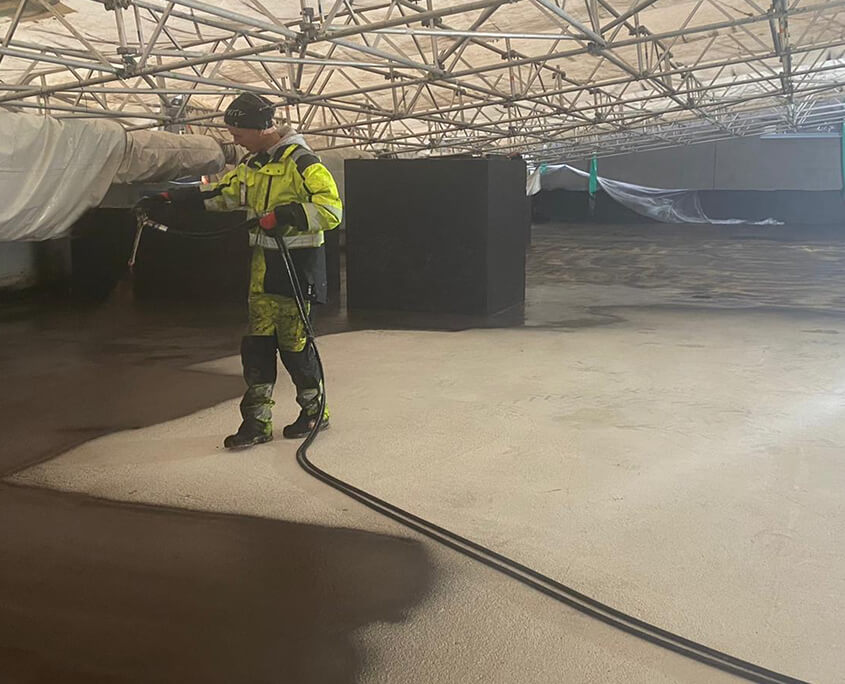
Large industrial roofs — typically 2,000m² to 50,000m²+ — require high-output application to be commercially viable. SprayGrade cold-spray achieves 600m²+ per day, making a 10,000m² industrial roof achievable within a two-to-three week programme. This minimises the live-site risk period and reduces production disruption. SprayGrade creates a seamless, fully-adhered waterproofing membrane across the entire roof area, sealing every lap joint, fastener position and detail in a single operation. For industrial roof owners, the commercial case is straightforward: a spray overlay at a fraction of replacement cost, with a project-specific manufacturer warranty, delivered without production shutdown.
TopSpray35 for industrial roofing requiring long-life protection
Where the primary requirement is long-life protective coating performance — particularly for UV resistance on south-facing metal roofs, or where a project-specific extended warranty is required for asset management purposes — TopSpray35 provides the specification alternative to SprayGrade. TopSpray35 is a Prokol spray-applied two-component aliphatic topcoat with UV resistance and weather performance. It provides a protective coating layer that prevents further corrosion and resists weathering over the existing substrate. System build-up, primer requirements and warranty conditions must be confirmed per project.
Why These Projects Fail
Most failures are preparation, sequencing or specification failures — not product failures.
Thermal movement cracking through rigid coatings
Metal portal frame roofing expands and contracts by 10–15mm per 10m length with temperature change. Rigid coatings cannot accommodate this movement and crack at lap joints and ridge positions. A movement-accommodating system must be specified — confirmed per project.
Lap joint failure and capillary action
Profiled metal roofing sheets overlap at laps. As fixings corrode and sealants age, laps open and close with thermal movement, drawing water through capillary action during rainfall.
Penetrating fastener failure
Self-drilling fixings corrode and the neoprene sealing washer deteriorates over time. Water enters at fixing heads before any visible failure appears on the coating surface.
Condensation from inadequate ventilation
Industrial buildings with high internal humidity — food production, washing facilities, heated warehouses — generate condensation on cold metal roofing. This condensation can saturate insulation and cause internal corrosion independent of external weather.
ACM panel delamination
Asbestos-containing roof panels that are delaminating or friable cannot be overlaid. ACM condition assessment is required before any industrial roof coating specification.
What Must Be Surveyed Before Specification
Specification cannot be confirmed without site survey. These are the minimum assessment requirements.
ACM / asbestos assessment
Any industrial roof with profiled sheets pre-1999 requires an ACM assessment before any works commence. If asbestos is confirmed in poor condition, specialist removal may be required before overlay.
Fixing and lap condition survey
Survey fixing heads for corrosion and washer condition. Probe lap joints for sealant integrity. Count and map areas of lap failure — these drive the preparation scope.
Purlin and structural condition
Check purlin condition at fixing positions — corrosion can compromise load-bearing capacity. Confirm sheet fixings still have structural integrity before applying overlay loads.
Internal condensation and moisture assessment
Measure internal moisture conditions and assess insulation saturation where access allows. Saturated insulation beneath metal cladding affects overlay suitability and must be addressed.
Fall and drainage assessment
Industrial roofs typically drain to gutters at eaves. Confirm gutter capacity, fall adequacy and downpipe condition. Gutter failure is common on industrial buildings and must be scoped alongside roof coatings work.
Warranties Are Conditional — Not Absolute
Manufacturer warranties depend on the following conditions being met. A warranty is only as strong as the preparation and specification that supports it.
ACM in acceptable condition
Overlay of ACM panels is only permissible when the panels are in stable, non-friable condition and ACM status is confirmed in the survey report. Overlay of deteriorating ACM is not permissible.
Structural integrity of fixings and purlins
Warranty applies to the coating system applied over a structurally sound substrate. Failed fixings or compromised purlins that allow sheet movement are a substrate failure, not a coating failure.
Appropriate coating system confirmed
Rigid coatings are not suitable for metal roofing thermal movement. A movement-accommodating system (SprayGrade or TopSpray35 within correct build-up) must be specified and confirmed per project. Warranty applies to the confirmed system only.
Question
Why do metal roof coatings crack?
Answer
Metal roofing structures experience significant thermal movement — steel expands and contracts with temperature change at approximately 12mm per 10m per 100°C temperature range. In northern England, annual temperature ranges of 40–50°C generate 5–6mm movement per 10m of metal. Rigid coatings cannot accommodate this movement. They crack at laps, ridges and fixing points — typically within 3–5 years of application. Coating systems specified for metal roofing must be assessed for their movement accommodation properties. This is a project-specific specification requirement — not a generic product label.
Operational Implication
Specifying a rigid coating on a metal roof is specifying a predictable failure. The crack pattern will be visible within years. Coating systems must be assessed and confirmed for movement accommodation before specification.
When Not Suitable
Any coating system not confirmed as suitable for the thermal movement characteristics of the substrate is not appropriate for steel or aluminium metal roof cladding. System suitability must be confirmed per project.
Specification Requirement
ACM assessment, structural condition survey, fixing and lap inspection, and movement-appropriate system specification before any industrial roof coating specification is confirmed.
System Pathways
Systems typically applicable to this topic. All recommendations subject to project assessment and substrate suitability.
High-output cold-spray waterproofing. Primary system for large industrial roof refurbishment.
Aliphatic protective topcoat for long-life industrial roof performance. Warranty conditions project-specific.
Hand-applied system for industrial gutter lining, ridge capping and penetration detailing.
Frequently Asked
Ready to progress your project?
Submit your project for a technical assessment. Our team will advise on the right system pathway, specification and applicator availability.