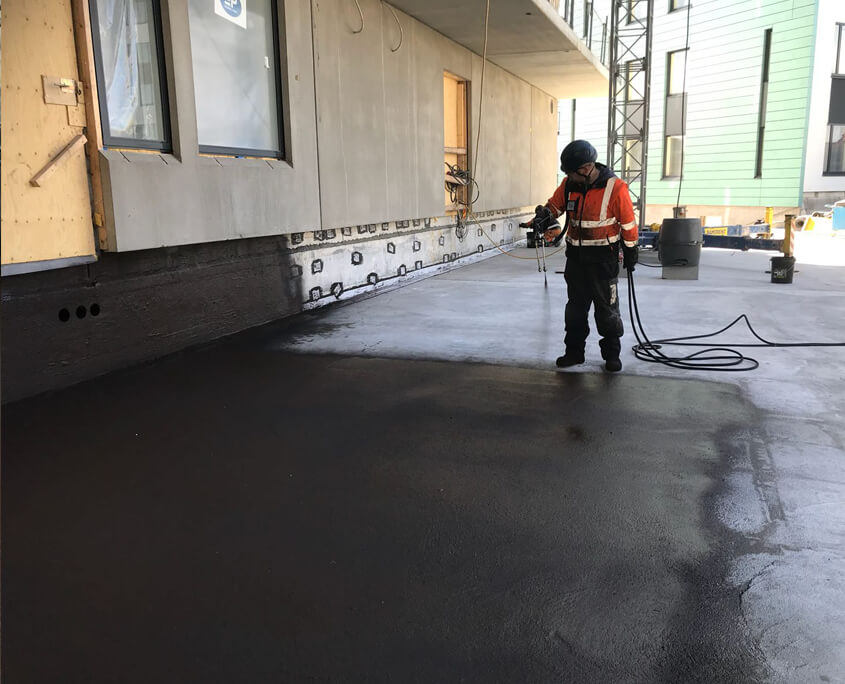
Industrial roofs present challenges at a different scale and operational complexity from standard commercial roofing. A leaking warehouse roof does not just create inconvenience — it threatens stock, equipment, production continuity, tenant relationships and asset value. A leaking factory roof on a food production or pharmaceutical line can trigger regulatory consequences. The consequence of getting a large industrial roof refurbishment wrong — selecting the wrong system, overlooking saturated insulation, underestimating preparation, or allowing a programme that cannot be completed within weather or operational windows — is disproportionately severe.
The most common industrial roof failure conditions encountered on UK commercial and industrial buildings are:
Profiled metal roofing — cut edge corrosion at sheet ends, side and end lap failures, fastener corrosion, surface oxidation, failed sealant beads, open joints at ridge and eaves, UV degradation, thermal fatigue cracking at fixing lines and isolated sheet perforation. Metal roofs degrade progressively — the condition that appears manageable at survey can be significantly worse when detailed access is established.
Felt and bituminous roofs — splitting, blistering, delamination at laps, failed flashings, blocked or overwhelmed drainage outlets, saturated build-up beneath an apparently intact surface layer, failed movement joints and inadequate falls leading to standing water. Felt condition is frequently underestimated from walkover survey alone.
Concrete and screeded flat roofs — cracking at construction joints and movement positions, surface carbonation, failed or absent waterproofing, plant and services penetration failures, drainage outlet deterioration and blocked or cracked internal drainage channels.
Asbestos cement roofing — fragility, surface degradation, physical damage, failed ridges and purlins, and the legal and practical constraints that govern any work on ACM in any condition. Asbestos cement must not be approached without a current licensed assessment.
Industrial gutters and valley gutters — corrosion at laps and joints, outlet blockage, reduced fall, structural failure and persistent standing water that concentrates corrosive material and accelerates surrounding sheet failure.
The interaction of multiple failure modes within a single large roof area is the defining feature of industrial roof refurbishment programmes. Assessment must address all of them — not just the most visible.
Programme planning for large industrial roofs is a distinct discipline. The principal considerations are:
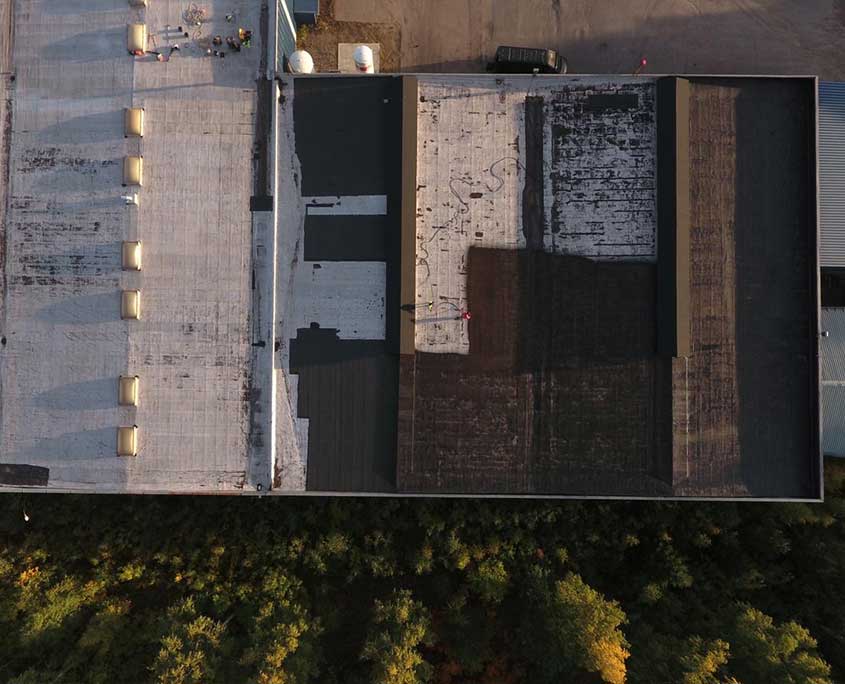
Roof zoning — large roofs are divided into work phases by structural bay, drainage zone or material type. Zoning allows the building to remain operational; only the active phase is under treatment while other zones remain intact and watertight.
Phased work — each phase requires its own preparation, priming and application sequence. Phase boundaries are designed at ridge lines, movement joints or structural breaks. Handover between phases requires quality-control inspection records before the next phase begins.
Operational continuity — most industrial roof refurbishments are carried out over occupied, operating buildings. Access routes, loading bays, emergency exits and operational processes must remain functional throughout. Daily programme co-ordination with the building operator is essential.
Access and edge protection — industrial roofs require edge protection and, on fragile surfaces, purpose-designed walkway systems. MEWPs, scaffold or roof-edge rails must be confirmed before work begins. Access for spray equipment hose runs on large roofs requires specific logistics planning.
Plant and penetrations — extraction units, plant rooms, pipe penetrations, rooflights and services entries must each be detailed individually. Plant shutdowns for access may need to be co-ordinated with operations. Penetration count and complexity materially affect programme duration.
Material storage and deliveries — large-format spray programmes require staging areas for material deliveries and equipment. On busy industrial sites, delivery co-ordination and material storage must be agreed before the programme begins.
Weather windows — cold-applied liquid rubber cannot be applied below 5°C, in wet conditions or onto damp surfaces. Large-format industrial roof programmes require confirmed weather windows. Seasonal programme planning avoids weather-related delays.
Overspray control — spray application near open skylight positions, adjacent structures or public areas requires specific overspray management. Wind conditions must be assessed before and during spray stages.
Internal protection — even with overspray controls, sensitive internal processes, stock, machinery or food production lines may require additional internal protection during spray stages. This must be agreed with the building operator before work begins.
Fragile-roof controls — industrial roofing frequently contains fragile elements — asbestos cement panels, older rooflights, areas of underpurlined sheeting. Fragile-roof controls under CDM and Working at Height regulations must be in place before any access proceeds.
Interface with other trades — roof refurbishment commonly runs alongside cladding, gutter, rooflight or M&E works. Programme sequencing with other trades must be agreed to avoid contamination, access conflicts or cure interval interference.
Quality-control hold points — pre-application moisture readings, primer application records, wet-film thickness checks, detail photographic records and final inspection sign-off are all mandatory hold points. Records must be completed contemporaneously, not retrospectively.
Inspection records and handover — a complete quality-control file, including all inspection records, batch certificates, coverage data and photographic evidence, forms the warranty application package and the building owner's asset record.