
Spray-Applied Waterproofing Guide
Spray-applied waterproofing systems — specifically cold-applied liquid rubber spray and high-output protective coating systems — are the primary solution for large commercial and industrial roof waterproofing. This guide explains how spray-applied systems work, what substrates they suit, what output rates to expect, and how SprayGrade and TopSpray35 differ.
This guide covers
Spray-applied waterproofing systems for commercial and industrial roofs — how they work, system comparison, substrate requirements, and programme output.
Written for
Contractors, facilities managers, project managers and specifiers planning large-format commercial roof waterproofing.
Systems referenced
SprayGrade, TopSpray35
What is cold-spray liquid rubber waterproofing?
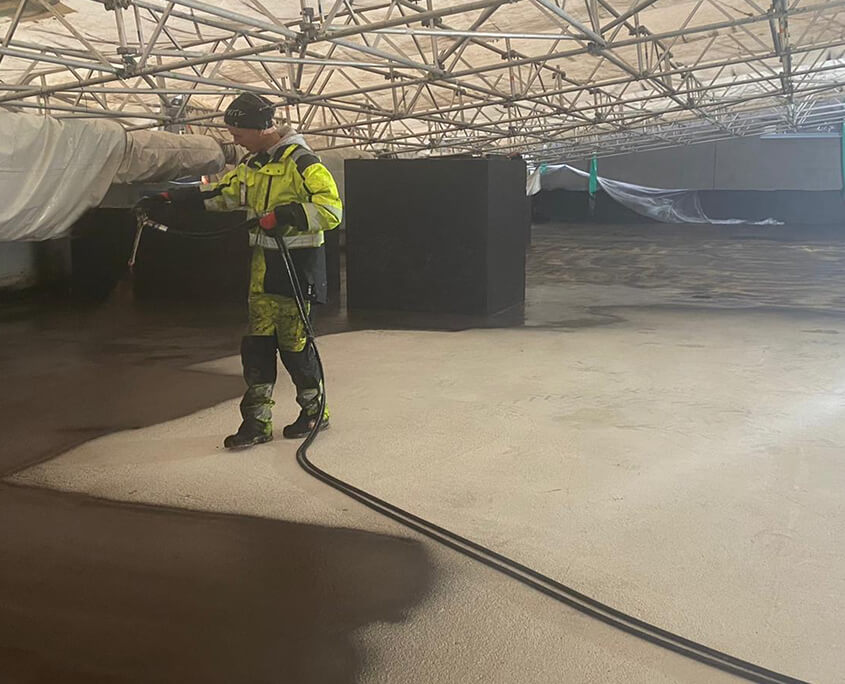
Cold-spray liquid rubber is a waterproofing system in which the liquid rubber membrane material is applied to the roof substrate using specialist spray equipment, building up a consistent membrane thickness across the entire roof area in a single operation. The system is 'cold-applied' — no heat, flames or gas equipment are required. This makes it significantly safer than hot-applied systems and eliminates the fire risk associated with torched-down membranes. The spray process creates a seamless, fully-adhered membrane with no laps, joints or overlaps — the primary failure points in traditional roofing systems.
SprayGrade vs TopSpray35: understanding the distinction
SprayGrade is a Liquid Rubber cold-applied spray system. Its primary function is to create a seamless waterproofing membrane. It bonds directly to the substrate and cures to form a flexible, waterproof barrier. TopSpray35 is a Prokol two-component aliphatic protective topcoat. Its primary function is to provide long-life UV resistance and weather performance within a documented coating system. While TopSpray35 provides protective coating performance, its system architecture, chemistry and role are different from SprayGrade. The choice between the two systems depends on the primary performance requirement: seamless waterproofing membrane (SprayGrade) or long-life aliphatic UV-stable protection (TopSpray35). Both are high-output spray systems applied by trained approved applicators.
Output rates and programme planning
SprayGrade cold-spray system achieves 600m²+ per day in suitable conditions. This makes it viable for large industrial and commercial roofs — a 10,000m² roof could be completed within two to three weeks, including preparation and priming stages. TopSpray35 has comparable spray output capacity. Programme planning must account for: substrate preparation time (often the most significant variable), weather windows (no application below 5°C or in wet/wet-forecast conditions), access time (scaffold erection, MEWP mobilisation), and any required inspection or inspection hold points within the application sequence.
Substrate requirements for spray-applied systems
Spray-applied systems require substrates that are clean, dry, structurally sound and free from contamination. Metal substrates must have loose rust removed and surface-treated with appropriate primer. Concrete and asphalt substrates require dust removal, degreasing and primer application. Felt substrates require assessment for blistering, delamination and moisture content before overlay. The spray nozzle must maintain consistent distance and angle for even membrane build-up — complex roof geometries, multiple penetrations and restricted access areas may require hand-applied detailing around intricate features. This is where HBS200 complements the spray system.
When spray is not appropriate
Spray-applied systems are not appropriate for all situations. Very small roof areas (under 200m²) may not justify the mobilisation cost of spray equipment — hand-applied HBS200 is typically more cost-effective at smaller scale. Roofs with extremely complex geometry, many penetrations, or restricted access may require a higher proportion of hand-applied detailing. Roofs in close proximity to occupied areas, vehicles or sensitive equipment require careful overspray management. Adverse weather — wind, rain, frost — halts spray application. These factors should be assessed at the programme planning stage.
Field Observations
Fast spray application does not reduce preparation time.
600m²/day is the application rate. Preparation — cleaning, degreasing, moisture testing, priming, repairs — routinely takes longer than the spray itself. The programme is dominated by preparation, not output.
Metal roofs rarely fail uniformly. Failure concentrates at fixings, laps and ridge details.
The field area between sheet laps is usually the last place to fail. Surveyors who walk the field area and miss the lap and fixing positions miss where the problem actually is.
Overspray on occupied buildings and vehicles requires planning, not improvisation.
Spray equipment produces fine mist that travels in wind. This is not a surprise on the day — it requires access planning, exclusion zones and weather window management at project outset.
Detailing scope is frequently underestimated at tender and dominates on-site time.
100 roof penetrations can take as long to detail as 2,000m² of field area to spray. Detailing must be counted and priced at survey — not estimated as a percentage of the field area.
Weather windows in northern England between October and March average 3–4 suitable spray days per week.
This is not a theoretical risk. Programmes without weather buffer in autumn and winter routinely overrun. October starts are borderline; November starts should have a contingency plan.
Insulation saturation beneath surface membranes is the most commonly missed pre-spray survey finding.
Moisture meters read the surface. Saturated PIR beneath an apparently dry felt surface does not show. Probe sampling at suspect low points is the only reliable method.
What Spray Project Planning Usually Uncovers
Current Condition
Large industrial roof — spray proposed
Next Reality
Preparation programme becomes the project constraint
Commercial Implication
Spray takes 3–5 days. Preparation takes 2–3 weeks. Compressing preparation introduces the most common spray failure mode
Required Decision
Preparation programme must be scoped, costed and scheduled as a separate phase before spray mobilisation
Current Condition
Metal roof scheduled for spray in autumn or winter
Next Reality
Weather window availability becomes programme driver
Commercial Implication
North England spray windows average 3–4 suitable days per week Oct–March. A 10,000m² roof needs 17+ spray days. Without weather buffer, overrun is certain
Required Decision
Weather contingency of 30–40% must be built into autumn/winter spray programmes
Current Condition
Active corrosion found during preparation
Next Reality
Treatment requirement changes specification and cost
Commercial Implication
Mechanical preparation (wire brush) is insufficient for active corrosion — treatment product required. This is not always priced at tender
Required Decision
Corrosion treatment scope must be quantified during preparation phase — not assumed at tender
How Spray Project Failures Develop
Observation
Programme compressed — preparation time reduced by 5 days to meet deadline
Substrate not fully dried after recent rainfall
Spray applied to marginal moisture — surface appears acceptable
Blistering develops within 3 weeks across 3,000m² of field area
Building operator reports water ingress — incorrect diagnosis initially
Full extent of blistering confirmed at post-application inspection
How It Usually Ends
Strip-out of 3,000m². Substrate drying — 3 weeks in October. Remobilisation. Temporary waterproofing on occupied site. Programme overrun — 7 weeks. Cost to client: £120,000+ above contract value.
Observation
Lap positions wire-brushed but not treated — active corrosion missed
Spray applied — visually complete and accepted
Corrosion continues beneath membrane at lap positions
Rust bleed-through visible at 40 lap positions after 14 months
Warranty position reviewed — active corrosion treatment not documented
Membrane removal required at all affected laps
How It Usually Ends
Partial re-specification. Active corrosion treatment. Resprayed laps. Warranty disputed — preparation standard not confirmed at installation.
Why These Projects Fail
Most failures are preparation, sequencing or specification failures — not product failures.
Wet substrate at application
The leading cause of spray-applied system failure. Moisture above 15% prevents adhesion and creates vapour pressure beneath the membrane. Blistering appears within weeks of application.
Insufficient preparation on metal substrates
Oils, waxes and surface coatings on metal roofing prevent spray rubber from bonding. Oil-contaminated metal roofing must be cleaned with appropriate degreasers before application.
Inadequate detailing at spray boundaries
Spray application covers the field area efficiently — but does not replace hand-applied detailing at gutters, penetrations, upstands and parapets. These details require HBS200 applied by hand before or after spray application.
Weather window failures
Spray application in rain or wet conditions compromises the membrane. Programmes that do not account for weather windows produce failed applications and aborted spray runs.
Spray angle and distance errors
Consistent spray angle and distance are required for even membrane build-up. Application errors create thin spots that provide lower waterproofing performance than the warranted specification.
What Must Be Surveyed Before Specification
Specification cannot be confirmed without site survey. These are the minimum assessment requirements.
Substrate moisture assessment
Moisture meter readings across the entire roof, not spot-checks. Identify drainage zones, low points and areas with standing water history. Test result must be confirmed below threshold before spray is mobilised.
Roof access and spray equipment logistics
Spray systems require hardstanding for equipment, power supply (electrical or diesel), hose runs of up to 30m+, and clear travel paths across the roof. Access logistics must be confirmed at survey stage.
Detailing complexity audit
Count and map all roof penetrations, gutters, upstands, parapets, and abutments. These determine the hand-applied detailing scope that must be priced alongside the spray application programme.
Existing substrate compatibility
Identify existing roofing material type and any surface treatments. Felt, asphalt, metal and concrete each require different primer systems. Incompatible surface treatments must be identified and removed.
Drainage assessment
Falls, gutter capacity, outlet positions and drainage adequacy must be confirmed. Spray application does not resolve drainage failures — and inadequate drainage accelerates membrane degradation post-application.
What Must Be Established Before Specification
Visual inspection alone is insufficient. This is what a competent survey actually covers.
What Surveyors Look For
Moisture distribution across full roof area
Grid-pattern moisture readings at regular intervals — not just perimeter and outlet areas. Drainage zones and low points require denser reading coverage. A single pass of the roof surface is not an adequate moisture survey.
Surface contamination on metal roofing
Oil, wax, and release agents on metal roof sheets are common and not always visible. Run a rag over the surface — contamination will transfer. This is a preparation requirement that affects specification scope.
Spray equipment access feasibility
Can the spray rig reach the roof? Is there hardstanding? What is the hose run length? These are not afterthought questions — they affect whether spray application is achievable and at what cost.
Detailing complexity before spray scope is priced
Every penetration, gutter junction, upstand and parapet requires hand-applied detailing. Count them at survey stage — the detailing scope can represent 30–40% of project time on complex roofs.
What Usually Gets Missed
Insulation saturation beneath surface membranes
Spray applied over saturated insulation creates a system that will fail prematurely. Moisture meters read the surface condition — not the insulation below. Suspect areas require probe sampling.
Active corrosion at metal laps beneath surface coatings
Maintenance coatings on metal roofing can conceal progressive corrosion. The surface looks coated and stable. But corrosion product expansion beneath is breaking adhesion. Only probe or peel-back confirms active corrosion.
Drainage fall accuracy across large areas
Surveyors assess gutters and outlets. They often miss the effective drainage fall across the full field area — particularly on large, flat roofs where 100mm of cumulative deflection creates permanent ponding invisible from the perimeter.
Cannot Be Confirmed Visually
Insulation saturation beneath existing membrane — requires probe sampling
Active corrosion status beneath maintenance coatings — requires peel-back or probe
Accurate drainage fall across full area — requires level survey
Spray equipment access constraints — requires site visit with equipment specification in hand
Existing coating chemical composition — requires product identification from maintenance records
When Intrusive Investigation Becomes Necessary
When moisture readings are elevated and the source is not identifiable from surface evidence
When maintenance coatings conceal the substrate condition beneath
When the deck specification is unknown and structural loading cannot be assumed
When there is evidence of internal water ingress without identifiable external failure path
How Failure Actually Appears on Site
What you find during survey and what it means for specification.
Widespread blistering within weeks of spray application
Spray membrane has separated from the substrate. Vapour pressure from trapped moisture is driving the membrane upward.
Cause
Substrate was above moisture threshold at time of application. Spray was mobilised on a survey-stage reading that had become invalid after subsequent rainfall.
What Happened Earlier
Moisture testing was carried out at survey, not on application day. Application proceeded based on results taken days or weeks earlier.
Overlay Not Possible
Blistered membrane must be removed. Substrate must be dried to threshold and retested on the day of reapplication. This is a remediation project.
Cracking at profiled metal lap joints and ridges
Thermal movement in the metal roof deck is cracking the spray membrane at points of concentrated movement.
Cause
Rigid or insufficiently elastomeric coating applied over metal that moves 5–8mm per 10m with temperature change. Movement joint treatment at laps was not included in the specification.
What Happened Earlier
Metal roofing movement characteristics were not assessed. The spray system was specified without lap treatment detail.
Overlay May Be Possible
Remove spray at cracked zones. Apply lap sealing treatment, incorporate movement accommodation, and respray. Confirm appropriate system specification for movement-affected substrates with technical team.
Localised delamination at gutter and parapet junctions
Spray membrane has not bonded at the junction with vertical elements. This is where thermal movement and water pressure combine.
Cause
Hand-applied detailing at junctions was not completed before or after spray application. The spray passed over the junction but did not achieve the adhesion required at the angle change.
What Happened Earlier
Detailing scope was not priced or sequenced into the programme. Spray application was completed without confirming detailing stage.
Overlay May Be Possible
Field area spray may be sound. Hand-apply HBS200 at all junction positions. Confirm primer compatibility before application.
What Remediation Usually Involves
Spray system remediation on large roofs is commercially significant. The scale that makes spray application cost-effective on large roofs is the same scale that makes remediation expensive — the problem is spread across a large area.
Spray rig remobilisation
Spray equipment must be remobilised for reapplication. This is a fixed mobilisation cost regardless of the area being resprayed — disproportionate on small remediation areas.
Strip-out on blistered areas
Failed membrane must be removed. On large roofs this is a significant operation — labour-intensive, creating an unprotected area that requires temporary waterproofing until reapplication.
Substrate drying before respray
Exposed substrate must reach moisture threshold before respray. In autumn/winter conditions in northern England, this requires active drying measures and introduces programme uncertainty.
Programme disruption to occupied building operations
Original programme dates for roof access restrictions, car park closures and plant room isolation must be rescheduled around the remediation programme — with associated cost and disruption.
Why Warranties Get Rejected
Moisture not confirmed on application day
The most common rejection reason. Survey-stage readings are not the qualifying condition. Application day moisture must be confirmed within threshold.
Equipment not calibrated to specification
Spray systems must deliver consistent film thickness within manufacturer tolerances. Mis-calibrated equipment that produces underthin coverage affects warranty eligibility.
Detailing not completed at all terminations
Field area warranty does not cover failures at penetrations, gutters and parapets where hand-applied detailing was not completed to specification.
Active corrosion not treated before spray
Application over active corrosion — even when mechanically prepared — does not achieve a warranted installation. Corrosion treatment is a prerequisite.
Warranties Are Conditional — Not Absolute
Manufacturer warranties depend on the following conditions being met. A warranty is only as strong as the preparation and specification that supports it.
Substrate moisture at application
Application must occur when substrate moisture is below threshold. Spray applied to wet roofing does not qualify for manufacturer warranty — regardless of product quality.
Equipment calibration and output
Spray systems must be calibrated to deliver consistent film thickness within specification tolerances. Application with mis-calibrated equipment affects coverage rates and warranty eligibility.
Full specification sequence
Primer application, coat sequence, coverage rates and cure time must all comply with the manufacturer's published specification. Shortcuts in any stage affect warranty position.
Detailing completion
Field-area warranties do not cover detailing failures at penetrations and upstands. Detailing must be completed to manufacturer specification — typically using hand-applied HBS200 around all terminations.
Question
What is cold-spray liquid rubber waterproofing?
Answer
Cold-spray liquid rubber is a waterproofing system where liquid rubber is applied by specialist spray equipment to create a seamless, fully-bonded membrane without joints or overlaps. It is cold-applied — no heat or flame — making it safer than hot-applied alternatives. SprayGrade achieves 600m²+ per day, making it viable for large commercial and industrial roofs. TopSpray35 is a different system — a spray-applied aliphatic protective topcoat with different chemistry and function.
Operational Implication
High output (600m²+/day) changes the programme economics on large roofs. Preparation dominates the programme, not application. A 10,000m² roof may take 2–3 weeks preparation and 3–5 days spray application.
When Not Suitable
Spray application is not economical on areas below 200m². Access-restricted areas, extremely complex geometry and high-overspray-risk locations may require hand-applied systems instead.
Specification Requirement
Substrate moisture assessment, access logistics confirmation, detailing scope audit and applicator mobilisation planning — all before programme dates are committed.
Connected Knowledge — Spray System Context
Spray-applied waterproofing exists within a network of preparation decisions, programme constraints, weather realities and detailing requirements. These are the adjacent topics that change how spray projects are planned and specified.
Why Trapped Moisture Destroys Spray Overlays
Spray application over substrates above moisture threshold is the single most common cause of spray system failure — blistering within weeks of application.
Why Metal Roof Coatings Fail Prematurely
Active corrosion beneath maintenance coatings is the most commonly missed pre-spray finding. It changes the specification and the cost.
Why Preparation Failures Invalidate Warranties
Application day moisture, active corrosion treatment and applicator approval are the three most common reasons spray system warranties are challenged after installation.
Why Detailing Determines Roof Lifespan
Spray covers the field area. The junctions — penetrations, gutters, parapets — require hand application. Detailing scope determines how long the spray membrane performs.
SprayGrade — Cold-Spray Liquid Rubber
600m²+ per day. The primary waterproofing membrane system for large commercial and industrial roofs. Substrate and programme assessment required.
TopSpray35 — Aliphatic Protective Topcoat
Two-component aliphatic topcoat for UV resistance and long-life protection. Different system, different function — applied over SprayGrade or existing sound membranes.
HBS200 — Detailing Complement
Hand-applied liquid rubber for all gutter, penetration and perimeter detail work that spray cannot reach or adequately cover.
Manchester — Logistics Warehouse Scale
Manchester's logistics estate — frequently 5,000m²+ roof areas — is the context where spray application's output advantage is most commercially significant.
Yorkshire — Industrial Roof Stock
Yorkshire's manufacturing and logistics buildings are a consistent source of large-format spray refurbishment projects.
System Pathways
Systems typically applicable to this topic. All recommendations subject to project assessment and substrate suitability.
Cold-spray liquid rubber waterproofing. 600m²+ per day. Up to 25-year system warranty.
Aliphatic protective topcoat for suitably prepared metal roofing and cladding — substrate condition, preparation and primer must be confirmed.
Complementary hand-applied system for detailing around penetrations and intricate features.
Frequently Asked
Ready to progress your project?
Submit your project for a technical assessment. Our team will advise on the right system pathway, specification and applicator availability.