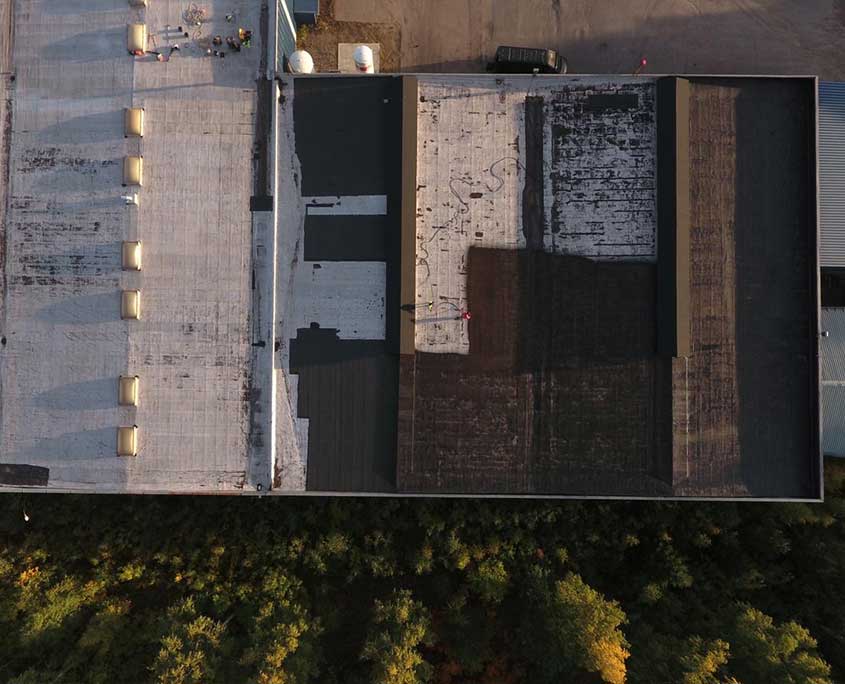
Cold-applied liquid rubber overlay being applied to commercial roof without strip-out
Roof Overlay and Replacement Assessment

Commercial Roof Overlay Systems

The assessment determines the route — not the budget

Overlay, partial replacement, comprehensive refurbishment and re-roofing are different responses to different findings. Specifying overlay on an unassessed or wet substrate does not produce an overlay — it produces a premature failure.

Roof overlay systems apply a seamless waterproofing membrane directly over an existing roof without strip-out — where the substrate has been assessed and confirmed suitable. The decision between localised repair, partial replacement and repair, liquid-applied roof overlay,…

The Problem

When a commercial or industrial roof reaches the point of persistent water ingress or failing waterproofing performance, the procurement decision is typically framed as a binary: repair or replace. In practice, the range of appropriate responses is broader — and the correct choice depends on what the assessment finds across the full roof build-up.

The five routes are distinct, not a sliding scale:

Localised repair addresses isolated defects — failed laps, blocked outlets, cracked details, individual sheet failures — while the wider roof remains serviceable. It does not address the underlying condition of the roof build-up and is not a substitute for a condition assessment.

Partial replacement and repair removes and replaces failed sheets, saturated insulation zones, defective details or drainage components while retaining serviceable areas. This is appropriate where discrete zones have failed beyond overlay candidacy but where the wider roof is sound. It is not merely overlay with extra work — it involves strip-out, disposal and reconstruction in the failed zones.

Liquid-applied roof overlay applies a compatible waterproofing or protective system over a suitable retained roof surface following full assessment and preparation. Overlay is appropriate only where the substrate is confirmed sound and dry, drainage is adequate, the existing roofing is compatible with the proposed system, and detailing scope is within the overlay programme.

Comprehensive roof refurbishment is a wider programme combining preparation, local replacement, gutter or drainage work, rooflight treatment and a specified coating or membrane across multiple roof zones. It is not another name for overlay. It may include elements of partial replacement, drainage redesign, structural repair and overlay within a single coordinated programme.

Complete roof replacement is appropriate where the existing build-up, substrate or structure cannot justify retention — whether for structural, moisture, thermal, drainage or lifecycle reasons. Overlay cannot be specified as an alternative to replacement where the conditions for overlay are not met.

The visible surface of a roof is an unreliable guide to the condition of the build-up beneath it. A felt roof that looks intact at the surface may have saturated insulation across a significant proportion of its area. A concrete deck that appears sound may have active cracking at screed level. A metal roof that appears dry may have moisture tracking under failed lap sealants. A dry surface does not prove the underlying build-up is dry — assessment requires investigation, not inspection.

Apparent surface condition alone cannot establish overlay suitability. Assessment may require moisture surveying, core sampling, local opening-up, insulation inspection, vapour-control-layer investigation, deck inspection, existing membrane identification, adhesion testing and test areas. The appropriate scope of investigation depends on the roof type, age, build-up composition and the consequences of a missed moisture zone.

Before You Specify
  • Substrate survey required before specification — not optional
  • Application by trained approved applicators is a warranty condition
  • Coating over a failing or saturated substrate will fail — usually within a year
  • Preparation shortcuts invalidate manufacturer warranties
System Pathways

The Right System for This Application

Liquid Rubber
Prokol

MonoSeal

MonoSeal is a cold-applied pure-polyurea waterproofing membrane developed for seamless flat-roof waterproofing — a different technology from the liquid-rubber systems, with its own substrate requirements, primer specification and application conditions. Suitable substrates and primers confirmed from the approved system documentation. Rapid return to foot traffic where approved conditions are achieved. System build-up and warranty requirements confirmed per project.

View Full System

Rocathaan HotSpray

Rocathaan HotSpray is a hot-spray pure-polyurea waterproofing system — applied at elevated temperature via plural-component heated equipment, achieving gel times of approximately 12–15 seconds and rapid return to service. Suited to large-area industrial and commercial overlay applications where speed of application and seamless monolithic performance are the primary requirements. Substrate assessment, primer specification and approved build-up must be confirmed per project. Not a cold-applied system — specialist heated equipment and trained applicators required.

View Full System

TopSpray35

Rocathaan TopSpray35 may be considered as a spray-applied protective coating within suitable metal-roof refurbishment specifications. It is not presented as a generic waterproofing overlay for felt, asphalt, concrete or unidentified existing membranes. Two-component, aliphatic, UV-stable. Available in RAL colours according to the manufacturer's current colour overview; other colours may be available on a project basis and by request. Any warranty position is project-specific and depends on the substrate, preparation, complete system build-up, application records and manufacturer acceptance. See Metal Roof Coatings for substrate-specific guidance.

View Full System
Applied in the Field
SprayGrade cold-spray overlay — large industrial flat roof

SprayGrade cold-spray overlay — large industrial flat roof

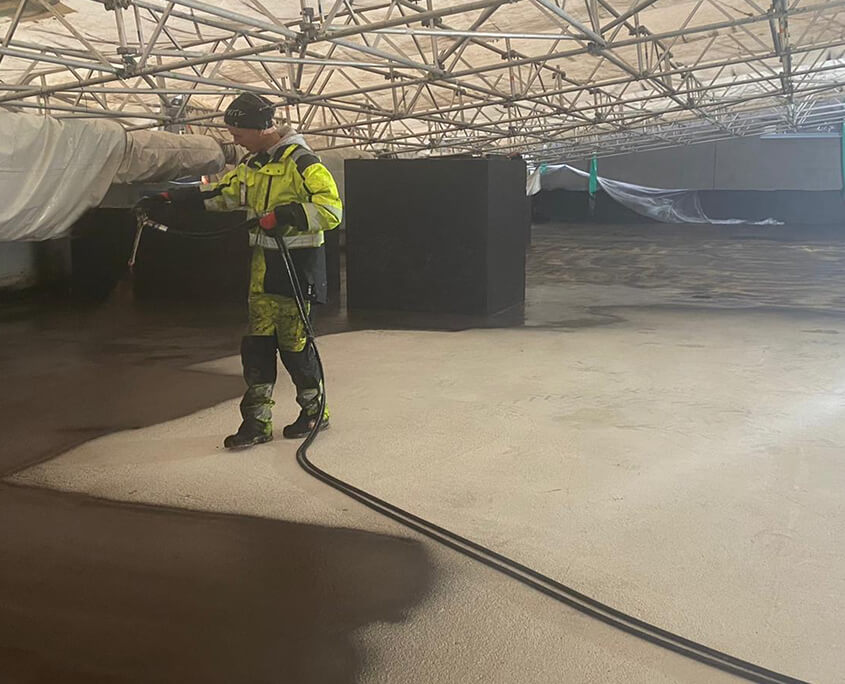
Seamless liquid rubber membrane over existing felt substrate

Seamless liquid rubber membrane over existing felt substrate

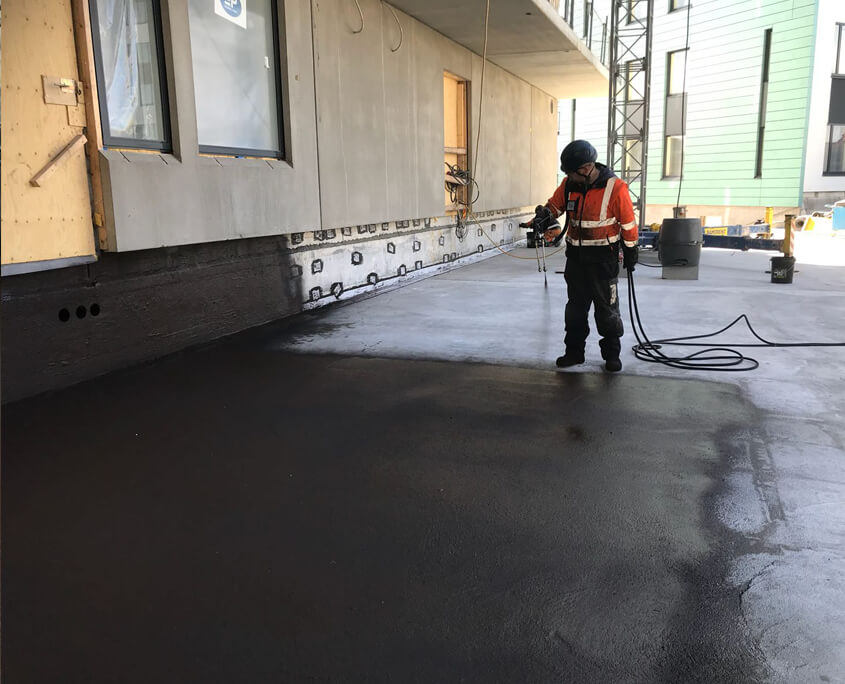
Commercial spray application — occupied building, no strip-out

Commercial spray application — occupied building, no strip-out

Specification Logic

What Each Assessment Finding Leads To

The five routes are not options to choose between — they are outcomes of the assessment. These paths describe what different findings lead to, and why.

Felt, modified bitumen or asphalt flat roof — substrate confirmed sound, insulation confirmed dry by measurement, falls adequate, laps failing or surface degradedWater ingress at lap and joint positions. The full build-up assessment confirms the insulation layer is sound and dry. Strip-out would require building vacation and significant cost.Liquid-applied roof overlay — seamless cold-applied membrane over the confirmed-suitable substrate without strip-outHBS200 or SprayGrade

Why This System Fits

Where the full assessment confirms the substrate is suitable, HBS200 may be considered for hand-applied overlay on smaller or more complex areas. SprayGrade may be considered for larger accessible field areas. These are different technologies — where used within the same project, the build-up must be confirmed, interfaces designed and the specification must define each product's role. All detail positions, upstands, outlets and penetrations require individual assessment and confirmed specification regardless of field-area methodology.

What Still Needs Verifying

Core sampling or moisture probing at representative positions — not just at reported leak locations. Previous treatments, patches and additional overlay layers must be identified and assessed for compatibility. Falls must be confirmed adequate. Primer and reinforcement requirements confirmed for the specific substrate and approved build-up.

Metal industrial or commercial roof — sheets structurally sound, no perforation, fixing lines functional though surface-corroded, UV-degraded factory coat, lap sealants failedSheet integrity confirmed. Replacement not justified on cost-benefit. The primary requirement is long-cycle surface protection with movement accommodation at fixings and laps.Spray-applied UV-stable protective coating for metal — substrate, primer and approved build-up confirmedTopSpray35

Why This System Fits

Rocathaan TopSpray35 may be considered as a spray-applied protective coating within suitable metal-roof refurbishment specifications. It is not a waterproofing membrane and is not presented as a generic flat-roof overlay. Active corrosion at fixings must be treated to specification before application. Silicone-based lap sealants must be removed — not overcoated. Primer confirmed for the specific substrate and approved build-up. Where waterproofing membrane is also required on the metal roof, SprayGrade may be considered for suitable areas — build-up confirmed against the approved specification.

What Still Needs Verifying

Cut-edge corrosion at sheet edges must be assessed and treated. Any previously applied coatings must be assessed for adhesion and compatibility. Adhesion testing before full programme commitment is standard practice on previously treated or contaminated metal substrates. See Metal Roof Coatings for the full substrate-specific assessment framework.

Large mixed-condition commercial roof — some zones confirmed sound and dry, other zones with saturated insulation, failed sections or extensive detailing defectsA uniform overlay approach would include zones that are not overlay candidates. A full re-roofing approach would replace areas that remain sound.Comprehensive refurbishment — zoned assessment leading to partial replacement of defective areas combined with overlay of confirmed-sound zonesZoned approach — confirmed per zone

Why This System Fits

Partial replacement of the most-defective zones — where insulation is saturated, deck is degraded or detailing is irreparable — combined with cold-applied overlay of remaining confirmed-sound areas. This is a comprehensive refurbishment programme, not simply overlay with exceptions. Each zone requires independent assessment and specification. The boundary between replacement and overlay zones must be established by investigation. Transition detailing between replaced and overlaid sections must be designed and specified. No system is specified across the full roof without zone-specific assessment.

What Still Needs Verifying

The zone boundary must be established by investigation — core sampling, probing or opening-up — not by visual inspection alone. Drainage must be assessed and any inadequate falls addressed within the programme scope. Each zone's moisture status, substrate condition and detailing scope confirmed before the final specification.

Not sure if this system fits your project?

Send substrate type, failure description and photos. We'll confirm the right system and flag warranty risks before you commit.

Common Questions

Specification Questions

Technical Enquiry

What is a roof overlay system?

A roof overlay system applies a new seamless waterproofing membrane directly over an existing roof — without removing the existing roofing material. The existing roof becomes the substrate. This eliminates strip-out costs, waste disposal obligations and the operational disruption of a full re-roofing programme — where the assessment confirms the existing roof is a suitable candidate. Overlay is not applicable to every roof. The assessment determines whether the route is viable.

What is the difference between overlay, partial replacement, comprehensive refurbishment and complete re-roofing?

These are distinct responses to different assessment findings — not a sliding scale of cost. Localised repair addresses isolated defects while the wider roof remains serviceable. Partial replacement and repair removes and replaces failed sheets, saturated insulation zones or defective details while retaining serviceable areas — it involves strip-out and reconstruction in the failed zones. Liquid-applied roof overlay applies a compatible system over a confirmed-suitable retained roof surface following full assessment and preparation. Comprehensive roof refurbishment is a wider coordinated programme combining preparation, local replacement, gutter work, rooflight treatment and membrane application across multiple zones — not another name for overlay. Complete roof replacement is appropriate where the existing build-up, substrate or structure cannot justify retention. The assessment determines which combination is appropriate — they are not interchangeable choices.

When is roof overlay appropriate?

Overlay is appropriate where: the existing roof structure is sound with no structural cracking or deck movement; the insulation is confirmed dry — by measurement, not estimation; falls are adequate to prevent persistent ponding; the existing roofing material is compatible with the proposed overlay system; and detailing at upstands, outlets, penetrations and parapets can be addressed within the overlay programme. All conditions require confirmation by assessment. Overlay on a dry but structurally failing deck, or on a sound but saturated deck, will fail.

When is overlay not appropriate?

Overlay is not appropriate where: the structural deck is deflecting, cracking or failing; the insulation is saturated; there is unresolved moisture in the build-up regardless of surface condition; the existing waterproofing is extensively delaminated; drainage falls are inadequate; outlets are defective or undersized; widespread detailing defects cannot be addressed within the overlay programme; unstable historic coatings cannot be stabilised; contamination cannot be fully removed; the build-up composition is unknown; failed vapour-control layers are contributing to trapped moisture; or the overall extent of defects makes a warranted overlay outcome unlikely. The full suitability assessment determines the correct route.

Why does apparent surface condition not establish overlay suitability?

A dry surface does not prove the underlying build-up is dry. A felt roof that looks intact at the surface may have saturated insulation distributed across a significant area. A concrete deck that appears sound may have active cracking at screed level. A metal roof that appears dry may have moisture tracking under failed lap sealants. Historic repairs, patch bonding and previous overlay layers introduce composition and compatibility unknowns that visual inspection cannot resolve. Assessment may require moisture surveying, core sampling, local opening-up, insulation inspection, vapour-control-layer investigation, deck inspection, existing membrane identification, adhesion testing and test areas — the appropriate scope depends on the roof type, age and build-up history.

Can felt roofs be overlaid?

Yes, on suitable substrates. Where the felt is well-bonded, the insulation beneath is confirmed dry and falls are adequate, HBS200 or SprayGrade may be considered for overlay. Core sampling at representative positions across the roof is the standard method for moisture investigation — not just near reported leak positions. Where the felt is extensively delaminated, blistered or saturated, or where the insulation condition is unknown, overlay is not appropriate.

Can metal roofs be overlaid?

Yes, where sheets are structurally sound, not perforated and the substrate is confirmed suitable. On metal roofs where the primary requirement is long-cycle surface protection, Rocathaan TopSpray35 may be considered as a spray-applied protective coating within a suitable metal-roof refurbishment specification — subject to substrate assessment, preparation to specification and approved build-up confirmation. TopSpray35 is a protective coating, not a waterproofing membrane. Where a waterproofing membrane is also required, SprayGrade may be considered for suitable areas — the build-up confirmed against the approved specification. See Metal Roof Coatings for the full substrate-specific assessment framework.

Can concrete roofs be overlaid?

Yes, where the concrete deck is sound and the proposed system is confirmed for the specific substrate and condition. Concrete preparation is critical — laitance, contamination and carbonated surface layers must be removed mechanically. Structural cracks require investigation to determine whether deck movement is active — a surface membrane cannot bridge active structural movement. Where carbonation has contributed to concrete deterioration, repair of defective areas may be required before overlay. Primer requirements must be confirmed for the specific system and substrate.

Can existing liquid membrane roofs be overlaid?

Not automatically — and not without structured assessment. Existing liquid membranes require product identification, compatibility review, removal of loose or degraded material, cleaning, abrasion, primer trials, adhesion testing and test areas before any overlay can proceed. Universal adhesion to unknown historic membranes cannot be assumed. Where the existing system type is unknown, a test area is required to confirm compatibility before committing the full programme.

What does wet insulation mean for an overlay project?

Saturated insulation is the primary reason overlay projects fail prematurely. Applying a sealed waterproofing membrane over saturated insulation traps moisture within the build-up permanently. As the roof heats in summer, trapped moisture becomes water vapour — and vapour pressure beneath the membrane causes blistering and delamination, typically within the first summer. A membrane that blisters has debonded and is no longer waterproof at the blister positions. Saturated insulation is not a problem that overlay resolves — it is a condition that makes overlay inappropriate until the insulation is confirmed dry.

What moisture investigation is required before overlay?

Moisture content across the full roof area must be confirmed before any overlay is specified — not estimated and not inferred from the visible surface. Core sampling at representative positions provides physical samples of each insulation layer for assessment. Electrical resistance or capacitance probing gives faster coverage at more positions. Infrared thermal imaging at dawn reveals differential heat retention from wet insulation zones. On larger roofs, a combination of methods is standard. The investigation must cover the full area — moisture is frequently concentrated in zones away from reported leak positions.

Why can overlay not correct drainage problems?

A liquid-applied overlay membrane conforms to the existing roof surface — it does not correct falls, increase outlet capacity, repair defective drainage design, remove hidden water from saturated insulation or compensate for failed sumps or outlets. Where falls are inadequate, water will continue to pond after every rainfall regardless of membrane quality. Persistent standing water accelerates membrane degradation and may be a condition that invalidates warranty. Drainage alterations, tapered insulation, outlet enlargement or local reconstruction may be required before or alongside overlay work — these are design decisions that must be resolved at specification stage.

What preparation is required before overlay?

Preparation requirements depend on the substrate type, existing condition and approved build-up. Typically: mechanical cleaning to remove loose material, contaminated coatings, failed sealants and organic growth; treatment of any crack or defect positions; moisture confirmation at the required standard; primer application where required — type, dilution and coverage rate confirmed for the specific substrate and system; reinforcement at specified positions — upstands, penetrations, lap positions, detail transitions; and test-area adhesion confirmation on previously treated substrates. Preparation represents the majority of programme duration on most overlay projects and cannot be compressed without affecting system performance and warranty eligibility.

What is the role of primer in overlay?

Primer creates the chemical and mechanical bond between the existing substrate and the overlay membrane. Primer requirements are substrate-specific — what is required on concrete differs from what is required on existing felt, existing liquid membrane or metal. The type, dilution rate and coverage rate must be confirmed against the manufacturer's current specification for the specific overlay system and substrate combination. Omitting primer where it is required is a preparation failure — it affects bond strength, may cause adhesion failure in service and will invalidate warranty eligibility.

What is the difference between HBS200, SprayGrade and MonoSeal?

These are different technologies — not interchangeable versions of the same product — each with its own substrate requirements, primer specification and application conditions. HBS200 is a single-component liquid-rubber system applied by hand for suitable overlay and detailing applications. SprayGrade is a two-component liquid-rubber membrane applied by cold-spray equipment for larger accessible areas — the same product family as HBS200 but with different application requirements. MonoSeal is a cold-applied pure-polyurea waterproofing membrane — a distinctly different chemistry. TopSpray35 is a spray-applied protective coating relevant to metal-roof refurbishment only — not a waterproofing membrane for flat, felt, asphalt or concrete roofing. Where more than one system is used within a project, each product must have a defined role, interfaces must be designed, compatibility confirmed, primer and recoat requirements confirmed, manufacturer approval obtained where required, and the warranty specification must identify the complete build-up.

Can overlay be carried out on an occupied building?

HBS200 and SprayGrade are cold-applied water-based systems with no hot works and no fumes requiring building evacuation — suited to occupied buildings with appropriate operational planning including zone management, HVAC air-intake protection during spray, overspray controls and daily communication with the building operator. MonoSeal and TopSpray35 application conditions should be confirmed from the approved product documentation for the specific project. The absence of hot works is a significant advantage on occupied buildings where hot-work permit conditions apply.

What warranty is available for roof overlay?

Any warranty position is project-specific and depends on the substrate, existing condition, preparation, complete system build-up, application records and manufacturer acceptance. No warranty is automatic — all require full preparation to specification, application by a trained approved applicator, achievement of specified film thickness and documentary compliance. Where more than one system is used, warranty conditions for the complete build-up must be confirmed as part of the same approval.

What is the expected service life of an overlay, and how does it differ from the warranty?

Manufacturer warranty and expected service life are distinct figures and must not be conflated. A warranty is a conditional commitment by the manufacturer for a defined period, subject to specified compliance. An expected service life is a separately stated figure describing what the system may achieve under continued compliant conditions — it is not a guarantee. Any warranty position and service-life expectation for a specific system must be confirmed from the manufacturer's current documentation as part of the project assessment. In practice, the service life of any overlay is determined primarily by the detailing quality at upstands, outlets and penetrations — not by field membrane performance.

What information is needed to begin an overlay assessment?

A useful assessment enquiry should include: the roof type and approximate area; the existing roofing system and its age; the known or suspected build-up type; any known leaks — location, frequency and suspected cause; whether previous repairs or coatings have been applied; whether the building is occupied during works; drainage outlet positions and any history of ponding; access constraints; whether gutters and drainage channels are in scope; and photographs of the roof surface, outlets, upstands, penetrations and visible defect areas. For larger or complex roofs, a site visit for substrate condition assessment and moisture investigation is the appropriate starting point before any specification or programme commitment.

Our technical team advises on substrate suitability, system selection and programme planning.

Technical Enquiry
Knowledge Hub

Roof Overlay — Connected Knowledge

The overlay versus replacement decision connects to substrate moisture, structural assessment, drainage design, system compatibility, programme logistics and lifecycle cost. These are the adjacent decisions that determine whether the overlay route is correct and whether it produces a warranted outcome.

Failure Intelligence
System Pathways
Specification Decisions

When This System Is Not Appropriate

When overlay is not appropriate:

Liquid-applied roof overlay is not appropriate and must not be specified where: (1) the structural deck is deflecting, cracking or otherwise failing — overlay cannot contribute structural integrity and will fail at the same positions as the deck; (2) the roof insulation is moisture-saturated and cannot be confirmed dry within programme constraints — applying a sealed membrane over saturated insulation traps moisture and produces blistering and delamination; (3) there is unresolved moisture within the build-up regardless of visible surface condition — a dry surface does not prove a dry build-up; (4) the existing waterproofing is extensively blistered, delaminated or unbonded across the field area — overlay over an unbonded substrate will delaminate at the same positions; (5) drainage falls are so inadequate that ponding water covers a significant proportion of the roof after rainfall — overlay cannot correct falls or increase outlet capacity; (6) outlets are defective or undersized and alteration is not within scope — a new membrane over an under-drained roof will not resolve repeated overflow; (7) widespread defective detailing — at upstands, parapets, penetrations and outlets — cannot be addressed within the overlay programme; (8) unstable historic coatings, previous patch repairs or incompatible overlay layers cannot be stabilised or removed to provide a sound substrate; (9) contamination — silicone, oil, bitumen strippers, solvents — is present and cannot be fully removed; (10) the roof build-up is of unknown or unverified composition and cannot be confirmed compatible with the proposed system without further investigation; (11) failed vapour-control layers are contributing to interstitial condensation or trapped moisture that surface waterproofing cannot resolve; or (12) the overall commercial and technical case for overlay is not more favourable than the case for partial replacement or re-roofing — where the extent of deck, insulation, drainage and membrane defects collectively makes a warranted overlay outcome unlikely.

In these conditions, the appropriate route is localised repair, partial replacement, comprehensive refurbishment, full re-roofing or further structural investigation before any overlay specification. All recommendations subject to survey.

Ready to Proceed?

Begin Project Assessment