
Commercial Roof Coatings, Waterproofing and Protection Systems in Preston
Forti Nova supplies commercial roof coatings, liquid waterproofing, metal roof refurbishment, below-ground waterproofing and industrial flooring for commercial and industrial buildings across Preston and Central Lancashire. Preston is within Forti Nova's primary Lancashire operational area — 15 miles from the Blackburn headquarters.
Commercial Roof Coatings and Waterproofing in Preston
Preston is Central Lancashire's county town and commercial centre — with a building stock that spans Victorian commercial core, post-war industrial estates, major retail parks, three significant higher education and health institutions, and a large public-sector portfolio. The city's Riversway Docklands and Walton Summit industrial areas contain substantial logistics and manufacturing buildings. The University of Central Lancashire's city-centre campus, Royal Preston Hospital, and Lancashire County Council's estate create consistent demand for occupied-building refurbishment programmes.
Preston's flat Lancashire Plain topography creates specific drainage considerations. Large industrial buildings on relatively flat terrain rely entirely on designed drainage systems — gutters, outlets and internal drainage channels — for water removal. Where these systems are marginal or blocked, the consequences are rapid and significant. The city's consistent westerly rainfall and periodic River Ribble flooding risk also create below-ground waterproofing requirements in some areas.
Forti Nova supplies Liquid Rubber and Prokol systems across Preston and Central Lancashire. As a Lancashire-based business with its Blackburn headquarters 15 miles from Preston city centre, Forti Nova has direct operational knowledge of the Preston commercial refurbishment market, its building stock, its procurement routes, and its programme constraints.
Who This Information Is For
- Building owners and asset managers
- Facilities managers
- Roofing contractors
- Main contractors
- NHS Estates teams
- UCLan estates department
- Lancashire County Council property team
- Architects and surveyors
- Housing associations
- Industrial operators
Commercial Roofing Problems Across Preston
Preston's Lancashire Plain position and westerly weather exposure create consistent and repeating roofing failure patterns. Correct diagnosis before specification prevents the repeated remedial cycles common on Preston commercial and public-sector buildings.
Metal Roof Lap Failure and Cut Edge Corrosion
Likely cause: Profiled metal roofing on Preston's Walton Summit and Riversway industrial buildings fails most commonly at sheet laps — where thermal movement opens lap sealants, fixings corrode, and water is retained between overlapping sheets. Preston's consistent westerly rainfall means the lap environment is almost permanently wet during the autumn and winter months. Cut edges are the most vulnerable point — steel exposed without protective coating corrodes rapidly when maintained in a wet environment.
What to inspect: Inspect all lap positions across the full roof area — not just above reported internal leaks. Probe the lap gap. Assess fixing condition. Determine whether corrosion is surface-only or has caused section loss at sheet edges or fixing zones.
Remediation routes: Lap sealant reinstatement, cut edge treatment, metal primer and elastomeric overcoat as part of a full metal roof refurbishment programme. Partial treatment of discrete identified failures where general roof condition is sound.
Coating not appropriate when: perforation or significant section loss has occurred at sheet laps or fixing zones — those areas require sheet replacement before coating.
Metal Roof Coatings for Preston BuildingsFelt Roof Blistering and Moisture Accumulation
Likely cause: Built-up felt roofs on Preston's UCLan campus buildings, Royal Preston Hospital, and public-sector commercial buildings accumulate moisture through membrane failure, inadequate drainage and condensation within the build-up. Preston's flat topography means drainage outlets are critical — where outlets block, water accumulates rapidly on the roof surface and drives through any membrane defect.
What to inspect: Moisture testing — electrical capacitance survey or infrared thermography — before any overlay specification. Drainage outlet condition and falls assessment. Adhesion testing of existing felt at representative points. Core sampling to confirm build-up and moisture depth.
Remediation routes: Moisture-free felt in sound condition: cold-applied liquid rubber overlay. Localised wet areas: selective strip-out and reinstatement before overlay on dry areas. Generalised moisture saturation: full strip-out required.
Coating not appropriate when: moisture testing confirms saturation across the majority of the felt build-up — overlay will trap moisture and fail.
Why Trapped Moisture Destroys OverlaysGutter Overflow and Drainage Failure
Likely cause: Preston's flat terrain means industrial buildings at Walton Summit and Riversway rely entirely on gutters and outlets for roof drainage — there is no natural drainage assistance from roof pitch. Gutters at eaves level on large-span industrial buildings carry significant drainage loads. Joint failures, blocked outlets and gutter deflection through structural settlement are the most common failure mechanisms.
What to inspect: Clear gutters before inspection. Map all joint failure locations, confirm falls direction, assess outlet condition and capacity. Establish whether capacity is adequate for the roof area draining to each outlet.
Remediation routes: Seamless liquid rubber gutter lining forming a monolithic membrane over the existing substrate. Outlet enlargement or additional outlets where capacity is insufficient.
Coating not appropriate when: the gutter structure itself has corroded through or is physically failing — lining does not restore structural integrity.
Commercial Gutter Refurbishment in PrestonBelow-Ground Water Ingress — Preston City Centre and Riverside
Likely cause: Preston's city-centre commercial buildings and riverside developments can experience elevated groundwater conditions — particularly following extended rainfall periods that raise the River Ribble water table. Older basement and below-ground structures with failing original waterproofing allow hydrostatic pressure to drive water through concrete walls and floors. Construction joints and tie holes are primary ingress locations.
What to inspect: Identify ingress points precisely — construction joints, tie holes, pipe entries, form-tie pockets. Assess whether the structure is sound — waterproofing cannot compensate for structural failure. Review existing waterproofing condition.
Remediation routes: BelowGrade liquid rubber applied to positive face where access permits; negative face where exterior access is unavailable. Construction joints and pockets require specific detailing before general membrane application.
Coating not appropriate when: structural failure is present — waterproofing specification must await structural repair.
Below-Ground WaterproofingCoating Delamination from Poor Previous Preparation
Likely cause: Many Preston commercial buildings carry a history of repeated roof repairs — particularly on older local authority and education estate buildings where the lowest-cost repair option has been applied multiple times. Each subsequent repair applied over an inadequately prepared or contaminated surface reduces the adhesion of the entire build-up. The latest layer delaminating exposes all previous layers and the original substrate simultaneously.
What to inspect: Adhesion testing at representative points across the roof. Map delaminated areas. Identify the interface at which adhesion failure is occurring — whether at the existing coating-to-substrate interface or within the existing coating layers. A delaminated upper layer on well-adhered lower layers presents differently from full build-up delamination.
Remediation routes: Remove delaminated material to the point of confirmed adhesion. Apply compatible liquid membrane system to the confirmed-adhered substrate. Where adhesion testing shows failure across the full coating-to-substrate interface, full removal is required before new membrane application.
Coating not appropriate when: adhesion testing shows failure at the coating-to-substrate interface across representative points — the existing coating cannot act as a substrate.
Why Liquid Coatings DelaminateSystems Available for Preston and Central Lancashire Projects
All systems are subject to project assessment and substrate suitability review. Occupied-building programme management is standard practice for Preston's NHS, education and active industrial projects.

HBS200 — Single-Component Liquid Rubber
Full Spec →Technology: Single-component moisture-curing liquid rubber. Cold-applied.
Application method: Hand application by brush or roller. Two coats with reinforcement at details.
Suitable substrates: Concrete, existing roofing felt (subject to moisture testing), metal (primed), asphalt, GRP, bitumen.
Cure / return to service: Moisture-curing — cure rate depends on humidity and temperature.
UV characteristics: UV-stable.
Movement / elongation: High elongation.
Warranty position: Manufacturer warranty available subject to approved-applicator installation and complete specified build-up.
Equipment / contractor: Standard application equipment.
Applications: Flat roof waterproofing on Preston NHS, UCLan and commercial buildings. Gutter and valley gutter lining. Detail waterproofing around penetrations and upstands. Below-ground waterproofing.
SprayGrade — High-Output Spray Waterproofing
Full Spec →Technology: Spray-applied liquid rubber. Cold-applied via specialist spray equipment.
Application method: Spray application. Approved operatives only.
Suitable substrates: Concrete, metal (primed), existing felt (subject to moisture testing), asphalt, bitumen.
Cure / return to service: Similar to HBS200.
UV characteristics: UV-stable.
Movement / elongation: High elongation.
Warranty position: Manufacturer warranty subject to approved equipment and operatives.
Equipment / contractor: Specialist cold-spray equipment required.
Applications: Large commercial and industrial roof waterproofing — Walton Summit and Riversway logistics buildings. 600m²+ per day. Primary choice for large Preston industrial roofs where programme windows are constrained by operational requirements.
Primary system for Preston's large logistics and industrial roofs where hand application cannot cover the required area within the available programme window.
BelowGrade — Below-Ground Waterproofing
Full Spec →Technology: Cold-applied liquid rubber for below-ground and negative-side waterproofing.
Application method: Brush or roller. Multiple coats. Reinforcement at construction joints.
Suitable substrates: Concrete, masonry, blockwork. Clean, sound surface required.
Cure / return to service: Moisture-curing.
UV characteristics: Not exposed in below-ground applications.
Movement / elongation: Minor substrate movement accommodation.
Warranty position: Manufacturer warranty subject to approved installation.
Equipment / contractor: Standard.
Applications: Basement walls, foundation waterproofing, retaining walls in Preston city centre and riverside commercial developments. River Ribble proximity creates elevated groundwater context in some areas.

Rocathaan TopSpray35 — Aliphatic Protective Topcoat
Full Spec →Technology: Two-component aliphatic polyurethane protective topcoat. UV stable. RAL colours. Cold-applied.
Application method: Spray application.
Suitable substrates: Steel and aluminium profiled sheet, primed with ProFix. Existing sound coatings where adhesion confirmed.
Cure / return to service: Return to service typically within 24 hours in standard conditions.
UV characteristics: UV-stable — essential for unshielded Central Lancashire metal roofs.
Movement / elongation: High elongation — essential for metal roofing under Preston's temperature range.
Warranty position: Up to 35 years subject to approved application, full build-up, and inspection.
Equipment / contractor: Spray equipment. Approved operatives required.
Applications: Profiled metal roof sheets on Preston's industrial estate and logistics buildings. Cladding refurbishment. Long-life lifecycle extension — system warranty up to 35 years subject to specification compliance.
MonoSeal — Waterproof Protective Coating
Full Spec →Technology: Waterproof protective coating. Cold-applied.
Application method: Brush, roller or spray.
Suitable substrates: Concrete, masonry, existing coatings (subject to adhesion testing), metal.
Cure / return to service: Consult data sheet.
UV characteristics: Good UV stability.
Movement / elongation: Moderate.
Warranty position: Available subject to compliance.
Equipment / contractor: Standard.
Applications: Roofs, walls and horizontal surfaces on Preston commercial buildings. Primer and preparation requirements must be confirmed separately for the relevant substrate and complete system specification.
ProFix — Primer and Surface Preparation System
Full Spec →Technology: Commercial primer for Prokol applications.
Application method: Brush, roller or spray.
Suitable substrates: Concrete, masonry, metal, existing coatings.
Cure / return to service: Confirm open time with data sheet.
UV characteristics: Not a surface coat.
Movement / elongation: Not applicable.
Warranty position: Part of warranted system build-up. Omitting ProFix typically voids warranty.
Equipment / contractor: Standard.
Applications: Substrate preparation preceding MonoSeal and Rocathaan TopSpray35 on Preston projects.
Industrial Flooring — ProFast Flooring
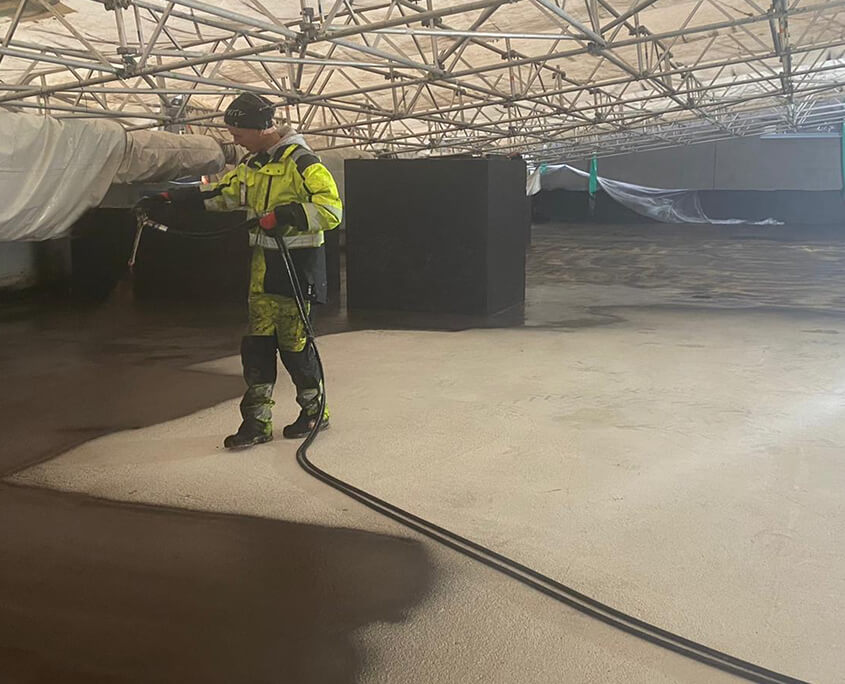
ProFast Flooring is an autocatalytic polyurea floor coating for Preston warehouses, production areas, loading bays and walkways. Up to three times the wear resistance of conventional epoxy or polyurethane coatings. Aliphatic and UV stable. Available in RAL colours with anti-slip configurations. Walkable from approximately 45–60 minutes where approved system conditions are achieved. Concrete substrate mechanical preparation is required.
Industrial Protective CoatingsFireGuard Pro 200 — Fire-Rated Protective Coating
FireGuard Pro 200 achieves fire class A2-s1,d0 (EN 13501-1). It is a surface fire-rating system for interior walls, ceilings, stairwells and escape routes — not a structural intumescent system and not a roof waterproofing product. For Preston NHS, UCLan or commercial projects with fire-protection requirements, submit full project details for system confirmation.
Commercial Buildings and Sectors Across Preston
Logistics and Industrial — Walton Summit, Riversway, Bamber Bridge
Large-span metal roofing on Preston's strategic industrial sites. High-output spray application required for large areas in operational programme windows. Gutter failure at eaves level is a consistent refurbishment driver.
Systems: SprayGrade for large roof areas; Rocathaan TopSpray35 for metal roof protection; HBS200 for gutters.
Sector information →University of Central Lancashire — City Centre Campus
Mixed-age campus with flat roofs, concrete decks and cladded buildings. Access constrained to summer vacation windows. Complex penetration arrangements from services and communications infrastructure.
Systems: SprayGrade and HBS200 for flat roof overlay during summer access windows.
Sector information →NHS — Royal Preston Hospital and Lancashire Estate
Continuous occupation, infection control requirements, restricted access. Phased programme management essential. Method statements required before any access to clinical areas.
Systems: HBS200 and SprayGrade with occupied-building programme management.
Sector information →Retail Parks — Deepdale, Capitol Centre, Fishergate
Large flat-roof commercial buildings with trading continuity constraints. Complex drainage with multiple rooflight penetrations. Night and early morning working often required to avoid customer and delivery conflicts.
Systems: Commercial roof coatings, gutter refurbishment, rooflight junction detailing.
Sector information →Lancashire County Council Estate — Schools, Civic Buildings
Framework procurement route. Long approval processes. Schools constrained to holiday access windows. Substrates often multi-layer with historical repair history.
Systems: Roof overlay, asbestos encapsulation, gutter refurbishment across mixed council estate.
Sector information →Housing Associations and Residential Blocks
Preston has a significant housing association sector managing flat-roof residential blocks in Ribbleton, Fulwood and the city centre. Occupied at all times — programme management around residents essential.
Systems: Flat roof waterproofing, balcony waterproofing, gutter refurbishment.
Sector information →Preston and Central Lancashire Coverage
Commercial roof coatings, waterproofing and protection systems are available across Preston and the wider Central Lancashire area. Forti Nova's technical support, product supply and approved-applicator coordination are managed from our Blackburn headquarters — approximately 15 miles from Preston city centre.
Commercial Roof Coatings Preston — FAQs
All answers permanently visible. No accordions or collapsed content.
1. What commercial roof coating systems are available in Preston?
The Liquid Rubber range — HBS200, SprayGrade and BelowGrade — covers cold-applied and spray-applied waterproofing for commercial roofs, gutters and below-ground structures across Preston and Central Lancashire. The Prokol range — MonoSeal, Rocathaan TopSpray35 and ProFix — covers aliphatic protective topcoat, waterproof protective coatings and industrial flooring. ProFast Flooring is the autocatalytic polyurea floor coating system for Preston warehouses and production facilities. System selection for any Preston building depends on the substrate type, existing condition, moisture content, performance requirement and programme. Every project requires substrate assessment before specification.
2. Is Preston within Forti Nova's primary operational area?
Yes. Preston is approximately 15 miles from Forti Nova's Blackburn headquarters — well within the primary Lancashire operational area. Preston and Central Lancashire projects benefit from the same technical support, specification guidance and applicator coordination available to East Lancashire projects. Preston is the county town of Lancashire and represents a significant proportion of the region's commercial and industrial refurbishment demand.
3. What building types drive refurbishment demand in Preston?
Preston's refurbishment demand is driven by several distinct property groups. The Riversway Docklands and Walton Summit industrial areas contain large logistics and manufacturing buildings with profiled metal roofing requiring overlay and gutter refurbishment. The University of Central Lancashire campus contains mixed-age flat-roof buildings constrained to summer access windows. Royal Preston Hospital and the wider NHS Lancashire estate require occupied-building programme management. Preston's retail parks — Deepdale Retail Park, Capitol Centre, the Fishergate Shopping Centre roof areas — create commercial flat-roof refurbishment requirements. Lancashire County Council's civic and education estate creates public-sector demand with framework procurement constraints.
4. Can manufacturing and logistics operations continue during roof refurbishment in Preston?
Yes, in most cases. SprayGrade achieves 600m² or more per day, allowing significant roof areas on Preston's Walton Summit and Riversway industrial buildings to be treated within operational programme windows. Phased programmes — treating one building bay or section while operations continue in adjacent areas — are standard practice on occupied industrial buildings. Out-of-hours working (evenings, weekends) can extend the viable treatment area within tight operational windows. The programme must be specifically designed for the building and its operational pattern — not assumed from a standard programme template.
5. What are the most common roofing failures on Preston industrial and logistics buildings?
On Preston's Walton Summit and Riversway industrial buildings — predominantly profiled metal roofing on steel portal frames — the most common failures are cut edge corrosion at sheet laps, failed lap sealants, and gutter joint failures at eaves level. Preston's flat Lancashire Plain topography and westerly weather systems mean gutters must handle consistent rainfall — blocked or failed gutters on industrial buildings are a primary ingress source. On Preston's flat-roof commercial and public-sector buildings, felt delamination, blocked drainage outlets and failed membrane-to-upstand junctions are the most frequent failure mechanisms.
6. How are UCLan campus roofing projects managed?
University of Central Lancashire roofing projects are typically constrained to summer vacation periods — from late June to mid-September. This provides a 10–12 week window for external building works on most campus buildings. SprayGrade's high output allows large flat roof areas to be treated within this window. For multiple-building programmes, applicator scheduling must be confirmed well before April to secure the required resource for the summer period. Some UCLan buildings may have restricted access beyond the academic vacation due to research or student accommodation occupation — individual building constraints must be confirmed with the estates team before scheduling.
7. Can below-ground waterproofing be specified for Preston commercial buildings?
Yes. BelowGrade liquid rubber is available for below-ground and negative-side waterproofing applications in Preston. Preston's low-lying position and proximity to the River Ribble creates elevated groundwater levels in some areas — particularly in the city centre and riverside zones. Below-ground structures in these areas, including commercial basement car parks and older city-centre buildings, require hydrostatic pressure-resistant waterproofing membranes. Positive-face application before backfill is the more effective approach where access to the exterior of the structure is available. Where access is limited, negative-face (internal) application using BelowGrade provides a secondary barrier. Construction joints and tie holes are primary ingress points in all Preston below-ground structures.
8. Can commercial gutters on Preston buildings be relined?
Yes. Liquid rubber gutter lining is a consistent application on Preston commercial and industrial buildings. Box gutters, valley gutters, parapet gutters and eaves gutters in steel, aluminium, concrete, asphalt and asbestos cement can all be relined — subject to structural assessment. The seamless liquid rubber membrane eliminates all joints, covers all lap failures and provides a continuous waterproof surface to the full gutter profile. Reinforcement at outlets and end laps is standard. Preston's flat Lancashire Plain position means gutters on large industrial buildings handle consistent drainage loads — capacity must be confirmed adequate before lining commences.
9. What industrial flooring systems are available for Preston warehouses?
ProFast Flooring is an autocatalytic polyurea floor coating suitable for Preston warehouses, production facilities, loading bays and walkways at Walton Summit, Ribbleton industrial area and the city's logistics parks. Up to three times more wear and scratch resistant than conventional epoxy or polyurethane coatings. Aliphatic and colour-fast — UV stable for external application as well as internal environments. Available in RAL colours with anti-slip configurations. Walkable from approximately 45–60 minutes where approved system conditions are achieved. Concrete floors must be mechanically prepared — shot blasting or diamond grinding — before coating application.
10. What are the procurement routes for Preston and Lancashire public-sector projects?
Lancashire County Council, NHS Lancashire and South Cumbria, and Preston City Council typically procure construction and refurbishment works through framework agreements. Forti Nova works with Lancashire-based contractors and FM companies who hold relevant frameworks. Direct specification work is available for consultants and surveyors. Framework route compatibility is project-specific — discuss your procurement requirements at the enquiry stage rather than assuming a route.
11. What is the weather pattern in Preston and how does it affect coating programmes?
Preston sits on the Lancashire Plain — sheltered from the Pennines to the east but exposed to consistent westerly weather systems from the Irish Sea. Annual rainfall of 800–900mm is distributed across frequent moderate rainfall events rather than concentrated storms. This means that any outdoor coating programme in Central Lancashire must incorporate weather window planning — no application during rainfall, and confirmation of dry substrate before each day's work. Spring and early summer typically offer the best weather windows for large-area work, but guaranteed dry periods are uncommon. Programme buffers of 15–25% are standard for Central Lancashire outdoor coating work.
12. Are roof overlay systems valid for Preston commercial and industrial buildings?
Yes — where the existing substrate is structurally sound, free of trapped moisture, adequately adhered and the drainage is adequate. Overlay avoids the cost and disruption of strip-out and is appropriate on many Preston commercial buildings where the roof structure is sound but the membrane has failed. On Preston's industrial buildings, the most common overlay constraint is moisture within the existing build-up — Preston's frequent rainfall means flat-roof felt systems on industrial and public-sector buildings regularly accumulate trapped moisture. Electrical capacitance moisture testing is required before overlay specification on any Preston commercial roof to confirm whether overlay is a valid approach.
13. How is the condition of asbestos cement roofing managed in Preston?
Asbestos cement roof sheets are present on a proportion of Preston's older industrial buildings — particularly on older Walton Summit and Ribbleton estate buildings. Where sheets are in sound structural condition and the management survey confirms encapsulation is the appropriate control measure, specialist encapsulation by a licensed contractor can extend useful life. This requires a prior management survey by a qualified asbestos surveyor, a licensed encapsulation contractor, and full HSE compliance. Encapsulation does not make sheets safe for foot traffic and does not remove the asbestos hazard. A new management survey is required before any decision — do not assume that previous survey results remain current.
14. What fire protection coatings are available for Preston buildings?
Forti Nova supplies FireGuard Pro 200 — a 2K polyurea fire-rated protective coating achieving fire class A2-s1,d0 (EN 13501-1), independently tested by Warrington Fire. It is a surface fire-rating system for interior walls, ceilings, stairwells and escape routes — not a structural intumescent system and not a roof waterproofing product. For Preston NHS, UCLan or commercial buildings with fire-protection requirements, submit the full project details including substrate type, construction type and fire strategy for system confirmation.
15. What is the difference between HBS200 and SprayGrade for Preston roofing projects?
HBS200 and SprayGrade are both single-component liquid rubber waterproofing systems with the same fundamental chemistry — the difference is the application method and output. HBS200 is applied by hand (brush or roller) and is the appropriate system for complex roof profiles, occupied buildings with restricted access, gutter relining, and flat roofs where coverage areas are manageable within hand-application output. SprayGrade uses specialist cold-spray equipment and achieves 600m² or more per day — making it the practical system for Preston's larger industrial and logistics roofs at Walton Summit and Riversway where hand application cannot cover the required area within the available programme window. SprayGrade requires approved spray equipment and trained operatives.
16. How are Royal Preston Hospital and NHS estate projects managed?
Royal Preston Hospital and the wider NHS Lancashire estate operate continuously. Roofing and waterproofing programmes require a formal method statement covering infection control procedures, working hours and noise management, access coordination with the estates management team, and arrangements for clinical priority access. Roofing work above or adjacent to clinical areas requires specific assessment. Programme windows are typically shorter than on commercial buildings — NHS estates management teams confirm available access periods in advance. Approved operatives must have site-specific inductions before work commences.
17. Why does drainage adequacy matter on Preston's flat commercial buildings?
Preston's flat Lancashire Plain topography means that natural surface water drainage is limited — the same flat terrain that creates Preston's logistically convenient industrial sites also means that roofs on those industrial buildings have minimal natural falls. Where drainage outlet capacity is marginal or blocked, standing water accumulates rapidly. Standing water on Preston's flat commercial roofs accelerates membrane degradation through UV intensity increase at the water surface, biological growth, freeze-thaw damage at pool edges, and the weight loading associated with accumulated water. Drainage adequacy must be assessed as part of any roof refurbishment survey — not assumed from the building's original drainage design.
18. What areas around Preston does Forti Nova cover?
Coverage extends across Central Lancashire from Preston — Leyland, Chorley, Bamber Bridge, Longridge, Garstang, Penwortham, Fulwood, Ingol, Ribbleton, Walton-le-Dale, Walton Summit, Buckshaw Village and the wider Central Lancashire area. Coverage also extends to the Fylde Coast commercial areas — Blackpool, Lytham St Annes and Fleetwood — and north to the Lancaster commercial estate.
19. Are roof coating warranties available for Preston projects?
Manufacturer warranties are available for most systems applied on Preston commercial buildings, subject to conditions including:
- Installation by an approved and trained applicator
- Substrate preparation to the specified method and extent
- Primer application where required for the system and substrate
- Application within specified temperature and humidity limits
- Achievement of minimum dry film thickness across the full area
- Completion of specified build-up including reinforcement layers
- Final inspection on behalf of the manufacturer
The most common warranty rejection reason on Preston commercial roofs is inadequate surface preparation. Why Preparation Failures Invalidate Warranties
20. How is the correct system selected for a Preston commercial building?
System selection for a Preston or Central Lancashire building follows a structured assessment process:
- Identify the substrate: Metal, concrete, felt, asphalt, asbestos cement, existing liquid membrane?
- Assess condition: Sound and adhered? Moisture present? Drainage adequate? Structural issues?
- Define performance requirement: Waterproof? UV-stable protection? Traffic-rated? Industrial flooring?
- Consider programme: NHS or UCLan access constraints? Industrial operational continuity? Weather window planning?
- Confirm procurement route: Direct? Framework? FM company? What approval lead time is required?
- Confirm warranty: Approved applicator required? Inspection needed?
Submit project details — building type, substrate, area, problem description and programme — for confirmation of applicable systems for the specific Preston project.
System Selector ToolPreston Project Assessment
Submit your project details — building type, substrate, area and programme — and we confirm applicable systems for your Preston or Central Lancashire project.