
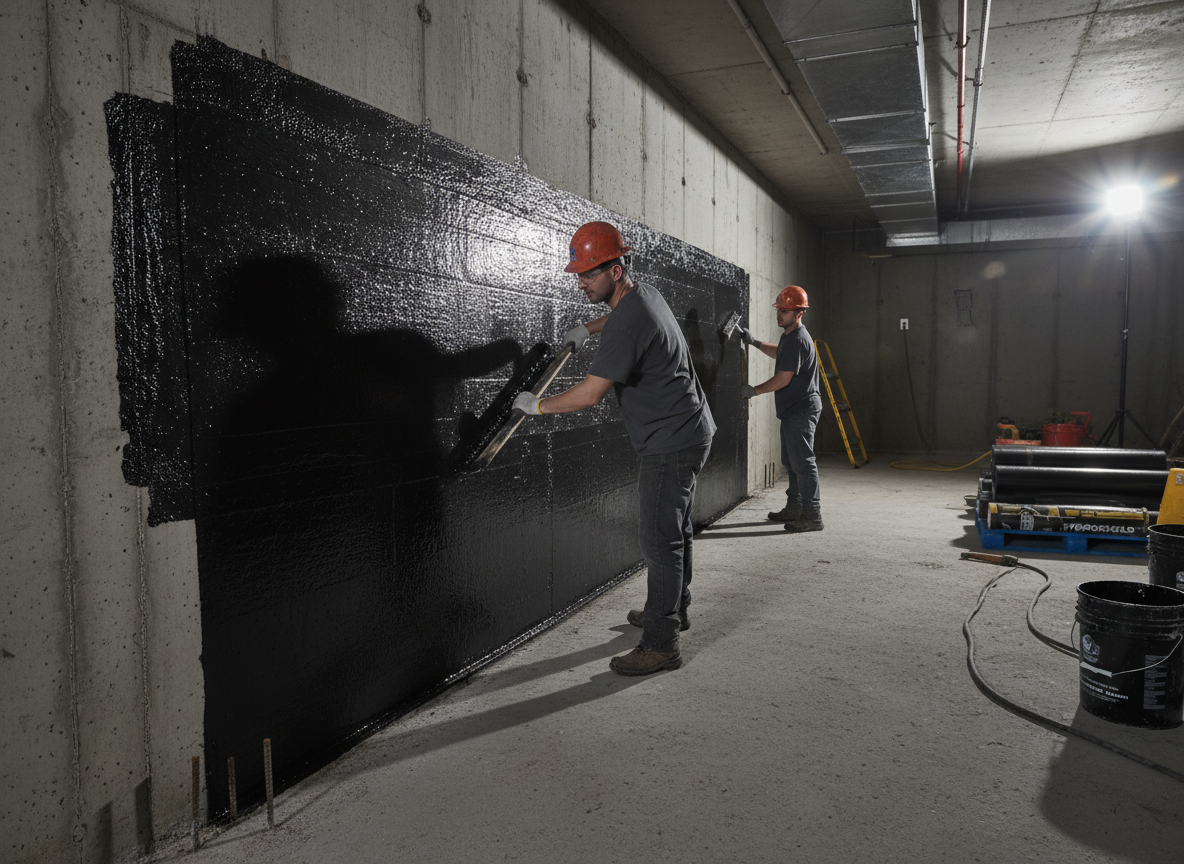
Below-Ground Waterproofing Guide
Below-ground waterproofing is a specialist discipline with specific design, material selection and installation requirements governed by BS8102. This guide covers the key considerations for specifiers and contractors working with below-ground liquid applied waterproofing systems, including the BelowGrade liquid rubber system and how it addresses the primary challenges of below-slab and below-ground construction.
This guide covers
Below-ground waterproofing for commercial basements and foundations — BS8102 grades of protection, system design principles, and the BelowGrade liquid rubber system.
Written for
Architects, structural engineers, building surveyors, main contractors and specifiers on commercial basement and below-ground construction projects.
Systems referenced
BelowGrade
BS8102 and grades of protection
BS8102:2022 is the British Standard for the protection of below-ground structures against water ingress from the ground. It defines four Grades of Protection: Grade 1 (minor seepage tolerable), Grade 2 (no water seepage, some moisture vapour acceptable), Grade 3 (dry environment required), and Grade 4 (completely dry environment). The grade required depends on the intended use of the below-ground space — plant rooms and car parks typically require Grade 2 or 3; archive storage, data centres and habitable spaces require Grade 3 or 4. Specification of a below-ground waterproofing system should begin by establishing the required Grade of Protection for the specific end use. This determines the system type and build-up required.
How BelowGrade liquid rubber works
BelowGrade is a liquid applied waterproofing membrane specifically designed for below-ground application. It is spray or hand applied to concrete, brick and masonry substrates, forming a seamless, fully-bonded membrane that eliminates the joint and lap failure points inherent in sheet membrane systems. The liquid applied nature of BelowGrade allows it to conform to complex substrate geometries — construction joints, pile cap interfaces, sump details and drainage channel junctions — without the mechanical complexity of sheet membrane detailing. The system accommodates minor substrate movement and provides a continuous barrier against hydrostatic water pressure when applied at the specified thickness.
External vs internal application
BelowGrade is primarily designed as an externally applied system — applied to the external face of the below-ground structure before backfill. External application is the preferred approach because the membrane is placed on the water-side of the structure, where hydrostatic pressure acts to press the membrane into the substrate rather than attempting to pull it away. For remedial waterproofing on existing below-ground structures where external access is not available, internal cavity drain systems are typically required instead of liquid applied membranes. Forti Nova's BelowGrade is an external application product. For internal remedial waterproofing, a different system type is required.
Construction joints and critical details
Construction joints are the primary waterproofing vulnerability in below-ground concrete structures. They represent discontinuities in the concrete that require specific waterproofing treatment. BelowGrade's liquid applied nature allows it to bridge and seal construction joints as part of the overall system application, provided appropriate joint treatment is incorporated into the specification. Other critical details include: pile head interfaces, column base transitions, ground-bearing slab edges, sump formations, drainage gully connections, and service penetrations. Each of these requires specific detailing within the liquid applied membrane system — they cannot simply be relied upon to be sealed by the field application.
Why These Projects Fail
Most failures are preparation, sequencing or specification failures — not product failures.
Application to damp or wet substrate
The most common cause of below-ground membrane failure. A membrane applied to a wet surface does not bond. Once backfill is compacted over an unbonded membrane, water migrates laterally behind it — creating leaks that appear far from the actual failure location.
Damage during backfill compaction
External membranes applied to foundation walls are vulnerable to mechanical damage during backfill. Compaction equipment and sharp fill material can puncture or abrade the membrane. Protection board is a specification requirement, not an optional extra.
Inadequate detailing at penetrations
Pipes, bolts, service entries and construction joints create weak points in the membrane continuity. Applying coating over these without specific collars, flashings or bonded detail strips creates the most common single-point leak path.
Active structural movement cracking the membrane
Settlement, heave or inadequately treated construction joints generate movement that the membrane cannot bridge without specific movement joint details. A membrane applied over an active crack will re-crack at the same location.
Negative-side application without drainage relief
Applying an internal membrane against active hydrostatic pressure without a cavity drainage system produces a membrane under sustained water pressure. This is a fundamentally different challenge from positive-side application and requires a different system strategy.
What Must Be Surveyed Before Specification
Specification cannot be confirmed without site survey. These are the minimum assessment requirements.
Structural condition and movement assessment
Inspect for active cracking, differential settlement and construction joint condition. Structural instability must be confirmed resolved before waterproofing specification proceeds.
Water table and drainage survey
Seasonal water table levels, ground permeability and drainage conditions determine pressure loading on the membrane. Worst-case conditions must be established — not just survey-day conditions.
Substrate material and condition confirmation
Confirm concrete type, masonry mix, existing surface treatments and existing waterproofing. Each substrate combination requires specific primer and membrane selection.
Access and excavation feasibility
External (positive-side) application is most effective. Confirm whether excavation and access to the structure face is achievable. If not, a fundamentally different strategy is required before specification can proceed.
Penetration and construction joint mapping
Map all pipe entries, service penetrations and construction joints across the structure face to be waterproofed. These drive the detailing scope, which is often more time-consuming than the field application.
Warranties Are Conditional — Not Absolute
Manufacturer warranties depend on the following conditions being met. A warranty is only as strong as the preparation and specification that supports it.
Substrate dry at application
Below-ground warranty conditions require substrate moisture to be within limits at time of application. Application to a wet surface in wet ground conditions is not a warranted application.
Protection board specified and installed
External warranties do not cover membrane damage during backfill where protection board was omitted. Protection board specification is a condition of warranty, not an optional addition.
Backfill specification compliance
Sharp fill, rubble and compaction immediately adjacent to an unprotected membrane causes damage. The backfill specification and compaction sequence must comply with the system design.
Structural stability confirmed
Warranty applies to the membrane's performance on a stable substrate. Settlement or movement after application is a structural matter, not a waterproofing warranty claim.
Question
Why is below-ground waterproofing expensive to get wrong?
Answer
Because detection is late and remediation is destructive. Above-ground waterproofing failures are visible quickly and access for repair is straightforward. Below-ground failures are detected only after water has penetrated internal finishes — sometimes years after the original application. By that point, internal linings, flooring, services and building contents may all be damaged. Remediation means excavation (for external failure) or cavity drainage installation (for internal), plus strip-out of failed membrane, full preparation, re-application, protection board replacement and re-backfill. The remediation programme cost routinely exceeds the original specification cost by several multiples.
Operational Implication
The cost of correct specification, survey and quality control below ground is proportionately small compared to the cost of failure. There is no shortcut that justifies the risk.
When Not Suitable
BelowGrade is not suitable for active structural movement without joint detailing, negative-side application against active hydrostatic pressure without drainage relief, or inaccessible areas where external membrane application cannot be achieved.
Specification Requirement
Structural assessment, water table survey, access feasibility review, substrate type confirmation and protection board specification — before any below-ground waterproofing is committed.
System Pathways
Systems typically applicable to this topic. All recommendations subject to project assessment and substrate suitability.
Related Applications
Coverage Areas
Frequently Asked
Ready to progress your project?
Submit your project for a technical assessment. Our team will advise on the right system pathway, specification and applicator availability.