
Roof Overlay Systems Guide
Roof overlay systems — applying a new liquid rubber or spray-applied membrane directly over the existing roofing — are one of the most commercially significant options in commercial building refurbishment. This guide explains when overlay is the right decision, what the technical requirements are, and what building owners and contractors need to understand before committing to an overlay specification.
This guide covers
Roof overlay systems using liquid rubber — overlay vs replacement decision framework, substrate requirements, system options, and commercial case.
Written for
Building owners, asset managers, FM teams and contractors considering liquid rubber overlay as an alternative to roof replacement.
Systems referenced
SprayGrade, HBS200, TopSpray35, Monoseal
Overlay vs replacement: the decision framework
The overlay vs replacement decision should be made on the basis of three assessments. First, structural: is the existing roof deck structurally sound? If there is structural failure, sagging, delamination of the deck layers, or moisture saturation through to structural elements, overlay is not appropriate. Second, substrate: is the existing waterproofing substrate in suitable condition to accept a bonded overlay? A badly blistered, delaminated or moisture-saturated membrane may not provide a stable base for overlay application. Third, drainage: does the existing roof drain adequately? Overlay does not fix inadequate falls or blocked drainage — these must be addressed before or alongside the overlay works. If all three assessments are satisfactory, overlay is almost always the preferred option on cost, programme, waste and disruption grounds.
The commercial case for overlay
Full strip-out and replacement on a large commercial or industrial roof involves: scaffold or MEWP for access, removal and disposal of existing membrane material (with skip costs, waste transfer notes and landfill tax), temporary weather protection during exposed periods, new insulation (often required to meet current U-value standards), new membrane, and reinstatement. For a 10,000m² industrial roof, these costs can be multiples of the overlay cost. Overlay systems applied by trained applicators with manufacturer-backed warranties of 25–35 years provide a commercially rational alternative that extends the asset life at a fraction of replacement cost. For asset managers with capital budget constraints, this distinction is significant.
What overlay systems can and cannot do
Overlay systems create a new seamless waterproofing layer over the existing substrate. They seal all joints, laps, cracks and penetrations in a single operation. They provide a new manufacturer warranty that extends the asset's waterproofed service life. They do not repair the structure. They do not correct drainage falls. They do not remove existing membrane material. They do not fix underlying insulation deficiencies that may require separate attention for compliance with current building regulations. An overlay specification should be clear about what it is achieving and should not be presented as a substitute for work it cannot deliver.
Overlay system options: SprayGrade, HBS200, TopSpray35
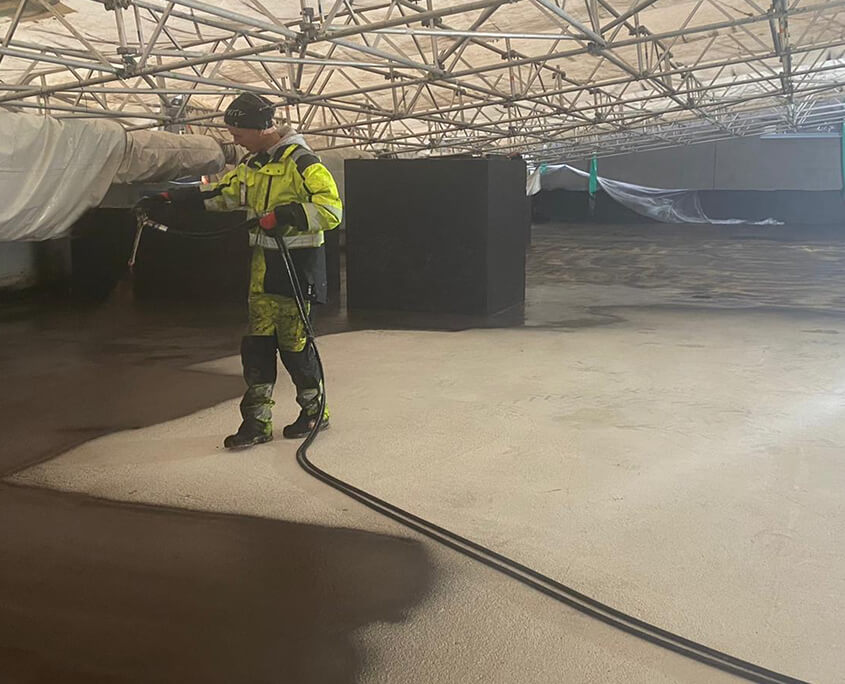
SprayGrade cold-spray liquid rubber is the primary overlay system for large commercial and industrial roofs — high-output, seamless, up to 25-year warranty. HBS200 is the hand-applied alternative for smaller areas, detailing and maintenance-scale overlays. TopSpray35 is Prokol's elastomeric spray system providing a protective overlay with up to 35-year warranty, particularly suited to metal and concrete substrates where long-life UV-resistant protection is the primary requirement. Monoseal provides a roller-applied protective coating option for specific substrates requiring a less intensive application approach. System selection should be confirmed through substrate assessment and project-specific specification.
Why These Projects Fail
Most failures are preparation, sequencing or specification failures — not product failures.
Moisture trapped in existing substrate
The leading cause of overlay failure. Moisture in the existing build-up vapourises under heat and pushes against the new membrane from below. Blistering appears within weeks. This is a preparation failure, not a product failure.
Drainage not addressed before overlay
Overlay systems do not resolve drainage inadequacy. If the existing roof ponds water, the overlay will pond water too — and degrade faster under the loading conditions.
Structural substrate movement beneath overlay
Active cracking, delamination or structural settlement creates forces the overlay cannot accommodate. The overlay cracks at the same locations as the substrate below it.
Incompatible existing surface treatments
Silicone-based roof sealants, bitumen modifiers and certain paints are chemically incompatible with liquid rubber. Overlay applied over these materials loses adhesion progressively.
Detailing failure at roof terminations
The field area of a roof overlay typically performs well. Failures concentrate at parapets, gutters, penetrations and upstands — where thermal movement and water concentration combine at the termination points.
What Must Be Surveyed Before Specification
Specification cannot be confirmed without site survey. These are the minimum assessment requirements.
Moisture content testing across full roof area
Not spot-checks at a single location. Moisture meter readings at systematic grid points across the entire roof area, with additional readings at drainage zones and low points. Above-threshold readings require investigation.
Structural assessment of substrate
Probe delaminated areas on felt and asphalt. Test adhesion of existing membrane to deck. Identify any cracking, settlement or structural defects in the underlying deck. These must be addressed before overlay proceeds.
Drainage fall survey
Measure effective drainage falls to gutters and outlets. Identify ponding zones. Drainage improvements are significantly cheaper to specify before overlay than after failure.
Compatibility check on existing surface treatments
Identify all existing coatings, sealants and repair products on the substrate. Chemical compatibility with the proposed overlay must be confirmed with the system manufacturer in writing.
Detailing complexity mapping
Count all penetrations, upstands, gutters, parapets and abutments. These drive the detailing time and cost, which can be as significant as the field area application.
Warranties Are Conditional — Not Absolute
Manufacturer warranties depend on the following conditions being met. A warranty is only as strong as the preparation and specification that supports it.
Substrate moisture below threshold on application day
Overlay warranties are conditional on substrate moisture being within limits at the time of application — not at survey, weeks prior. Rainfall between survey and application can change substrate status.
No active structural movement confirmed
Overlay warranties do not cover cracking caused by substrate movement that was present at the time of application. Structural issues must be resolved and confirmed resolved before overlay proceeds.
All existing coatings removed or confirmed compatible
Incompatible existing coatings that are not removed before overlay application are not a basis for warranty claim. Compatibility must be confirmed with the manufacturer.
Drainage adequate at installation
Warranty does not extend to accelerated degradation caused by standing water conditions that existed at time of application and were not remediated.
Question
When should a roof not be overlaid?
Answer
When the substrate is structurally compromised, when moisture saturation in the existing build-up cannot be resolved, when drainage falls are inadequate and cannot be remediated within the scope of the overlay contract, or when existing surface treatments are chemically incompatible and cannot be removed. In these cases, overlay adds cost without solving the underlying problem — and failure occurs faster than it would have on the original roof because the overlay traps the conditions that cause degradation.
Operational Implication
The decision between overlay and replacement is a substrate decision. Survey — not aspiration — determines which is appropriate. Overlay on a qualifying substrate is the right economic decision. Overlay on a failing substrate creates a more expensive problem.
When Not Suitable
Overlay is not suitable for structurally failed roofs, moisture-saturated substrates where the moisture cannot be resolved, drainage-failed roofs where remediation is not achievable, and substrates with incompatible surface treatments that cannot be removed.
Specification Requirement
Substrate assessment including moisture testing, structural survey, drainage review and compatibility check before any overlay system is specified or committed.
System Pathways
Systems typically applicable to this topic. All recommendations subject to project assessment and substrate suitability.
Primary overlay system for large commercial and industrial roofs. Up to 25-year warranty.
Hand-applied overlay for smaller areas, detailing and maintenance-scale applications.
Aliphatic protective topcoat with up to 35-year warranty for metal and concrete roofs.
Roller-applied protective coating overlay for specific substrates.
Frequently Asked
Ready to progress your project?
Submit your project for a technical assessment. Our team will advise on the right system pathway, specification and applicator availability.