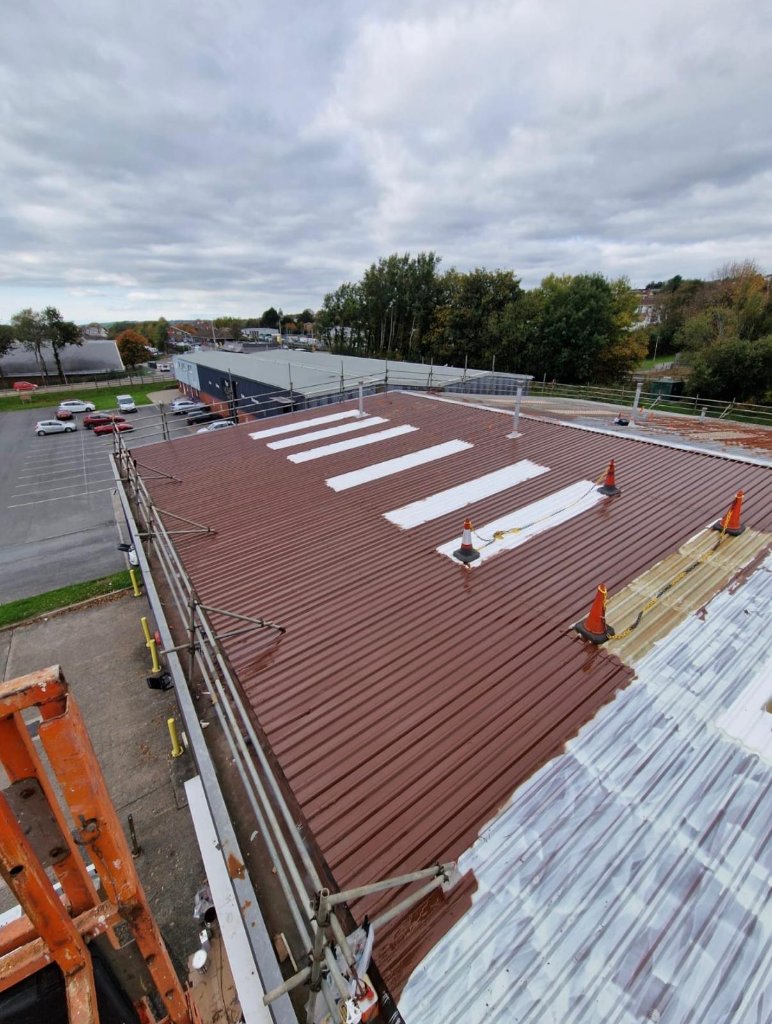
A cladding coating is a liquid-applied or spray-applied system applied to the outer face of suitable external wall panels to provide protection against UV degradation, weathering, atmospheric contamination and surface deterioration — and, where required, to restore or change the building's colour. It is applied to panels that are structurally serviceable and whose existing finish has been identified and confirmed compatible with the proposed system. A cladding coating does not repair structural defects, perforated panels, failed fixings, failed insulation or failed structural rails. The coating system — preparation, primer, topcoat, colour — is selected from the substrate type, existing finish condition and the outcome of adhesion assessment.
Cladding materials that may be suitable for coating include profiled steel, plastisol-coated steel, PVF2-coated steel, polyester-coated steel, powder-coated metal, galvanised steel, aluminium, composite panels and some fibre-cement or mineral boards — subject to condition assessment, preparation and adhesion confirmation. Compatibility cannot be assumed from the substrate name alone. Each substrate type has different existing coating chemistry, different preparation requirements and different primer and topcoat compatibility. Universal compatibility across all cladding types cannot be claimed. Compatibility must be established from the existing finish, condition, preparation, adhesion testing and approved coating specification.
Plastisol (PVC organosol) is a common factory-applied finish on profiled steel cladding. Where the plastisol is in sound condition — well-bonded, not blistering or delaminating, free from contamination — it may provide a substrate for an overcoat. Where it is chalking, cracking, blistering or delaminating, the unsound material must be removed or treated before any coating proceeds. Adhesion testing on the existing plastisol is required before programme commitment. The primer type and preparation regime required for adhesion to plastisol must be confirmed from the manufacturer's current specification for the proposed system. Universal compatibility with plastisol cannot be assumed for any coating system.
PVF2 (polyvinylidene fluoride) factory coating presents adhesion challenges that make compatibility confirmation particularly important. PVF2's low surface energy means that not all primers will bond reliably. Adhesion testing and trial areas on representative panels are required before any overcoating programme is committed. The primer type and preparation regime required for adhesion to PVF2 must be confirmed from the manufacturer's current specification. Where the proposed system cannot be confirmed compatible with PVF2, removal to bare metal and re-priming from the metal substrate may be the appropriate route.
Aluminium cladding panels may be suitable for coating, subject to identification and preparation of the existing finish. The primer specification for aluminium must be confirmed from the manufacturer's current documentation for the specific system and substrate — aluminium requires specific adhesion primers that differ from steel primer specifications. Adhesion testing before programme commitment is standard practice on aluminium substrates.
Powder-coated metal cladding panels may be suitable for overcoating where the existing powder coat is well-bonded, sound and free from contamination. Where the powder coat is blistering, chipping or delaminating, the failed material must be addressed before overcoating. Surface profiling — light abrasion of the existing powder coat — is typically required to provide mechanical key for the primer. The primer type, surface profile and preparation standard must be confirmed from the manufacturer's specification for the proposed system on the specific substrate. Adhesion testing before full programme commitment is required.
Visual appearance alone may not reliably establish what finish a panel carries. Plastisol, PVF2, polyester, powder coating and site-applied liquid paint can appear similar in colour, texture and condition — particularly when aged. Identification methods include: reviewing original construction documentation or panel manufacturer records; requesting information from the building owner or managing agent; physical inspection and cleaning trial; adhesion testing with the proposed primer on a small trial area; and manufacturer consultation. Where the finish cannot be reliably identified, trial areas with adhesion testing across the proposed primer and topcoat combination are required before the specification is committed. Coating over an unidentified finish and assuming compatibility is a preparation failure.
Adhesion testing is standard practice before committing to a cladding coating programme — particularly where the existing coating type is uncertain, where previous overcoating has occurred, or where silicone sealants are present at panel joints. A pull-off adhesion test on a prepared trial area confirms whether the proposed primer and topcoat combination achieves adequate bond strength on the actual substrate. If adhesion falls below acceptable levels, the preparation regime must be revised — or the substrate reconsidered — before the full programme proceeds. Trial areas also confirm cure profile and appearance under prevailing site conditions.
Chalking — the powdery, friable residue produced when an existing coating surface degrades — must be fully removed before any primer or topcoat is applied. Chalking material is an adhesion barrier. Removal methods include pressure washing at appropriate pressure for the substrate; mechanical brushing where the chalking is heavy; and degreasing to remove any residue. Sound coating beneath the chalking layer may remain as a substrate for overcoating if adhesion is confirmed. Extensively chalking coatings that have lost adhesion across the field area require more intensive preparation — potentially removal to bare metal — before overcoating.
Active corrosion must be treated to the appropriate standard before any coating is applied. Coating over active corrosion does not arrest it — corrosion continues beneath the new coating. The degree of preparation depends on severity: surface rust bloom may be treated by mechanical cleaning followed by a corrosion-inhibiting primer; advancing corrosion at fixing positions or cut edges requires more intensive preparation. Through-corrosion — where the base metal is perforated — requires panel repair or replacement, not coating. The extent of corrosion across the elevation must be mapped at survey before the preparation specification is confirmed.
Primer requirements depend on the substrate type, its condition and the approved system build-up. For TopSpray35 applied to prepared steel, aluminium or existing factory-coated cladding, the primer type and coverage rate must be confirmed from the manufacturer's current specification for the specific substrate and build-up. Applying a topcoat without primer where primer is required is a preparation failure that will affect adhesion. There is no single primer that is universally appropriate for all cladding coating conditions — primer selection is substrate-specific and must be confirmed per project.
TopSpray35 is available in RAL colours according to the manufacturer's current colour overview, while other colours may be considered on a project basis and by request. Final colour availability, substrate compatibility, coverage and appearance must be confirmed before specification. Some colours — particularly very dark or very light shades — may require additional coats to achieve full, even coverage. Colour consistency across large elevations depends on consistent application rate, spray distance and film thickness. Where buildings require colour matching to existing panels or corporate colour specifications, confirmation from a test panel before full application is advisable.
TopSpray35 must not be applied below +5°C surface temperature, above +35°C surface temperature, or at relative humidity above 85%. On cladding elevations, surface temperature varies across the building depending on orientation, shading and time of day — sun-facing elevations can exceed maximum temperature in summer while shaded elevations remain cooler. Metal surfaces cool and heat faster than masonry. Surface temperature checks before each application session are standard practice. Wind conditions on elevated working platforms can cause spray drift and uneven film formation. Application must not proceed in conditions that prevent uniform, controlled film formation.
Dew point is the temperature at which moisture in the air condenses onto a surface. Applying a coating to a metal surface at or within 3°C of the dew point creates a moisture film between the substrate and the coating, preventing adhesion and causing delamination during cure. Metal cladding cools rapidly — the surface temperature may drop below ambient after a drop in air temperature, after rainfall, or overnight — even on mild days. Dew-point checks using a psychrometer or digital meter are required before each application session and should be repeated if conditions change. Application must not proceed when the surface is within 3°C of the calculated dew point.
The PDS reference cure stages for TopSpray35 at 20°C are approximate: recoat approximately 12–24 hours; mechanical resistance after approximately three days; chemical and water resistance after approximately seven days. These values are affected by environmental conditions, product temperature, relative humidity and layer thickness — cooler or more humid conditions will extend all stages. Exceeding the maximum recoat window of approximately 24 hours requires sanding and re-priming before the next coat is applied. These are application-sequencing references for the programme — they are not building-handover times, operational-reopening times or maintenance-free performance claims.
A cladding coating applied to the outer panel face seals that surface against direct rain penetration through the coating film. It does not resolve water ingress from: failed lap joints or open seams that the coating film does not address; failed flashings, copings or sills at the top of the elevation; failed fixings allowing water to track behind panels; ingress from the roof or at eaves level; or any other envelope defect not at the panel face. Where water is tracking behind panels or entering from other positions, coating the panel face does not resolve the ingress. All water-ingress sources must be investigated and confirmed before coating specification — coating over an unresolved ingress route will produce delamination.
Cladding coating does not determine the fire performance of the complete wall assembly. A coating applied to the outer face of a cladding panel does not make a combustible panel non-combustible, change the core fire classification of a composite panel, make a façade compliant with external wall fire requirements, upgrade the wall system, provide cavity barriers, provide compartmentation, or provide structural fire resistance. The fire performance of the complete wall assembly depends on the documented construction, including panels, core material, joints, fixings, cavities, barriers and interfaces. A surface coating must not be treated as a substitute for competent fire-safety design or a tested wall-system specification. Where fire performance is a specification requirement, the question must be referred to the competent fire-safety design team.
A coated cladding elevation should be inspected at least annually and after significant weather events. Inspection should confirm: no mechanical damage at fixing positions, lap edges or penetrations; no blistering or delamination at panel faces or edges; sealants at joints and flashings remain intact; no biological growth is colonising the coating surface; and drainage from sills, copings and window frames is unobstructed. Localised mechanical damage can be repaired with compatible coating material without full re-application. Cleaning must be compatible with the coating — aggressive solvents or abrasive methods can damage the surface. No coating should be described as maintenance-free.
Cladding is unsuitable for coating where: panels are perforated or structurally compromised; existing coating is extensively delaminated or blistered across the field area; silicone contamination at joints cannot be fully removed; the existing finish cannot be identified or confirmed compatible with the proposed system; active water ingress originates from positions the face coating cannot address; structural fixings, rails or panel supports are defective; panel distortion prevents the cladding from functioning as a weather barrier; failed insulation requires resolution within composite panels; or the fire strategy requires a different construction. In these conditions the appropriate route is industrial cladding refurbishment, panel replacement, or a structural and fire-safety assessment before any coating programme.
A robust quality record for a cladding coating programme should include: existing finish identification records and adhesion test results from trial areas; defect mapping from survey; preparation records — cleaning method, degreasing confirmation, corrosion treatment standard; primer application records with batch number, coverage rate and surface temperature; topcoat application records including coverage rate, colour confirmation, application conditions and dew-point readings; photographic records of prepared surfaces, primer stage, completed coating and any remediation; and a final inspection record confirming film thickness or coverage. These records support any warranty application and provide the building owner with a documented application history. Records do not automatically guarantee manufacturer acceptance — warranty conditions must be confirmed separately.
A useful enquiry should include: the cladding panel type and approximate area; the original factory coating specification where known; the age of the cladding and its current visible condition; any history of previous coatings or treatments; the building colour requirement — restoration or colour change; whether the building is occupied during works; access arrangements; the exposure environment; and photographs of the elevation, panel condition, lap joints, fixing positions and any visible defect areas. This enables a preliminary assessment of the preparation scope, system compatibility and programme approach. Submit project details via the enquiry form for a technical review.