
Commercial Roof Coatings, Waterproofing and Protection Systems in Sheffield
Forti Nova supplies commercial roof coatings, liquid waterproofing, metal roof refurbishment, cladding coatings, below-ground waterproofing and industrial flooring for commercial and industrial buildings across Sheffield and South Yorkshire. Don Valley industrial buildings, NHS estate, universities and commercial offices — each requiring specification based on substrate, topographic context and programme.
Commercial Roof Coatings and Waterproofing in Sheffield
Sheffield's commercial roofing environment is shaped by its industrial heritage. The Don Valley — running from the city centre through Attercliffe and Tinsley to Meadowhall — contains a concentrated legacy of large-span factory, foundry and workshop buildings, many now repurposed as logistics, commercial warehousing or light manufacturing. These buildings have roof areas that frequently span 50–100 years of repair history, with multiple incompatible materials in sequence. Substrate investigation before any specification is not a formality — it is a necessity.
Sheffield's commercial core — office buildings, retail, mixed-use — and the city's NHS and university estate add flat-roof waterproofing demand with occupied-building programme complexity. Rotherham, Barnsley and Doncaster extend the South Yorkshire industrial roofing footprint significantly beyond the Sheffield city boundary. The wider Chesterfield and north Derbyshire commercial area is also within operational reach.
Sheffield's topographic context — bowl city with elevated western and southern suburbs, Don Valley wind channelling — creates specific weather and wind exposure considerations for both specification and application programme planning. Forti Nova supplies Liquid Rubber and Prokol systems for Sheffield and South Yorkshire projects from our Blackburn headquarters.
Who This Information Is For
- Building owners and asset managers
- Facilities managers
- Roofing contractors
- Main contractors
- NHS Estates teams
- University estates departments
- Local authority property teams
- Architects and surveyors
- Housing associations
- Industrial and logistics operators
Commercial Roofing Problems Across Sheffield
Sheffield's industrial building stock, valley topography and wind-channelling environment create specific failure patterns. Correct identification of the root cause — not just the presenting symptom — is essential before any specification.
Don Valley Industrial Building — Complex Multi-Layer Deck Failure
Likely cause: Don Valley factory and warehouse buildings frequently have concrete or steel decks with 50–80 years of repair history. Original asphalt, bitumen or felt waterproofing has been repaired multiple times with varied materials — not all compatible with each other. The result is a build-up with uncertain adhesion between layers, trapped moisture at various interfaces, and specific areas of structural deterioration from long-term water ingress.
What to inspect: Core sampling at representative points across the roof to establish the full build-up sequence. Adhesion testing at every identified interface. Electrical capacitance survey to map moisture distribution. Structural survey of the concrete deck where long-term moisture ingress is suspected — reinforcement corrosion and concrete section loss are concerns on buildings with decades of waterproofing failure history.
Remediation routes: Where condition allows: selective strip-out of failed zones and overlay of sound areas. Where condition is complex or uncertain: full strip-out to confirmed substrate. System selection confirmed after substrate investigation — no assumption is appropriate on Don Valley industrial buildings.
Coating not appropriate when: structural damage to the concrete deck is present — structural repair before waterproofing specification.
Roof Condition Inspection ChecklistMetal Roof Thermal Cracking and Lap Failure
Likely cause: Sheffield's temperature range — cold elevated winters and warm summers — creates significant thermal movement in profiled metal roofing on South Yorkshire's industrial buildings. On light manufacturing and warehousing buildings across Sheffield's business parks, lap sealants harden and crack through repeated thermal cycling. Once laps open, corrosion begins at cut edges and fixings. Wind channelling in the Don Valley increases driving rain penetration through opened laps.
What to inspect: Walk or inspect all lap positions. Probe lap gaps. Assess fixing condition. Determine whether corrosion is surface-only or section loss has occurred.
Remediation routes: Cut edge treatment, lap sealant reinstatement, metal primer and elastomeric overcoat. Full metal roof refurbishment where general deterioration is advanced.
Coating not appropriate when: perforation or structural section loss at sheet laps or fixing zones — sheet replacement required before coating.
Metal Roof Coatings for Sheffield BuildingsGutter Failure on Large Industrial Roof Spans
Likely cause: Valley gutters and box gutters on Sheffield's Don Valley industrial buildings carry large drainage loads from wide roof spans. Joint failures, blocked outlets and gutter deflection through structural settlement are the most common failure mechanisms. Sheffield's rainfall — 850mm average in the city — combined with Don Valley wind effects that drive rain horizontally into gutter-edge details creates a demanding drainage environment.
What to inspect: Clear and clean gutters before assessment. Map all joint failure locations. Confirm falls direction. Assess outlet condition and capacity for the roof area draining to each gutter run.
Remediation routes: Seamless liquid rubber gutter lining over the existing substrate. Outlet enlargement or addition where capacity is inadequate.
Coating not appropriate when: gutter structure has corroded through or is failing structurally — lining does not restore structural integrity.
Commercial Gutter Refurbishment in SheffieldFlat Roof Moisture Accumulation — Education and Commercial Buildings
Likely cause: Sheffield's schools, universities and commercial flat-roof buildings have built-up felt or asphalt waterproofing systems, many installed in the 1970s–1990s. Sheffield's frost cycle creates freeze-thaw damage at pool boundaries on flat roofs where drainage is inadequate. Moisture accumulation within the flat roof build-up is common — and is the most frequent reason overlay fails when moisture assessment is omitted.
What to inspect: Electrical capacitance moisture survey before overlay specification. Drainage outlet condition and falls assessment — particularly on University of Sheffield and Sheffield Hallam buildings where rooftop plant obstructs falls. Core sampling to confirm moisture distribution.
Remediation routes: Dry, sound felt: cold-applied liquid rubber overlay. Localised wet areas: selective strip-out before overlay. Widespread saturation: full strip-out required.
Coating not appropriate when: moisture testing confirms saturation across the majority of the build-up — overlay will fail.
Flat Roof WaterproofingCladding Failure — Sheffield Industrial and Commercial
Likely cause: Steel cladding panels on Sheffield's manufacturing and commercial buildings degrade through UV exposure, acid rainfall and mechanical damage. Where the factory-applied protective coating has failed, corrosion of the steel substrate proceeds. Cladding lap joints at horizontal overlaps open through thermal movement — wind-driven rain penetrates the opened laps and is drawn into the building cavity. Sheffield's wind channelling effects in the Don Valley are particularly aggressive at cladding-to-roof junctions.
What to inspect: Full elevation inspection — not just areas above reported internal penetration. Probe all lap positions. Assess colour fading and checking as an indicator of UV degradation. Check cladding-to-roof junctions and cladding-to-purlin fixings.
Remediation routes: Aliphatic protective topcoat — Rocathaan TopSpray35 — applied to prepared and primed cladding to restore weather performance. Lap sealant reinstatement at all cladding laps before overcoating. Junction detailing at roof-to-wall interfaces.
Coating not appropriate when: cladding structural integrity has been compromised through corrosion — elastomeric coating cannot restore structural performance.
Cladding Coatings for Sheffield BuildingsSystems Available for Sheffield and South Yorkshire Projects
All systems are subject to project assessment and substrate suitability review. Don Valley industrial buildings require substrate investigation before specification — no standard build-up is assumed.

HBS200 — Single-Component Liquid Rubber
Full Spec →Technology: Single-component moisture-curing liquid rubber. Cold-applied.
Application method: Hand application by brush or roller. Two coats with reinforcement at details.
Suitable substrates: Concrete, existing roofing felt (subject to moisture testing), metal (primed), asphalt, GRP, bitumen.
Cure / return to service: Moisture-curing — cure rate affected by Sheffield's winter frost conditions.
UV characteristics: UV-stable.
Movement / elongation: High elongation.
Warranty position: Manufacturer warranty subject to approved-applicator installation and complete build-up.
Equipment / contractor: Standard application equipment.
Applications: Flat roof waterproofing on Sheffield NHS, university and commercial buildings. Gutter and valley gutter lining. Below-ground waterproofing and penetration detailing.
SprayGrade — High-Output Spray Waterproofing
Full Spec →Technology: Spray-applied liquid rubber. Cold-applied via specialist equipment.
Application method: Spray application. Approved operatives only. Wind speed monitoring required — Don Valley wind channelling affects spray application conditions.
Suitable substrates: Concrete, metal (primed), existing felt (subject to moisture testing), asphalt, bitumen.
Cure / return to service: Similar to HBS200.
UV characteristics: UV-stable.
Movement / elongation: High elongation.
Warranty position: Manufacturer warranty subject to approved equipment and operatives.
Equipment / contractor: Specialist cold-spray equipment required.
Applications: Large commercial and industrial roof waterproofing — Don Valley factory and warehouse buildings, Rotherham and Barnsley industrial estate. 600m²+ per day. Wind speed monitoring required for Sheffield Don Valley applications.
Primary system for Sheffield's Don Valley and South Yorkshire industrial roof areas. Wind speed must be confirmed within application limits — Don Valley channelling can create locally elevated wind conditions.
BelowGrade — Below-Ground Waterproofing
Full Spec →Technology: Cold-applied liquid rubber for below-ground and negative-side applications.
Application method: Brush or roller. Multiple coats. Reinforcement at construction joints.
Suitable substrates: Concrete, masonry, blockwork.
Cure / return to service: Moisture-curing.
UV characteristics: Not exposed.
Movement / elongation: Minor movement accommodation.
Warranty position: Manufacturer warranty subject to approved installation.
Equipment / contractor: Standard.
Applications: Basement car parks in Sheffield city centre. Below-ground commercial space. Retaining walls and foundation waterproofing on older industrial buildings.

Rocathaan TopSpray35 — Aliphatic Protective Topcoat
Full Spec →Technology: Two-component aliphatic polyurethane protective topcoat. UV stable. RAL colours. Cold-applied.
Application method: Spray application. Approved operatives required. Wind speed monitoring essential for Don Valley locations.
Suitable substrates: Steel and aluminium profiled sheet and cladding, primed with ProFix. Existing sound coatings where adhesion confirmed.
Cure / return to service: Return to service typically within 24 hours.
UV characteristics: UV-stable — essential for South Yorkshire metal roofing exposed to summer UV.
Movement / elongation: High elongation — essential for Sheffield's temperature range and wind-induced cladding movement.
Warranty position: Up to 35 years subject to approved application and inspection.
Equipment / contractor: Spray equipment. Approved operatives required.
Applications: Profiled metal roof sheets and steel cladding panels on Sheffield's Don Valley industrial buildings, light manufacturing premises and South Yorkshire commercial estate. Cladding refurbishment — essential where wind channelling in the Don Valley drives rain into cladding lap failures. System warranty up to 35 years subject to specification compliance.
Primary system for Sheffield's metal-roofed Don Valley industrial buildings and steel cladding refurbishment.
MonoSeal — Waterproof Protective Coating
Full Spec →Technology: Waterproof protective coating. Cold-applied.
Application method: Brush, roller or spray.
Suitable substrates: Concrete, masonry, existing coatings (adhesion tested), metal.
Cure / return to service: Consult data sheet.
UV characteristics: Good UV stability.
Movement / elongation: Moderate.
Warranty position: Subject to compliance.
Equipment / contractor: Standard.
Applications: Roofs, walls and horizontal surfaces on Sheffield commercial buildings.
ProFix — Primer and Surface Preparation System
Full Spec →Technology: Commercial primer for Prokol applications.
Application method: Brush, roller or spray.
Suitable substrates: Concrete, masonry, metal, existing coatings.
Cure / return to service: Confirm open time with data sheet.
UV characteristics: Not a surface coat.
Movement / elongation: Not applicable.
Warranty position: Part of warranted system build-up. Omitting ProFix typically voids warranty.
Equipment / contractor: Standard.
Applications: Substrate preparation preceding MonoSeal and Rocathaan TopSpray35 on Sheffield projects.
Industrial Flooring — ProFast Flooring
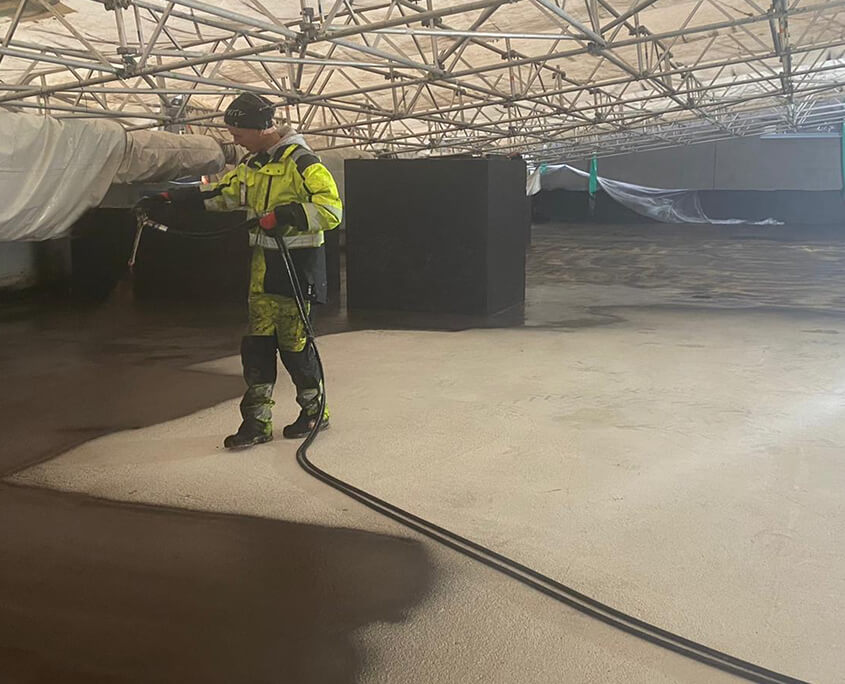
ProFast Flooring is an autocatalytic polyurea floor coating for Sheffield and South Yorkshire warehouses, production areas, loading bays and walkways. Up to three times the wear resistance of conventional epoxy or polyurethane. Aliphatic and UV stable. RAL colours. Anti-slip configurations available. Walkable from approximately 45–60 minutes where approved conditions are achieved.
Industrial Protective CoatingsFireGuard Pro 200 — Fire-Rated Protective Coating
FireGuard Pro 200 achieves fire class A2-s1,d0 (EN 13501-1), independently tested by Warrington Fire. Surface fire-rating system for interior walls, ceilings, stairwells and escape routes — not a structural intumescent system and not a roof waterproofing product. Submit full Sheffield or South Yorkshire project details for system confirmation.
Commercial Buildings and Sectors Across Sheffield
Don Valley Industrial — Attercliffe, Tinsley, Meadowhall
Large-span factory and warehousing buildings with complex roof histories. Substrate investigation before specification is mandatory. Wind channelling in the valley creates specific application and long-term performance requirements.
Systems: SprayGrade for large industrial roofs; Rocathaan TopSpray35 for metal protection; HBS200 for gutter lining.
Sector information →Light Manufacturing — Sheffield Business Parks
Steel portal frame buildings with profiled metal roofing across Sheffield's business parks. Thermal movement cracking, cut edge corrosion and lap failures are the primary failure modes.
Systems: Rocathaan TopSpray35 with substrate-confirmed primer specification; SprayGrade for large roof areas.
Sector information →Sheffield Teaching Hospitals NHS Trust
Royal Hallamshire and Northern General operate 24/7. Formal method statements, infection control compliance and estates team coordination are mandatory. Wind exposure on elevated Sheffield hospital sites creates specific spray application constraints.
Systems: HBS200 and SprayGrade with occupied NHS programme management.
Sector information →Universities — Sheffield and Sheffield Hallam
Both universities have extensive city-centre campus buildings with flat roofs, concrete decks and cladded accommodation. Access typically constrained to summer vacation windows. Sheffield Hallam's distributed campus creates individual building access complexity.
Systems: SprayGrade and HBS200 for summer-access flat roof programmes.
Sector information →South Yorkshire Industrial — Rotherham, Barnsley, Doncaster
Rotherham, Barnsley and Doncaster's industrial estates extend the South Yorkshire industrial roofing footprint significantly beyond Sheffield. Large-span metal and concrete roofs with similar failure profiles to Sheffield's Don Valley buildings.
Systems: SprayGrade and Rocathaan TopSpray35 for large industrial roofs across South Yorkshire.
Sector information →Local Authority and Housing Associations
Sheffield City Council and South Yorkshire housing associations manage large flat-roof residential and commercial portfolios across the metropolitan area. Framework procurement standard.
Systems: Flat roof waterproofing, gutter refurbishment across mixed council and housing estate.
Sector information →Sheffield and South Yorkshire Coverage
Commercial roof coatings, waterproofing and protection systems are available across Sheffield and South Yorkshire. Forti Nova's technical support, product supply and approved-applicator coordination are managed from our Blackburn headquarters. There is no Sheffield office — all South Yorkshire enquiries are handled through the Blackburn base.
Commercial Roof Coatings Sheffield — FAQs
All answers permanently visible. No accordions or collapsed content.
1. What commercial roof coating systems are available in Sheffield?
The Liquid Rubber range — HBS200, SprayGrade and BelowGrade — covers cold-applied and spray-applied waterproofing for commercial roofs, gutters and below-ground structures across Sheffield and South Yorkshire. The Prokol range — MonoSeal, Rocathaan TopSpray35 and ProFix — covers aliphatic protective topcoat, waterproof protective coatings and surface preparation. ProFast Flooring is the autocatalytic polyurea floor coating for Sheffield warehouses and production facilities. System selection for any Sheffield building depends on the substrate type, existing condition, moisture content, performance requirement and programme. Every project requires substrate assessment before specification.
2. What building types drive refurbishment demand in Sheffield?
Sheffield's refurbishment demand is shaped by its industrial heritage. The Don Valley and Lower Don Valley industrial corridors contain large-span factory, workshop and warehousing buildings with steel or concrete roofing — many repurposed from steel and cutlery manufacturing, now used as logistics, light manufacturing or commercial warehousing. These buildings have frequently undergone multiple roof repair cycles with varied and sometimes incompatible materials. Sheffield's city centre commercial stock — office buildings, retail, mixed-use — adds flat-roof waterproofing demand. The education estate — University of Sheffield, Sheffield Hallam University, Sheffield's schools — and Sheffield Teaching Hospitals NHS Trust create occupied-building programme management requirements. Rotherham, Barnsley and Doncaster add further industrial roofing demand across the wider South Yorkshire area.
3. Why is the Don Valley specifically relevant to Sheffield commercial roofing?
The Don Valley industrial corridor — running from the city centre northeast through Attercliffe, Tinsley and Meadowhall — contains one of the largest concentrations of older industrial roofing in South Yorkshire. Buildings on this corridor were constructed primarily between 1900 and 1970 for steel, engineering and manufacturing use. The large-span factory and workshop buildings have been repurposed repeatedly — many have concrete or steel decks with complex drainage arrangements, decades of repair history, and substrates that require investigation before any specification can be issued. Don Valley building roofs are also subject to the wind channelling effect of the valley topography — higher effective wind speeds drive rain into details and cladding joints that perform adequately in sheltered conditions.
4. Can spray-applied waterproofing be used on Sheffield industrial roofs?
Yes. SprayGrade achieves 600m² or more per day on large commercial and industrial roof areas. For Don Valley and South Yorkshire industrial buildings where roof areas routinely exceed 3,000–8,000m², spray application is the practical approach within the programme windows available on occupied operations. Spray application requires approved equipment and trained operatives. The substrate must be prepared — cleaned, corrosion treated, primer applied — before spray commences. Sheffield's combination of Pennine rainfall and Don Valley wind channelling means weather window planning is essential — no spray application in wind above specified limits or during rainfall.
5. What is the most common roofing failure type on Sheffield industrial buildings?
On Don Valley and South Yorkshire industrial buildings — predominantly large-span factory roofing with concrete decks or profiled metal — the most common failures are: cut edge corrosion at metal sheet laps combined with failed or absent lap sealants; blocked or failed gutters at valley and eaves positions carrying large drainage loads from wide roof spans; and moisture trapped within concrete deck build-ups from historic repair cycles. On Sheffield's lighter manufacturing estate on city business parks — predominantly profiled metal on steel portal frames — lap failure and corrosion at fixings are the primary failure mechanisms.
6. How does Sheffield's topography affect roofing programmes?
Sheffield's distinctive bowl topography — built on seven hills, with the city centre lower than many surrounding areas — creates localised wind channelling effects, particularly in the Don Valley. Wind speeds in the valley can be significantly higher than general area forecasts, affecting both coating application (spray application has wind speed limits) and the long-term performance of roof details (wind-driven rain is channelled into joints and junctions at higher velocity than flat-terrain equivalents). Programme scheduling for Sheffield outdoor coating work must incorporate wind monitoring as well as rainfall monitoring. Fall direction on large industrial roof spans must be confirmed — Sheffield's topography can create unexpected drainage complexity on apparently simple shed roofs.
7. Can below-ground waterproofing be applied to Sheffield commercial buildings?
Yes. BelowGrade liquid rubber is available for below-ground and negative-side waterproofing applications across Sheffield. Sheffield's city-centre commercial development — mixed-use buildings, basement car parks in the city centre and the wider commercial core — and older industrial buildings with basement or sub-floor structures create below-ground waterproofing requirements. Sheffield's geology — varied between sandstone, shale and coal measures — affects groundwater behaviour and hydrostatic pressure in different areas of the city. Positive-face application before backfill is more effective where exterior access allows. Construction joints and tie holes are primary ingress points and require specific detailing.
8. Can commercial gutters on Sheffield industrial buildings be relined?
Yes. Liquid rubber gutter lining is a consistent application on Sheffield and South Yorkshire commercial and industrial buildings. Valley gutters and box gutters on large-span industrial buildings in the Don Valley and across South Yorkshire carry significant drainage loads — failure at joints and outlets is common. Seamless liquid rubber lining eliminates all joints and covers all lap failures. Reinforcement at outlets and end laps is standard. Sheffield's rainfall — approximately 850mm annually in the city, more on the western moors — combined with Don Valley wind effects means gutter performance is critical.
9. What industrial flooring systems are available for Sheffield warehouses and factories?
ProFast Flooring is an autocatalytic polyurea floor coating for Sheffield warehouses, production areas, loading bays and walkways — particularly on the Don Valley industrial corridor, Rotherham's logistics estate and Barnsley's commercial parks. Up to three times the wear resistance of conventional epoxy or polyurethane. Aliphatic, colour-fast and UV stable. Available in RAL colours with anti-slip configurations. Walkable from approximately 45–60 minutes where approved system conditions are achieved. Concrete substrate must be mechanically prepared before application.
10. Does Sheffield have asbestos cement roofing on older industrial buildings?
Yes. Asbestos cement roof sheets are present on a proportion of Sheffield's older industrial buildings — particularly in Attercliffe, Tinsley and the Don Valley where factory buildings from the mid-20th century remain in use, and in Rotherham and Barnsley where similar manufacturing premises date from the same period. Where sheets are in sound structural condition and the management survey confirms encapsulation is appropriate, specialist encapsulation by a licensed contractor can extend useful life. This requires a management survey, licensed contractor and HSE compliance. Do not proceed on any assumption about asbestos condition without a current management survey.
11. Are flat roof overlay systems valid for Sheffield commercial buildings?
Yes — where the existing substrate is structurally sound, free of trapped moisture and drainage is adequate. Overlay is appropriate on many Sheffield commercial and public-sector buildings. The key constraint is moisture within the existing build-up. Sheffield's 850mm annual rainfall means flat-roof felt systems on commercial and educational buildings regularly accumulate trapped moisture — electrical capacitance moisture testing before overlay specification is mandatory. Where moisture is confirmed, extent mapping determines whether selective strip-out or full replacement is required before any overlay proceeds.
12. How are University of Sheffield and Sheffield Hallam roofing projects managed?
University buildings across Sheffield's city-centre and Broomhall campuses are typically constrained to summer vacation access — late June to mid-September. Sheffield Hallam's city-centre campus has additional complexity from its distributed building portfolio across the Sheffield city centre area. SprayGrade's high output allows large flat roof areas to be treated within summer access windows. For multi-building programmes, applicator scheduling must be confirmed before April. Some university buildings — particularly research facilities and student accommodation occupied year-round — have more restricted access that must be confirmed with the estates team individually.
13. How are Sheffield Teaching Hospitals NHS projects managed?
Sheffield Teaching Hospitals NHS Trust — Royal Hallamshire Hospital, Northern General Hospital — operates continuously. Roofing programmes require formal method statements covering infection control procedures, working hours and noise restrictions, access coordination with the NHS estates team, and clinical priority access management. Work above or adjacent to clinical areas requires specific clinical risk assessment. Access windows are shorter than on commercial buildings — coordination with the estates management team is required before any programme commitment. Sheffield's wind-exposed hospital sites also create specific weather window considerations for spray application.
14. Can cladding coatings be applied to Sheffield's industrial buildings?
Yes. Steel cladding panels on Sheffield's manufacturing and warehousing buildings can be coated with Rocathaan TopSpray35. Substrate condition, preparation and primer must be confirmed for the project. The elastomeric nature of TopSpray35 is particularly important on cladding where wind-induced racking movement in the cladding system creates dynamic stress that rigid coatings cannot accommodate. For Don Valley industrial buildings where cladding age and condition varies across the same elevation, condition assessment before specification is required.
15. What areas around Sheffield does Forti Nova cover?
Coverage extends across Sheffield and the wider South Yorkshire area — Rotherham, Barnsley, Doncaster, Chesterfield, Worksop, Mansfield and the surrounding commercial and industrial zones. Coverage also extends to the Peak District fringe commercial areas — Hathersage, Buxton and Bakewell commercial properties. Technical support, product supply and approved-applicator coordination are managed from Forti Nova's Blackburn headquarters. There is no Sheffield office — all South Yorkshire enquiries are handled through the Blackburn base.
16. What sectors does Forti Nova serve in Sheffield and South Yorkshire?
Industrial and manufacturing (Don Valley, Rotherham, Barnsley); logistics and warehousing (Meadowhall, Doncaster logistics estate); healthcare (Sheffield Teaching Hospitals NHS Trust, Rotherham NHS Foundation Trust); higher education (University of Sheffield, Sheffield Hallam); schools and further education across South Yorkshire; commercial offices in Sheffield city centre; retail parks and leisure; local authority and housing associations across the South Yorkshire metropolitan area; and facilities management companies managing the South Yorkshire commercial estate.
17. Why does Sheffield's temperature range matter for metal roof specification?
Sheffield's climate creates significant temperature variation between winter cold (regular sub-zero events, particularly on elevated areas) and summer warmth. Uninsulated metal roof sheets — common on Don Valley factory and warehouse buildings — experience significant thermal expansion and contraction through this temperature range. Standard rigid coatings applied to metal roofing in Sheffield cannot accommodate this thermal movement — they crack at sheet joints and laps within one to two thermal cycles. Elastomeric coatings such as Rocathaan TopSpray35, with high elongation properties, are specifically required to accommodate the movement of Sheffield's metal-roofed industrial buildings. This is not a choice — it is a technical specification requirement.
18. Can fire protection coatings be applied to Sheffield buildings?
Yes. Forti Nova supplies FireGuard Pro 200 — a 2K polyurea fire-rated protective coating achieving fire class A2-s1,d0 (EN 13501-1), independently tested by Warrington Fire. It is a surface fire-rating system for interior walls, ceilings, stairwells and escape routes — not a structural intumescent system and not a roof waterproofing product. For Sheffield NHS, university or commercial buildings with fire-protection requirements, submit full project details including substrate type, construction type and fire strategy for system confirmation.
19. Are warranties available for Sheffield and South Yorkshire roof coating projects?
Manufacturer warranties are available for most systems on Sheffield commercial buildings, subject to conditions including:
- Installation by an approved and trained applicator
- Substrate preparation to the specified method and extent
- Primer application where required
- Application within specified temperature, humidity and wind conditions
- Achievement of minimum dry film thickness
- Completion of the full specified build-up including reinforcement
- Final inspection on behalf of the manufacturer
On Sheffield's Don Valley industrial buildings, substrate complexity means preparation quality is the most critical warranty compliance factor — inadequate substrate investigation before specification is the most common cause of warranty rejection. Why Preparation Failures Invalidate Warranties
20. How is the correct system selected for a Sheffield commercial building?
System selection for a Sheffield or South Yorkshire building follows a structured assessment:
- Identify the substrate: Metal, concrete, felt, asphalt, asbestos cement, mixed Don Valley industrial build-up?
- Investigate condition: Core sampling, moisture testing, adhesion testing — particularly on Don Valley buildings with complex histories.
- Assess topographic context: Wind channelling in Don Valley? Elevation and frost exposure?
- Define performance requirement: Waterproof? Elastomeric protection for thermal movement? Industrial flooring? Fire-rated?
- Consider programme: NHS or university access windows? Operational manufacturing continuity?
- Confirm warranty: Approved applicator? Inspection required?
Submit project details for technical confirmation of applicable systems for the specific Sheffield or South Yorkshire project.
System Selector ToolSheffield Project Assessment
Submit your project details — building type, substrate, area and programme — and we confirm applicable systems for your Sheffield or South Yorkshire project.