
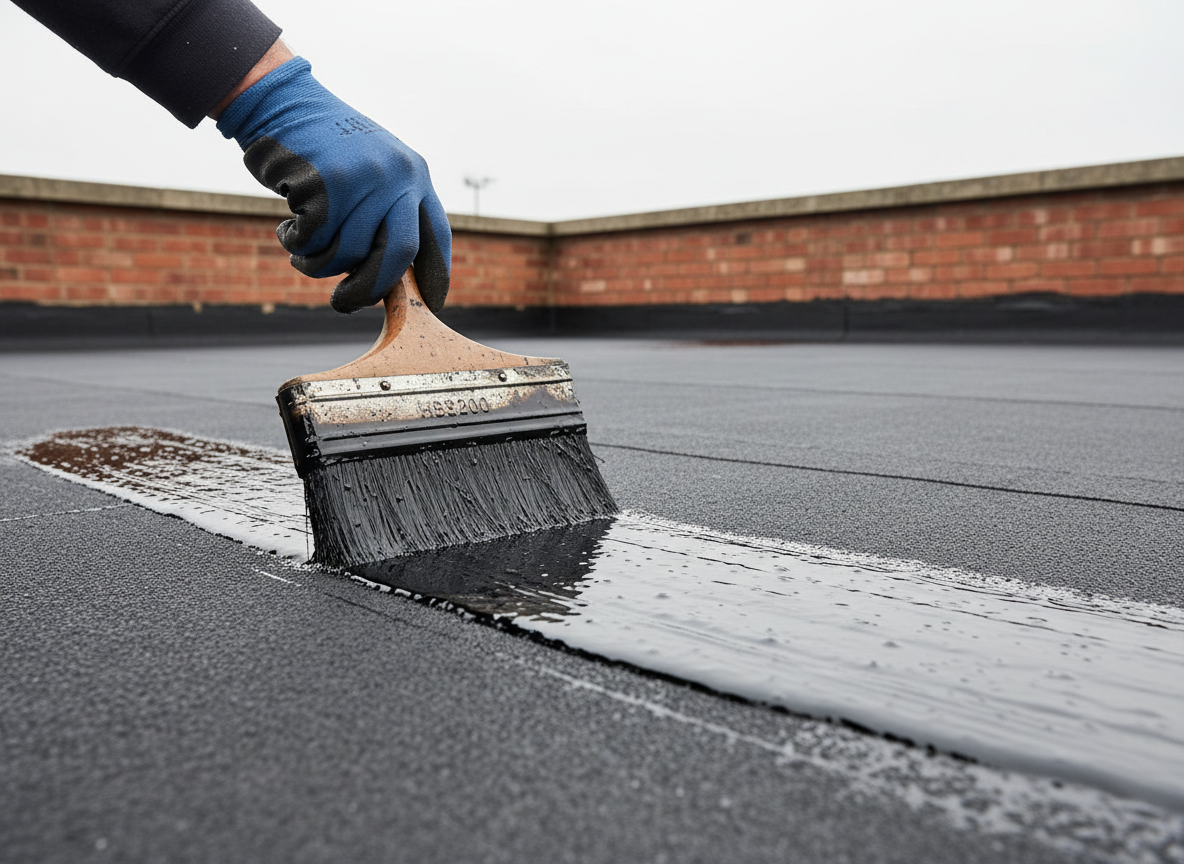
Commercial Gutter Refurbishment Guide
Commercial gutters — particularly box gutters and parapet gutters on industrial and commercial buildings — are a disproportionate source of water ingress relative to their surface area. This guide explains why commercial gutters fail, when liquid rubber lining is appropriate, and how HBS200 is specified and applied for effective long-term gutter refurbishment.
This guide covers
Commercial gutter refurbishment using liquid rubber — HBS200 box gutter lining, causes of failure, preparation requirements, and application approach.
Written for
FM managers, building surveyors, maintenance contractors and property managers dealing with commercial building gutter failures.
Systems referenced
HBS200, SprayGrade
Why commercial gutters fail
Commercial box gutters, parapet gutters and valley gutters fail for several predictable reasons. Cast iron and pressed steel gutters corrode progressively — first at joints, then through the gutter body. Built-up felt gutter linings blister, crack and delaminate as the felt ages and the bitumen oxidises. Lead-lined gutters fail at drip edges and joints as thermal movement causes progressive joint separation. The common factor is that gutters collect and hold water — meaning any failure in the waterproofing continuity creates an immediate, ongoing source of water ingress. Gutter failures are frequently responsible for far more water damage than their modest surface area would suggest.
HBS200 for commercial gutter lining
HBS200 single-component liquid rubber is the standard system for commercial gutter refurbishment. Applied by brush, roller or squeegee over the existing gutter substrate, it forms a seamless, fully-bonded waterproof membrane that eliminates joint and seam failure points. The single-component nature of HBS200 means no mixing, no catalyst management and no pot-life constraints — application can be staged across a working day without waste. HBS200 is compatible with most commercial gutter substrates including steel, galvanised steel, concrete, fibreglass, asphalt and sound existing felt. This makes it the practical choice for commercial gutter refurbishment across all building ages and construction types.
Preparation: the critical factor
Gutter lining performance is almost entirely dependent on substrate preparation. The substrate must be clean, dry and free from contamination before application. Steel and galvanised steel require degreasing, rust treatment (for corroded sections) and appropriate primer. Concrete and asphalt gutters require dust removal and priming. Existing felt gutters require removal of loose and blistered sections and priming of bare zones. Any through-corrosion or structural failure must be repaired mechanically before lining — HBS200 cannot bridge structural holes or fill deep voids. The objective of preparation is to create a stable, adhered, dry and primed substrate to which the liquid rubber membrane can bond effectively.
Repair vs lining: when to choose each
Gutter repair — patching individual failure points — is appropriate when the gutter substrate is otherwise in good condition with isolated defects. Lining — applying a new membrane over the entire gutter — is appropriate when failure is progressive across the gutter length, when the existing material is at end of service life, or when future maintenance access will be difficult. For commercial buildings where gutters are inaccessible except by scaffold or MEWP, lining during the scaffold period provides cost-effective long-term protection that avoids the need to re-mobilise access for future repairs. For industrial buildings with large-span valley gutters, HBS200 or SprayGrade application during the roof refurbishment programme is standard practice.
Field Observations
Most gutter failures are found at outlets and end laps — not along the field area.
The outlet is where debris accumulates, corrosion is most advanced, and water pressure is highest. It is the first place to check on any gutter survey.
Gutters that have been 'patched' once are usually patched again within 18 months.
Point-repair does not address the progressive nature of joint and corrosion failure. The failure mode continues along the gutter — just at the next joint.
Falls that look adequate from the outlet often have reverse sections in the middle.
A gutter can appear to fall toward the outlet at both ends but bow upward in the centre. This is not visible without a string line. It holds water permanently at the bow.
Gutter failures are frequently blamed on the roof membrane — but the source is the outlet or downpipe.
Water tracking from a blocked or overflowing gutter enters the building at fascia and ceiling level, appearing identical to a roof leak.
Maintenance coatings applied by estates teams can conceal severe corrosion for years.
Bitumen paint over steel gives the gutter an appearance of stability. Probing typically reveals advanced through-corrosion beneath.
Drainage problems are routinely mistaken for lining failures after refurbishment.
Standing water in a newly lined gutter confirms the fall was not corrected. The lining performed correctly — the drainage specification was incomplete.
What Gutter Survey Usually Reveals Next
Current Condition
Gutter lining specified without fall assessment
Next Reality
Standing water at low points after lining — same as before
Commercial Implication
Correctly applied lining on a gutter without adequate fall still ponds water — degrading faster than the unlined condition
Required Decision
Fall assessment and fall correction design required before lining specification
Current Condition
Corrosion visible at gutter surface
Next Reality
Active corrosion likely beneath surface at lap positions
Commercial Implication
Lining over active corrosion — surface dressed only — fails at lap lines within 12–24 months
Required Decision
Probe test at all lap positions — mechanical preparation insufficient where active corrosion is present
Current Condition
Repeat patch repairs to same gutter section
Next Reality
Substrate corrosion spreading beneath each successive patch
Commercial Implication
Each repair costs more than the last — each one fails sooner than the previous
Required Decision
Full lining assessment required — continued patch repair is not a strategy
How Gutter Failures Escalate
Observation
Steel outlet corroding — patch repair applied
Patch seals surface — corrosion continues beneath
Corrosion product expansion cracks patch within one season
Water bypasses patch — reaches building fabric behind gutter
Masonry saturation begins — internal damp appears at wall
Multiple trades now involved — roofing, damp proofing, decoration
How It Usually Ends
Full gutter replacement plus internal remediation works. Cost 4–6x what lining would have been if specified at first inspection.
Observation
Silicone sealant applied over gutter joint — not identified at survey
Liquid rubber specified and applied — appears visually correct
Silicone acts as bond-breaker beneath liquid rubber at joint
Membrane lifts from joint position within first winter
Water ingress at joint — same location as original failure
Liquid rubber blamed — incorrect diagnosis
How It Usually Ends
Lining stripped at joint positions. Silicone removed. Relined. Investigation reveals silicone was applied by maintenance contractor — not disclosed at survey.
Why These Projects Fail
Most failures are preparation, sequencing or specification failures — not product failures.
Joint failure in sectional gutters
Box gutters constructed in sections develop leaks at joints as sealants age and metal expands and contracts thermally. Patchwork joint repair creates new weak points adjacent to old ones — the repair cycle is perpetual without a seamless solution.
Inadequate fall to outlets
Gutters that were installed with insufficient fall accumulate standing water. Standing water accelerates corrosion at the lowest points and promotes vegetation growth, which in turn blocks outlets.
Corrosion penetration in steel gutters
Steel gutters in exposed northern England conditions corrode from the inside out. By the time corrosion is visible externally, the metal section may be significantly compromised internally.
Blocked outlets causing overflow loading
Blocked downpipes and gutter outlets cause water to overflow at parapets and building junctions — creating water ingress routes that are not in the gutter itself but are caused by it.
Application to wet or corroded substrate
Liquid rubber applied to standing water or severely corroded steel does not achieve the adhesion required. The membrane lifts from corroded areas within months.
What Must Be Surveyed Before Specification
Specification cannot be confirmed without site survey. These are the minimum assessment requirements.
Gutter fall and drainage audit
Measure effective fall along gutter length. Identify low spots and accumulated debris. Confirm outlet capacity relative to roof catchment area. Falls of less than 1:200 are typically inadequate.
Metal condition assessment
Probe corroded areas to assess section depth. Identify areas of perforation or near-perforation. Severely corroded sections may require replacement before lining.
Joint mapping
Map all joints, laps and existing repairs along the full gutter length. These are the primary leak locations and must be detailed specifically in the specification.
Outlet and downpipe condition
Confirm outlet capacity, downpipe condition and connection integrity. A relined gutter delivering water to a failed downpipe or undersized outlet is not a solved drainage problem.
What Must Be Established Before Specification
Visual inspection alone is insufficient. This is what a competent survey actually covers.
What Surveyors Look For
Effective fall measurement along gutter length
Not just a visual check. A level or string line along the full gutter length to measure actual fall. Gutters with zero or adverse fall cannot be effectively lined without fall correction.
Section depth and corrosion penetration
Probe corroded steel gutters with a screwdriver or spike probe. Soft sections indicate through-corrosion or near-perforation. The depth of probing required varies — active rust can be thick but structurally thin.
Joint and lap mapping
Map every joint, lap and previous repair along the full gutter length. Joint failure locations are predictable — they repeat where sealant has aged and movement has separated the sections. Every joint must be detailed specifically.
Outlet capacity and downpipe condition
Confirm outlet size against the roof catchment area. A 75mm outlet draining 1,000m² of roof is undersized. A lined gutter delivering water to a failed downpipe is not a solved drainage problem.
What Usually Gets Missed
Adverse fall in gutter centres
Gutters can appear to fall toward outlets at the perimeter but bow upward in the centre — creating a reverse fall zone that permanently holds standing water. This requires a string line to detect, not a walkover.
Internal gutter condition beneath existing coatings
Maintenance coatings applied by previous contractors can conceal active corrosion and perforation. The gutter appears coated and stable externally. Internal condition requires probe testing or partial removal of existing coatings.
Downpipe restriction or partial blockage
A downpipe that appears intact and clear at gutter junction may be partially blocked by debris 1–2m below. Confirm downpipe flow by flushing, not visual inspection at the outlet only.
Cannot Be Confirmed Visually
Gutter section thickness at corroded areas — requires probe testing
Active fall measurement accuracy — requires level survey
Internal condition beneath existing coatings — requires peel-back or probe
Downpipe capacity and blockage — requires flush testing
Historical overflow volume — requires drainage calculation against catchment area
When Intrusive Investigation Becomes Necessary
When corrosion is extensive and section depth cannot be confirmed by probe without partial strip
When existing coatings conceal the substrate condition and compatibility is uncertain
When downpipe restriction cannot be confirmed without CCTV or sectional disassembly
How Failure Actually Appears on Site
What you find during survey and what it means for specification.
Joint leaks immediately after lining — leak at the same positions as before
The joint movement that caused the original sealant failure has continued after lining. The lining membrane has been placed over a moving joint without adequate treatment.
Cause
Joint movement was not accommodated in the lining specification. The substrate continued to move, cracking the membrane at the same location as the original joint sealant failure.
What Happened Earlier
Joint treatment before lining was inadequate. Either joints were cleaned and sealed but movement accommodation was not built in, or the existing joint condition was not mapped and some were missed.
Overlay May Be Possible
Re-detail the affected joint with appropriate movement accommodation before relining. Probe adjacent joints to confirm movement extent.
Standing water remains after lining — no drainage improvement
The fall problem that existed before lining was not resolved. Lining does not change effective gutter fall.
Cause
Drainage survey did not establish fall adequacy before specification. Gutter was lined without fall correction.
What Happened Earlier
Fall inadequacy was either not identified at survey or was identified but not incorporated into the specification scope.
Overlay Not Possible
Fall correction — through screed, packing, or gutter rehang — must be carried out before any lining is applied to a zero-fall gutter.
Warranties Are Conditional — Not Absolute
Manufacturer warranties depend on the following conditions being met. A warranty is only as strong as the preparation and specification that supports it.
Steel substrate condition at application
Severely corroded steel that is perforated or near-perforated cannot hold a bonded membrane under hydrostatic loading. Replacement of these sections is a prerequisite for warranty eligibility.
Drainage adequacy maintained
Warranty does not extend to failure caused by ongoing drainage inadequacy. Outlet maintenance — clearing debris and checking fall integrity — is a maintenance obligation that protects warranty position.
Fall adequacy confirmed before lining
Falls that are insufficient at the time of lining application are not corrected by the lining. If standing water remains after lining, the lining will degrade faster than warranted.
Question
Why are gutters difficult to waterproof?
Answer
Because gutters combine several adverse conditions in one location: standing water, thermal movement, corrosion, joint movement and concentrated hydraulic pressure during rainfall. Sectional gutters fail at joints — because that is where movement concentrates and where sealants age fastest. The liquid rubber approach creates a seamless membrane that eliminates joints entirely — but only if the substrate is sound, fall is adequate, and outlets are clear. A seamless lining over a blocked or zero-fall gutter does not solve the drainage problem.
Operational Implication
Gutter refurbishment is not just lining — it is drainage remediation. Fall adequacy, outlet capacity and debris management must all be addressed before lining is specified.
When Not Suitable
Liquid rubber lining is not suitable for gutters with structural failure (section collapse, severe perforation), inadequate fall that cannot be remediated, or outlets that cannot be cleared or enlarged.
Specification Requirement
Gutter fall survey, outlet capacity check, metal condition assessment and joint mapping before specification is confirmed.
Connected Knowledge — Gutter Specification Context
Gutter specification decisions are connected to adjacent roof, drainage and detailing decisions. These are the related topics that affect whether a gutter lining system performs or fails to deliver its expected service life.
Why Standing Water Accelerates Membrane Failure
Gutters that hold water between events degrade faster than gutters that drain correctly. Fall correction is not optional — it is part of the specification.
Why Detailing Determines Roof Lifespan
The gutter-to-roof junction is the highest-risk detail on a commercial building. Lining performance depends on how this junction is handled.
Why Preparation Failures Invalidate Warranties
Steel corrosion not treated to the correct standard before lining is the leading cause of warranty rejection on gutter lining projects.
Why Overlay Cannot Fix Structural Failure
Gutters with section loss or structural corrosion cannot be lined — they require replacement. This boundary is often discovered on site, not at survey.
Flat Roof Waterproofing Guide
Gutter and roof membrane specifications are connected — the junction between gutter and roof membrane is where both systems must perform together.
Commercial Gutter Refurbishment — Application Page
Overview of system selection, suitability and sector coverage for commercial gutter lining.
Lancashire — Industrial Gutter Stock
Lancashire's manufacturing and logistics buildings are a consistent source of commercial gutter refurbishment requirements.
Yorkshire — Large Commercial Estates
Yorkshire's retail parks and industrial estates have significant gutter maintenance requirements across steel and aluminium systems.
System Pathways
Systems typically applicable to this topic. All recommendations subject to project assessment and substrate suitability.
Frequently Asked
Ready to progress your project?
Submit your project for a technical assessment. Our team will advise on the right system pathway, specification and applicator availability.