
Flat Roof Waterproofing Guide
Flat roofs are the most common source of commercial building water ingress. This guide explains why flat roofs fail, how liquid rubber systems address the root causes of failure, and what factors determine the right system choice between HBS200 hand-applied and SprayGrade cold-spray.
This guide covers
Flat roof waterproofing for commercial buildings using liquid rubber systems — failure causes, system selection, and overlay specification.
Written for
Building owners, FM teams, facilities managers, building surveyors and contractors managing commercial flat roof maintenance.
Systems referenced
HBS200, SprayGrade, Monoseal
Why flat roofs fail
Flat roofs fail for predictable reasons. Built-up felt systems — the most common commercial flat roof type in the UK — fail at laps and seams first, then develop blistering from moisture trapped beneath the membrane, then delaminate progressively as the bitumen oxidises and becomes brittle. Mastic asphalt fails through thermal cracking, movement-induced joint failure and UV degradation. Ponding water — often the result of inadequate falls or blocked drainage — accelerates all of these failure mechanisms. The critical point is that by the time internal leaks are visible, waterproofing failure has usually been progressing for months or years. Early liquid coating intervention — before breakthrough to the structure — provides the best value and the highest warranty eligibility.
HBS200 vs SprayGrade: choosing the right system
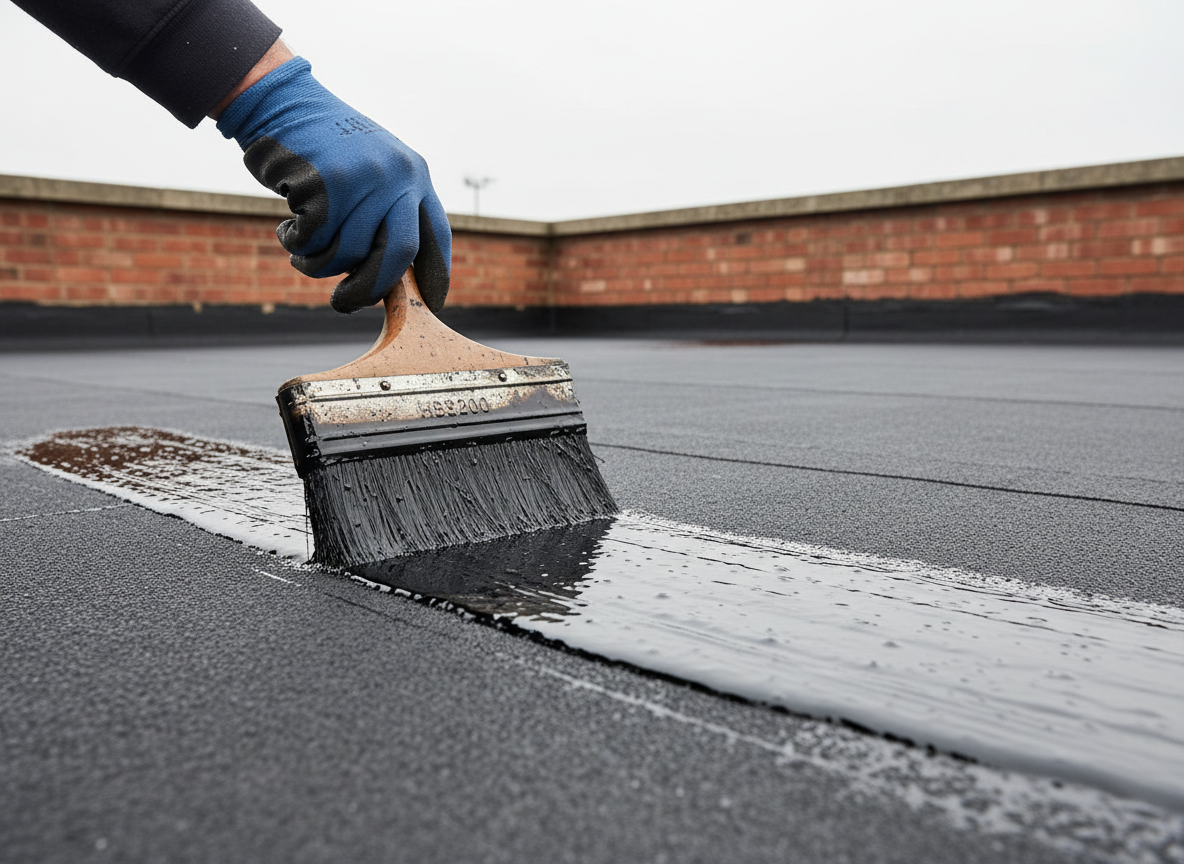
HBS200 is a single-component cold-applied liquid rubber system applied by brush, roller or squeegee. It requires no specialist equipment, is suitable for small and medium areas, and is the standard choice for flat roof maintenance, gutter lining and detailing work. SprayGrade is a cold-applied spray system requiring specialist spray equipment and a trained operator. It is suited to roof areas above 500m² where hand application would be uneconomically slow. The two systems are complementary: SprayGrade for the field area, HBS200 for the detailing around penetrations, upstands, gutters and edge details. On large commercial flat roofs, both systems are typically used within the same specification.
What a liquid rubber overlay does — and doesn't do
A liquid rubber overlay creates a new, seamless, fully-bonded waterproof membrane over the existing substrate. It seals all existing laps, cracks, joints and penetrations. It eliminates ponding water entry points. It provides a new service life with a manufacturer warranty. What it does not do: it does not repair structural roof damage, it does not address inadequate drainage falls, and it cannot be applied to substrates that are saturated, delaminated or structurally compromised. A liquid rubber overlay is a waterproofing solution, not a structural repair. Substrate condition assessment before specification is essential to ensure the overlay will perform as intended.
Substrate preparation for flat roof liquid rubber
Proper substrate preparation is the most important factor in flat roof liquid rubber system performance. Preparation requirements vary by substrate type. Built-up felt: remove loose and blistered areas, prime bare zones. Mastic asphalt: clean, degrease, confirm adhesion. Concrete: repair cracks and spalls, remove laitance, apply appropriate primer. Metal: remove rust, wire brush, prime with metal-compatible primer. In all cases, the substrate must be dry at time of application. Wet substrates will prevent membrane adhesion and trap moisture, leading to early failure. Our trained approved applicators are responsible for substrate preparation in accordance with manufacturer specification — this is one of the reasons warranty eligibility requires application by trained applicators.
Field Observations
Most flat roof failures are found at penetrations and perimeter details — not in the field area.
The field area is the easiest part to waterproof. The problem is always at the junction: where membrane meets pipe, parapet, upstand, or drainage outlet.
Coating failure is commonly discovered during unrelated maintenance works.
Rooflights being replaced, aerial brackets being repositioned, plant being serviced. The membrane failure was present long before the visit — it just wasn't the purpose of the visit.
Drainage problems are frequently mistaken for membrane failure.
A membrane that is performing correctly will still show water ingress if falls are inadequate. The fault is the drainage specification, not the coating.
Blistering at low points almost always indicates a drainage problem, not a product problem.
Blisters distributed across the field area suggest general substrate moisture. Blisters concentrated at low points confirm standing water as the saturation source.
Silicone sealant left by previous contractors is the most commonly missed incompatibility.
It looks like a repair. It is chemically incompatible with liquid rubber. It is only identifiable by material testing — not by visual inspection.
By the time internal ceiling staining appears, the waterproofing failure is usually months or years old.
Water follows the path of least resistance through structure. The internal appearance of water ingress is delayed, often significantly, from the external failure point.
What Flat Roof Overlay Assessment Usually Leads To
Current Condition
Overlay proposed on flat commercial roof
Next Reality
Substrate moisture becomes the determining factor
Commercial Implication
Overlay over substrate above moisture threshold fails within weeks — not years
Required Decision
Moisture test on application day required — survey readings insufficient
Current Condition
Blistering found during walkover survey
Next Reality
Trapped moisture beneath existing membrane confirmed
Commercial Implication
Overlay applied over blistered substrate fails in same locations — new membrane inherits the problem
Required Decision
Blister source must be identified and dried before overlay can proceed
Current Condition
Drainage appears adequate from perimeter walkover
Next Reality
Internal drainage fall across full roof area unconfirmed
Commercial Implication
Overlay on roof with inadequate internal fall creates standing water — accelerates membrane degradation from day one
Required Decision
Level survey of full roof area required — perimeter observation insufficient
How Flat Roof Failures Develop Over Time
Observation
Outlet partially blocked — left unresolved after survey
Water ponds at low point — within 25mm of membrane surface
Thermal cycling creates hydraulic pressure at membrane edge
Membrane lap begins to lift at drainage zone perimeter
Water tracks beneath membrane — begins to saturate insulation below
Internal staining appears at ceiling — months after membrane breach
How It Usually Ends
Emergency repair required on occupied building. Saturated insulation requires replacement. Outlet clearance would have cost under £50.
Observation
Pre-application moisture reading taken at survey — not repeated on application day
Rain during the week before application saturates existing felt
Operative notes surface appears dry — does not retest
Overlay applied to substrate above moisture threshold
Vapour pressure under solar gain lifts membrane from substrate
Widespread blistering confirmed at 6-week post-install inspection
How It Usually Ends
Full strip-out of new membrane. Substrate drying programme. Respray. Programme overrun on occupied building. Warranty position challenged.
Why These Projects Fail
Most failures are preparation, sequencing or specification failures — not product failures.
Blistering from trapped moisture
The most common flat roof failure. Water trapped in the existing build-up vapourises under heat and pushes against the new membrane. Blisters rupture under UV and thermal cycling, creating leak paths.
Inadequate drainage falls
Flat roofs are never truly flat — they require minimum falls to gutters. Falls below 1:80 create ponding conditions. Ponding accelerates coating degradation and, under frost, mechanically damages membrane edges through freeze-thaw.
Detailing failure at parapets and upstands
Water concentrates at the junction between field area and vertical elements. Inadequate upstand height, missing or poorly terminated flashings, and inadequate sealant at terminations are the most common failure points.
Delamination at junctions in existing felt
Felt laps and joints are inherent weak points. When overlaid, these joints can move independently of the new membrane, creating differential movement that shears the overlay at the joint location.
Inadequate membrane thickness in high-loading areas
Foot-traffic areas, plant access points and maintenance routes require additional membrane thickness. Standard field area thickness is insufficient for repeated point-loading.
What Must Be Surveyed Before Specification
Specification cannot be confirmed without site survey. These are the minimum assessment requirements.
Moisture content assessment
Electronic moisture meter readings across the entire roof area. Identify drainage zones and low points. Readings above 15% in existing build-up indicate trapped moisture that must be vented or removed before overlay.
Fall and drainage survey
Assess gutter positions, outlet locations and effective drainage falls across the entire roof area. Map any ponding zones. Drainage improvements must be scoped before overlay specification is confirmed.
Blister and delamination mapping
Walk the entire roof surface to map existing blistering, delamination and joint separation. Extensive blistering may indicate moisture saturation that prevents overlay suitability.
Parapet and upstand condition
Check upstand heights (minimum 150mm above finished membrane level), existing flashing conditions, and termination integrity. Inadequate upstands require raising before overlay.
What Must Be Established Before Specification
Visual inspection alone is insufficient. This is what a competent survey actually covers.
What Surveyors Look For
Blister character and distribution
Hard blisters — moisture has partially dried. Soft blisters — active moisture. Blisters concentrated at low points indicate drainage-related saturation. Scattered blisters indicate general substrate moisture.
Felt lap and joint separation
Probe all felt laps and sheet edges. Separation from deck at joints indicates adhesion failure below the surface — not detectable by walking the roof.
Upstand height at all parapets and abutments
Minimum 150mm from finished membrane level. Below this, overlay at the termination is not achievable without raising. This is a programme-critical finding that affects overall specification.
Gutter fall, outlet condition, and overflow staining
Overflow staining on fascias confirms sustained drainage inadequacy. Silt at gutter centres confirms standing water history. These findings must be addressed before overlay is committed.
What Usually Gets Missed
Moisture re-entry between survey and application
Substrate dries to acceptable moisture content at survey. Rain falls the week before application. Moisture content rises again. Application day readings are the qualifying condition — not survey readings.
Insulation saturation beneath felt
Moisture meter reads the felt surface condition. Saturated PIR or mineral wool beneath is not reliably detected without probe testing or coring. Overlay over saturated insulation fails prematurely.
Silicone-based repair sealants from previous maintenance
Maintenance teams apply silicone sealants at joints and cracks. These are chemically incompatible with liquid rubber. They are not identifiable by visual inspection alone.
Cannot Be Confirmed Visually
Substrate moisture content — requires electronic moisture meter grid survey
Insulation condition beneath felt — requires probe testing or core sampling
Chemical composition of existing repair sealants — requires product identification
Drainage fall accuracy — requires level survey, not visual observation
Deck condition beneath existing membrane — requires opening up
When Intrusive Investigation Becomes Necessary
When blistering is extensive and moisture source is unclear — core sampling required
When internal water ingress is occurring but no external failure path is identifiable
When the deck specification and age are unknown and structural capacity cannot be assumed
When existing membrane layers are multiple and substrate condition beneath is uncertain
How Failure Actually Appears on Site
What you find during survey and what it means for specification.
Blistering across field area, particularly at low points
Moisture in the existing build-up is creating vapour pressure beneath the overlay. Blistering at low points confirms drainage-related saturation as the moisture source.
Cause
Drainage falls were inadequate before overlay, causing standing water that saturated the substrate. The overlay was applied over a substrate that was above moisture threshold.
What Happened Earlier
A drainage survey was either not carried out or its findings were not acted upon. The drainage inadequacy existed before overlay was specified.
Overlay Not Possible
Blistered membrane must be removed. Drainage must be improved. Substrate dried to threshold and retested before reapplication.
Water ingress at parapet junction despite field area integrity
Termination detailing at the parapet has failed. Water is entering behind the membrane at the junction with the vertical element.
Cause
Upstand height was insufficient or detailing was not completed at the parapet. Thermal movement has progressively lifted the termination.
What Happened Earlier
Parapet upstand height constraint was not assessed at survey, or was identified but not resolved before application.
Overlay May Be Possible
Field area membrane may be sound. Re-terminate at parapets with correct upstand height and detailing specification.
Warranties Are Conditional — Not Absolute
Manufacturer warranties depend on the following conditions being met. A warranty is only as strong as the preparation and specification that supports it.
Moisture content confirmed on day of application
Survey-stage moisture testing is not sufficient. Conditions must be confirmed on the application day. Wet weather between survey and application can change substrate moisture status.
Drainage adequacy at installation
Warranty is not extended to cover failure caused by drainage conditions that existed at time of application and were not remediated. Falls and drainage must be adequate before application commences.
Detailing compliance at all terminations
Field area warranties do not cover failures at penetrations, upstands or gutters where detailing was not completed to specification. Every termination must be inspected before sign-off.
Question
Why do flat roofs fail?
Answer
Flat roof failures are almost always drainage, moisture or detailing failures — not membrane failures. Inadequate falls cause ponding. Ponding accelerates degradation. Trapped moisture in the existing build-up creates vapour pressure that blisters new overlays. Failed flashings and upstand terminations allow water to bypass the field area membrane entirely. The membrane is rarely the weak point — the conditions around it are.
Operational Implication
Specifying a new membrane without addressing falls, drainage and detailing is specifying a new problem. Survey must assess drainage adequacy and existing moisture content before any overlay is committed.
When Not Suitable
Flat roof overlay is not suitable where moisture saturation in the existing build-up is extensive, where drainage falls cannot be remediated, or where parapet upstands cannot be raised to minimum heights.
Specification Requirement
Drainage survey, moisture content testing, upstand height check, and blister mapping — before specification is confirmed.
Connected Knowledge — Flat Roof Specification Context
Flat roof waterproofing decisions connect to drainage, detailing, gutter condition, substrate preparation and long-term maintenance. These are the adjacent knowledge areas that determine whether a flat roof overlay delivers its warranted service life.
Why Standing Water Destroys Flat Roof Membranes
Flat roofs without adequate fall are the most common source of premature membrane failure. Standing water is not a cosmetic issue — it is a structural degradation mechanism.
Why Liquid Coatings Delaminate
Delamination on flat roofs is almost always a substrate preparation failure — not a product failure. Understanding the preparation conditions that cause delamination changes what gets specified at survey.
Why Trapped Moisture Destroys Overlays
The most common route to blistering and early overlay failure on flat roofs is application over a substrate that retained moisture between survey and application day.
Why Detailing Determines Roof Lifespan
Penetrations, upstands, parapets and gutters fail before the field area on every flat roof. Detailing scope drives most of the variation in flat roof overlay longevity.
Why Gutters Repeatedly Fail
Gutter failure is the most common ingress route on flat-roofed commercial buildings. It is frequently misdiagnosed as membrane failure — the gutter is where to start.
HBS200 — Hand-Applied Flat Roof System
For flat roofs under 500m² and all gutter and detailing work. Single-component hand application — the precision system for complex geometry and occupied building access.
SprayGrade — High-Output Flat Roof Overlay
For flat roofs over 500m² where spray application delivers programme and cost advantage over hand application.
Commercial Gutter Refurbishment Guide
Gutters and flat roofs share the same substrate zone and failure context. Gutter condition is assessed as part of every flat roof survey.
Roof Overlay Systems — Application Overview
System selection logic for flat roof overlay — when overlay is appropriate, when it is not, and what the substrate assessment must confirm before specification.
Manchester — Flat Roof Commercial Stock
Manchester's commercial office and retail buildings have significant flat roof waterproofing requirements — occupied building programme constraints are a consistent specification factor.
Lancashire — Industrial Flat Roof Stock
Lancashire's industrial and public-sector buildings represent a major segment of flat roof refurbishment demand in the North West.
System Pathways
Systems typically applicable to this topic. All recommendations subject to project assessment and substrate suitability.
Frequently Asked
Ready to progress your project?
Submit your project for a technical assessment. Our team will advise on the right system pathway, specification and applicator availability.